Examples of Performance Reviews That Hold Up (2026)
August 19, 2026
Amir Tavafi
12 min read

Examples of performance reviews online are mostly the same 200 interchangeable phrases wearing different domain names. "Demonstrates strong work ethic" could describe anyone on your team, which is the problem: it describes no one. Abloomify's performance management module pulls review language from logged goals and work activity instead of memory. Below, review examples organized by rating and competency, built to pass one test: attach a date and an outcome, or cut the line.
Key Takeaways
Q: What makes a performance review example actually effective, not just generic?
A: An effective example names a specific action, date, and outcome, like "caught a schema conflict in code review and shipped the migration two days early," not "demonstrates strong technical skills." Abloomify's performance management module pulls that kind of language straight from logged goals, PR activity, and collaboration data.
Q: Are performance review phrase banks like the ones from Lattice or PerformYard worth using?
A: They're a fine vocabulary starting point, not a finished sentence. A line like "leads by example" means nothing until it's attached to a specific decision, date, or outcome the employee actually owns. Treat every phrase-bank entry as a fill-in-the-blank, never a final answer.
Q: What's the difference between performance review examples and a performance review template?
A: A template is the form: sections for goals, evidence, and growth. Examples are the language that fills each section in. Abloomify's free performance review template covers the structure; this guide covers what to actually write inside it.
Q: How do you write a performance review example for a "needs improvement" rating without it reading as punitive?
A: Pair the gap with a specific instance and a forward step: "missed two sprint commitments in Q2; the retro showed estimation, not effort, was the issue, so next cycle adds a peer-reviewed estimate before sign-off." Specificity reads as coaching. Vague criticism reads as a grudge.
Why most performance review examples don't survive scrutiny
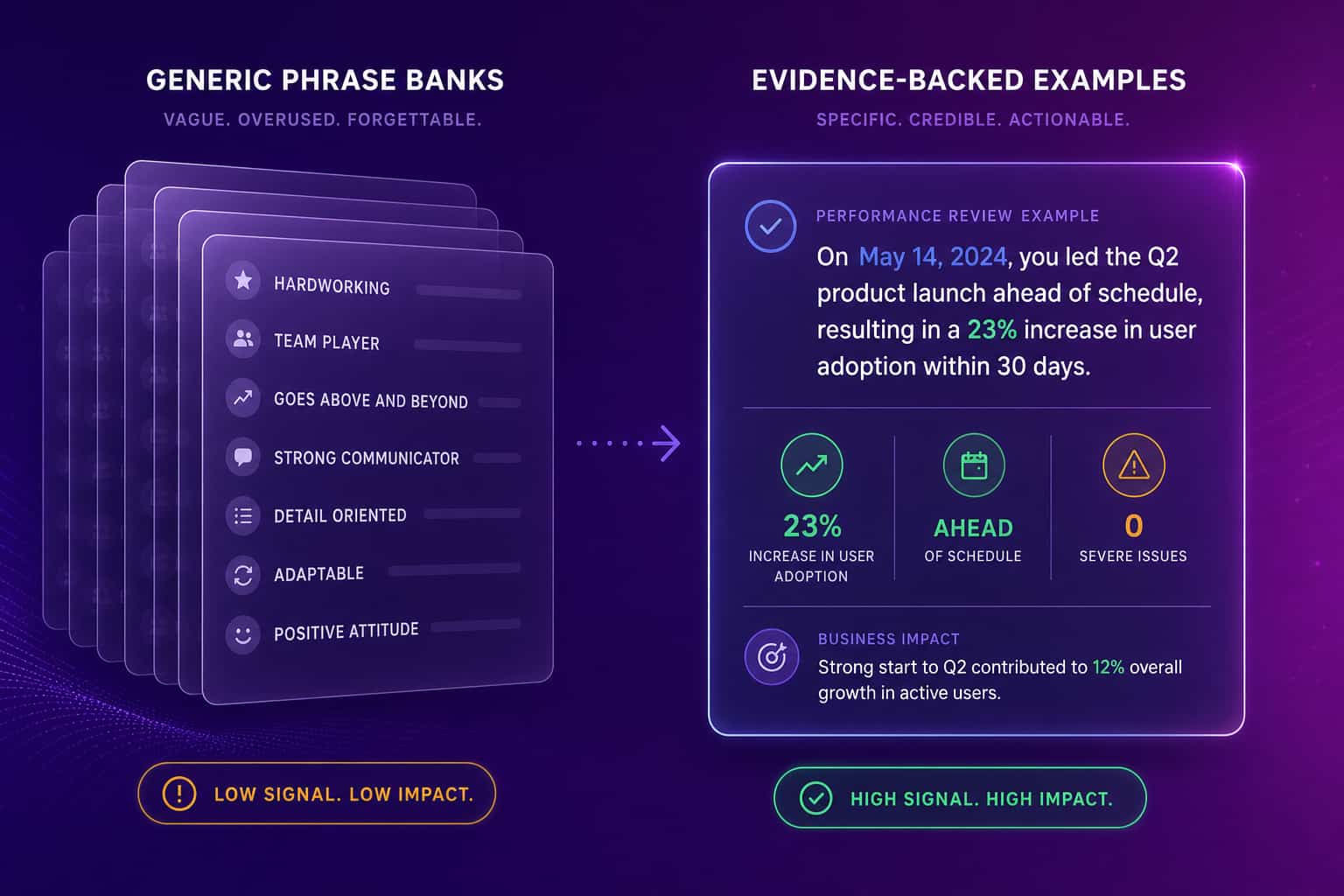
Most performance review examples circulating online, the "200 phrases and comments" listicles from HR software vendors, are built for volume, not defensibility, which means they optimize for a manager being able to find a plausible-sounding sentence fast rather than for that sentence holding up when an employee, HR, or a lawyer asks "based on what, exactly," and the tell is always the same: adjectives standing in for evidence, so "demonstrates strong leadership" or "consistently exceeds expectations" shows up dozens of times across dozens of competing phrase banks because it is generic enough to apply to almost any employee in almost any role, which is precisely why it applies to none of them specifically, and a review built out of interchangeable adjectives is not a record of what someone actually did this cycle, it is a fill-in-the-blank template with the manager's name attached.
Amir puts it bluntly when this comes up internally: the real work in most review cycles isn't judgment, it's archaeology. Digging through Slack threads, GitHub history, and six months of half-remembered 1:1 notes to reconstruct what an employee actually did, then translating that reconstruction into a sentence a phrase bank could have written anyway. The fix isn't a better phrase bank. It's not needing one, because the evidence is already sitting in the tools the work happened in, if the review process is built to pull from them.
Performance review examples by rating
Performance review examples split cleanly into three rating tiers, exceeds expectations, meets expectations, and needs improvement, and the difference between a generic version and a defensible one in every tier is the same: whether the sentence names a specific action tied to a date or project, versus a personality trait with no attachment point, so "exceeds expectations" should read as "shipped the Q2 migration two days ahead of schedule after catching a schema conflict other reviewers missed" rather than "goes above and beyond," "meets expectations" should read as "closed 14 of 16 sprint commitments on time, with the two misses both flagged early in standup" rather than "reliable team member," and "needs improvement" should read as "missed two sprint commitments in Q2, and the retro traced it to estimation rather than effort" rather than "struggles with time management," because every specific version survives being read back to the employee in the room and every generic version invites a follow-up question nobody can answer.
| Rating | Generic phrase | Evidence-backed rewrite |
|---|---|---|
| Exceeds expectations | "Goes above and beyond" | "Shipped the Q2 migration two days early after catching a schema conflict in review" |
| Meets expectations | "Reliable team member" | "Closed 14 of 16 sprint commitments on time; both misses were flagged early in standup" |
| Needs improvement | "Struggles with time management" | "Missed two sprint commitments in Q2; the retro traced it to estimation, not effort" |
| Exceeds expectations | "Strong communicator" | "Cut cross-team handoff delays by replying to blocking questions same-day for three straight sprints" |
| Needs improvement | "Needs to be more proactive" | "Waited for direct assignment on the auth migration instead of flagging the dependency risk when it surfaced two weeks earlier" |
Notice what's missing from the right column: adjectives. Every rewrite is a sentence you could hand an employee and expect them to nod, because it describes something they actually remember doing (or not doing), not a character assessment pulled from a dropdown.
Performance review examples by competency
Performance review examples also break down by competency, not just rating, and the five that come up in almost every review cycle, communication, collaboration, technical execution, leadership, and initiative, each have a version that means something and a version that doesn't, where the weak version is a trait ("good communicator," "collaborative," "technically strong," "shows leadership," "proactive") and the useful version names the specific behavior and its effect on the team or the work, because a rating scale can be gamed by picking a flattering adjective, but a specific behavior tied to a project the employee can point to cannot.
Communication
- Weak: "Communicates well with the team."
- Specific: "Posted a same-day PR summary on every merge this quarter, cutting the number of 'what changed' Slack pings from reviewers roughly in half."
Collaboration
- Weak: "Works well with others."
- Specific: "Paired with two junior engineers through the payments refactor, and both shipped their first production PR within the sprint."
Technical execution
- Weak: "Strong technical skills."
- Specific: "Reduced the checkout service's P95 latency from 800ms to 210ms by tracking down an unindexed query nobody had flagged."
Leadership
- Weak: "Shows leadership potential."
- Specific: "Ran the incident retro after the March outage and turned it into three concrete follow-up tickets, all closed within the sprint."
Initiative
- Weak: "Proactive and self-directed."
- Specific: "Flagged the auth-migration dependency risk two weeks before it would have blocked the release, without being asked to look."
Self-review examples: what changes when the employee writes it
Self-review examples follow the same rule, specific over generic, but the voice and the risk profile shift, because an employee writing their own performance review examples has two failure modes pulling in opposite directions: underselling real contributions out of habit or modesty, so the manager has to go fish for context that should have been on the page, or overselling with vague superlatives ("I went above and beyond all quarter") that read as defensive the moment a manager sits down to calibrate the self-review against what actually happened, and the fix in both directions is identical: name three to five specific contributions with dates and outcomes, let the manager's independent evidence confirm or complicate them, and skip the adjectives entirely, because a self-review's job is to surface things the manager might not have seen, a mentoring conversation, a stakeholder save, a debugging session that never made it into a PR, not to argue for a rating.
-
Instead of: "I consistently went above and beyond this quarter."
-
Try: "I covered the on-call rotation for a teammate on leave for three weeks and kept our SLA breach rate at zero across that stretch."
-
Instead of: "I'm a strong collaborator."
-
Try: "I ran three cross-team syncs during the vendor migration and kept both teams unblocked without a single escalation."
The same calibration problem shows up on the manager side, which is why fair reviews and evidence-backed reviews are really the same project. Our guide on building fair performance reviews with objective data covers the calibration meeting itself, where self-review and manager-review language finally get compared side by side.
Turning a phrase into an evidence-backed review
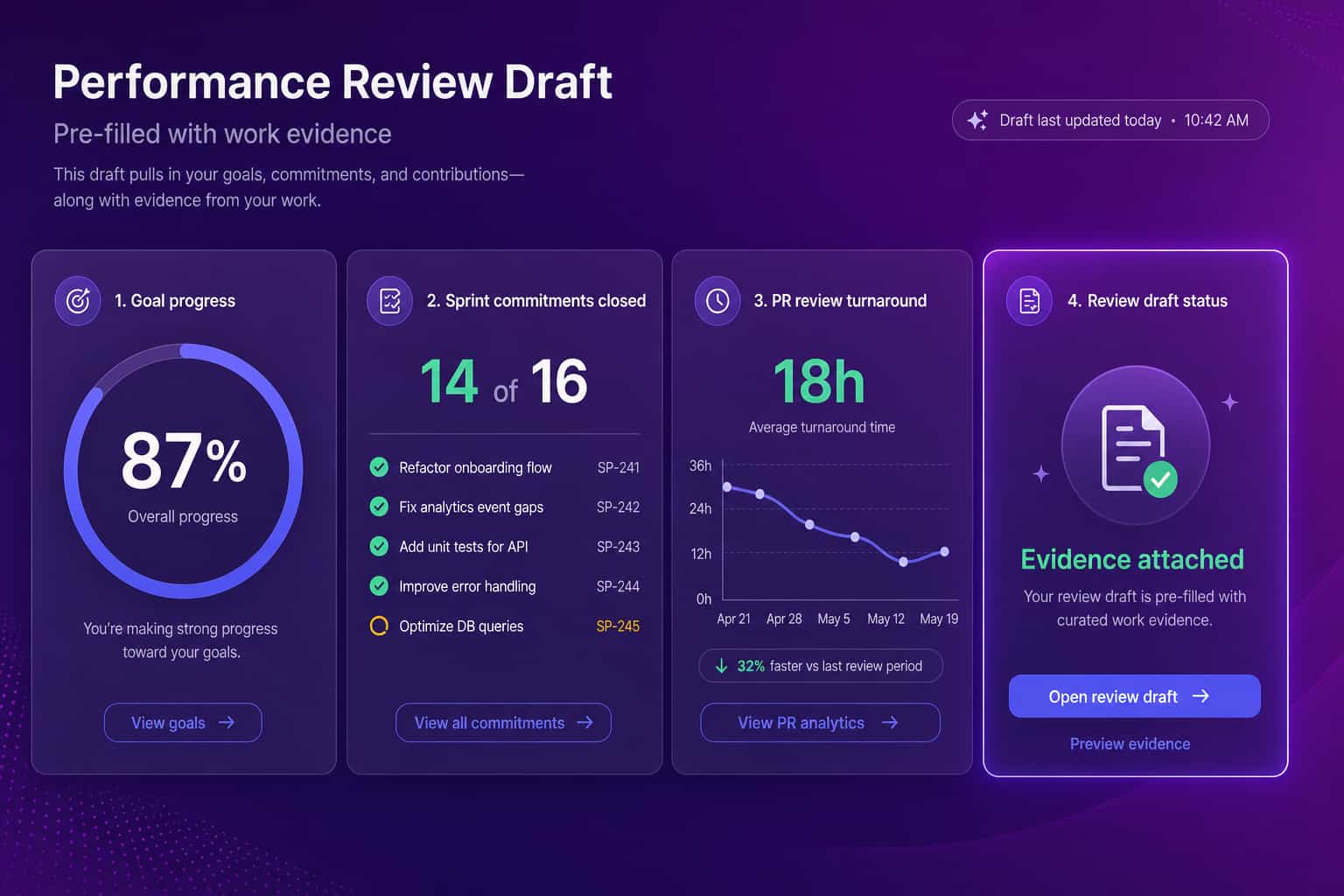
Turning a performance review example from a phrase into something evidence-backed takes one habit: before writing any sentence with a rating attached, ask whether it can be traced to a specific PR, ticket, goal update, calendar pattern, or piece of collaboration data from the review period, because that single question kills most generic phrase-bank language on contact, since "strong communicator" has no trace and "closed 14 of 16 sprint commitments, flagging the two misses early in standup" traces directly to Jira, and Abloomify's performance management module builds review drafts around that traceability requirement by pulling goal progress, PR and delivery signals, and collaboration patterns from the tools work already happens in, GitHub, Jira, Google Workspace, so a manager opens a review with the evidence already attached instead of reconstructing six months from memory.
Generic Phrase Banks
Abloomify
Common mistakes when writing performance review examples
The most common mistake in performance review examples isn't laziness, it's recency bias dressed up as specificity, where a manager writes a genuinely concrete, dated example, but it's from the last three weeks of a six-month cycle because that's what's fresh in memory, which means the review technically passes the "is it specific" test while still misrepresenting the period, the second most common mistake is stacking three or four generic adjectives in a row to compensate for not having a concrete memory to reach for ("collaborative, reliable, and hardworking" says nothing that three separate specific examples wouldn't say better), and the third is writing self-review and manager-review examples in totally different registers, one modest and vague, one calibrated and specific, so the two documents don't actually talk to each other in the calibration meeting.
Recency bias is the hardest one to catch because it looks like good writing. A manager who logs evidence continuously, instead of reconstructing it the week reviews are due, is the only real fix; everything else is a patch on top of a memory problem.
How to tell if your performance review examples are actually working
The test for whether your performance review examples are actually working isn't whether managers finish reviews faster, though that matters, it's whether an employee reading their own review can point to the specific week or project each sentence is describing, because a review an employee can't map back to real events isn't feedback, it's a rating with prose wrapped around it, and the gap between those two outcomes usually isn't a training problem, managers know the difference between "reliable" and "closed 14 of 16 sprint commitments," it's a time and access problem, six months of scattered evidence across GitHub, Jira, Slack, and memory is genuinely hard to reconstruct under a deadline, which is why the fastest fix is pulling that evidence into the draft automatically rather than asking managers to remember harder.
Big companies fix this with more phrase banks. The actual fix is better evidence.
FAQ
What makes a performance review example effective?
It names a specific action, date, and outcome instead of a trait. "Shipped the Q2 migration two days early after catching a schema conflict in review" survives scrutiny; "goes above and beyond" doesn't. Abloomify's performance management module pulls that language from logged work data instead of memory.
Are performance review phrase banks like Lattice's or PerformYard's worth using?
As a vocabulary starting point, yes. As finished sentences, no. Every phrase needs a specific date, project, or outcome attached before it goes in a real review, otherwise it's interchangeable across every employee in the company.
How do you write performance review examples for a "needs improvement" rating?
Pair the gap with one specific instance and a forward step, not a character judgment. "Missed two sprint commitments in Q2; the retro traced it to estimation, not effort, so next cycle adds a peer-reviewed estimate" reads as coaching. "Struggles with time management" reads as a grudge.
What is the difference between performance review examples and a performance review template?
A template is the form, sections for goals, evidence, ratings, and growth plans. Examples are the language that fills those sections in. Abloomify's free performance review template covers the structure; this guide covers what to write inside it.
Should self-reviews use the same examples as manager reviews?
The same rule (specific over generic), not the same lines. Self-reviews should surface contributions a manager might have missed: a mentoring conversation, a stakeholder save, a debugging session that never became a PR, with the same date-and-outcome discipline as any manager-written example.
How does Abloomify generate performance review examples automatically?
It connects to GitHub, Jira, Google Workspace, and the goals module, then pulls delivery, collaboration, and goal-progress signals into a review draft before a manager opens it. PII-free: no code content, no message content, only the signals a fair review needs.

Amir Tavafi
Co-Founder & CEO
Product leader and innovator with over 15 years of experience in the tech sector, grounded in AI and robotics. Previously led product development in fraud detection and AI solutions at Nasdaq Verafin.