What Engineering Leadership Actually Requires in 2026
September 2, 2026
Amir Tavafi
12 min read

Engineering leadership in 2026 comes down to one question: can you say, in a sentence, where your team's time actually goes? Abloomify's Customer 1, the COO at a 50-person Canadian SaaS company, put it this way after connecting GitHub and Jira: "What I did manually this week in a spreadsheet is exactly what I think Abloomify should be doing automatically." That's the job now.
Key Takeaways
Q: What does engineering leadership actually mean in 2026?
A: It means pairing the coaching and prioritization work with a real answer to "where is the team's time going." Leaders who can name their PR cycle time, review health, and AI-tool ROI from memory are working with better information than leaders who are still guessing off standup vibes and the last retro.
Q: What's the single biggest blind spot for engineering leaders right now?
A: AI coding tool ROI. Most VPs of Engineering can say how many Cursor or Copilot seats they bought. Very few can say whether the teams using them ship measurably faster, because the seat report and the delivery data live in two different tools that never talk to each other.
Q: What metrics actually separate strong engineering leadership from weak leadership?
A: PR cycle time, time to first review, and the four DORA metrics (deployment frequency, lead time, change failure rate, MTTR), each banded Elite to Low. A leader who tracks these catches a slipping team weeks before it shows up in a missed release date.
Q: Do engineering leaders need to monitor their developers to get this data?
A: No. Abloomify is PII-free by architecture, meaning no screenshots, no keyloggers, no reading code or message content. It reads signals like PR timing, review patterns, and deployment cadence from GitHub, Jira, and other connected tools, the same way you'd read a delivery report, not a webcam.
What engineering leadership actually means in 2026
Engineering leadership in 2026 is the job of turning a team's raw capacity into decisions a board will accept, and that job now runs on two kinds of information: the human read (is this person growing, is this team's morale intact, is this the right thing to build) and the data read (where is work actually getting stuck, is the team's tooling paying for itself, who is quietly overloaded). For most of the last decade, engineering leadership training focused almost entirely on the first kind. Books on servant leadership, courses on 1:1 cadence, frameworks for prioritization. All of that still matters. What's changed is that the second kind of information, the data read, used to be optional. A leader could get by on instinct and a good relationship with their tech lead. In 2026, with AI coding tools reshaping how fast code gets written and reviewed, instinct alone leaves you a step behind a leader who can pull up PR cycle time and AI adoption by team on demand.
Why the old engineering leadership skill set is running out of runway
The skills that made someone a good engineering leader in 2018, reading a room, running a clean retro, protecting the team from scope creep, are still necessary and none of them are sufficient anymore, because the questions leadership now has to answer have gotten more specific than a retro can surface. "Is velocity actually flat, or does it just feel flat because two engineers are heads-down on a migration nobody scoped properly?" "Are we getting real value from what we're spending on AI coding tools this year, or did adoption stall after the initial rollout?" "Which reviewer is quietly the bottleneck for most of the team's merges?" A standup won't answer any of these. Neither will a gut check. Jira shows tasks moved, not PR cycle time or review health. GitHub's native insights give you raw counts with no DORA banding, no AI-tool ROI, and no way to separate what a person wrote from what an agent generated. The leaders who are struggling right now aren't bad leaders. They're running 2018 tools against a 2026 problem.
The new core skill: measuring what your team and your AI tools are actually doing
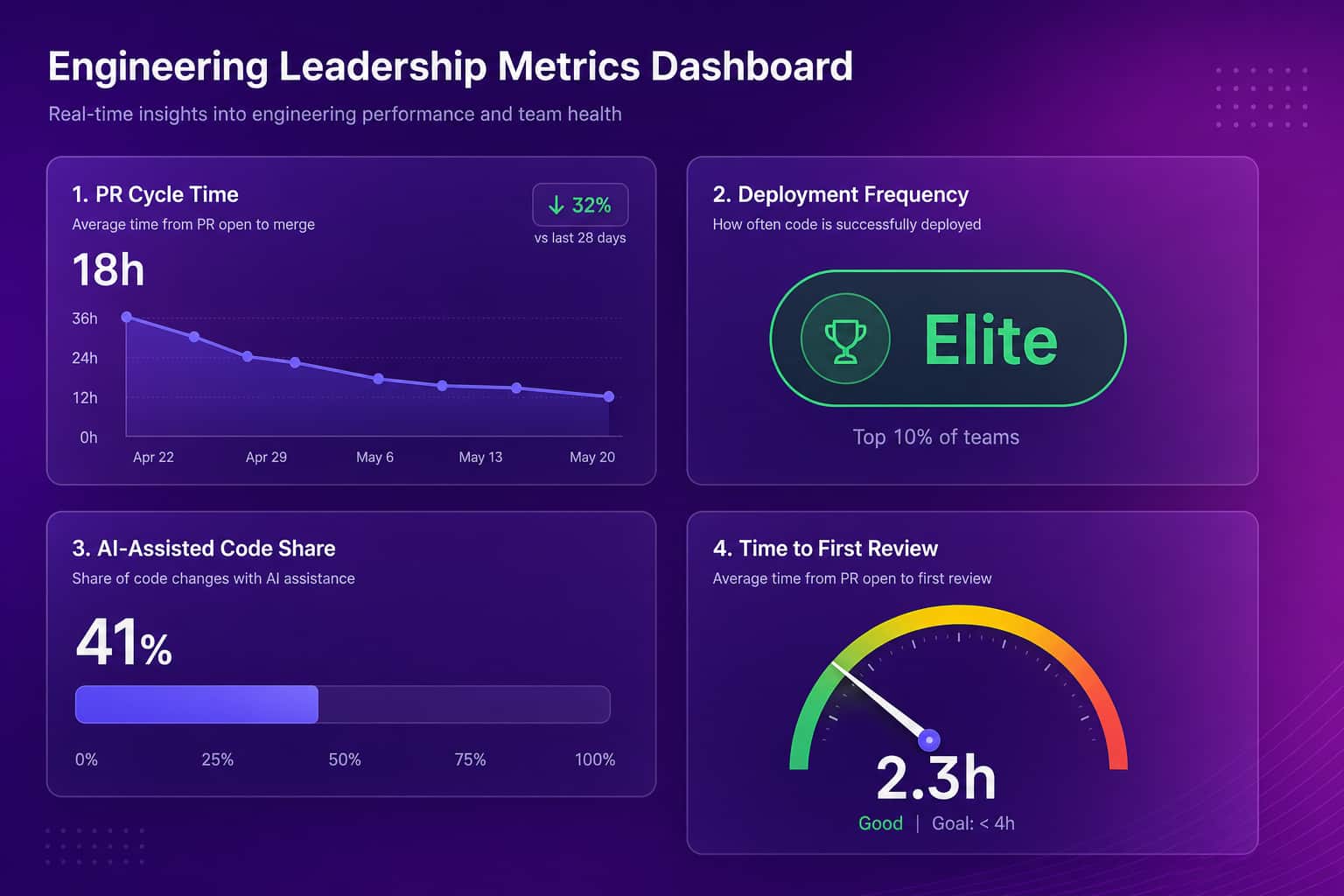
The engineering leadership skill nobody taught you in 2018 is knowing how to read AI tool ROI, and it's now as core to the job as running a good 1:1, because a growing share of the code your team ships is no longer purely human-written and the old delivery metrics don't separate the two. Companies now average 7+ AI coding and productivity tools deployed, up from 2 in 2023, and most engineering leaders can tell you the seat count without being able to tell you whether those seats are earning their keep. That's a governance gap, not a technology gap. The tools exist to close it: Abloomify imports usage data directly from Cursor, Claude Code, and GitHub Copilot and correlates it against PR velocity and task completion, so you can see adoption by team, AI-assisted lines versus human-written lines, and whether the teams using AI heavily are actually shipping and reviewing faster than the teams that aren't.
I've had this conversation with founders who assumed AI tool adoption in engineering runs on faith: buy the seats, tell people to use them, hope it shows up in velocity eventually. It doesn't have to. The same GitHub connection that gives you PR cycle time can tell you which teams are getting real leverage from Cursor or Copilot and which ones bought a license and kept coding the old way. Leadership's job is to ask that question on purpose instead of finding out at renewal time.
Where engineering leadership goes wrong
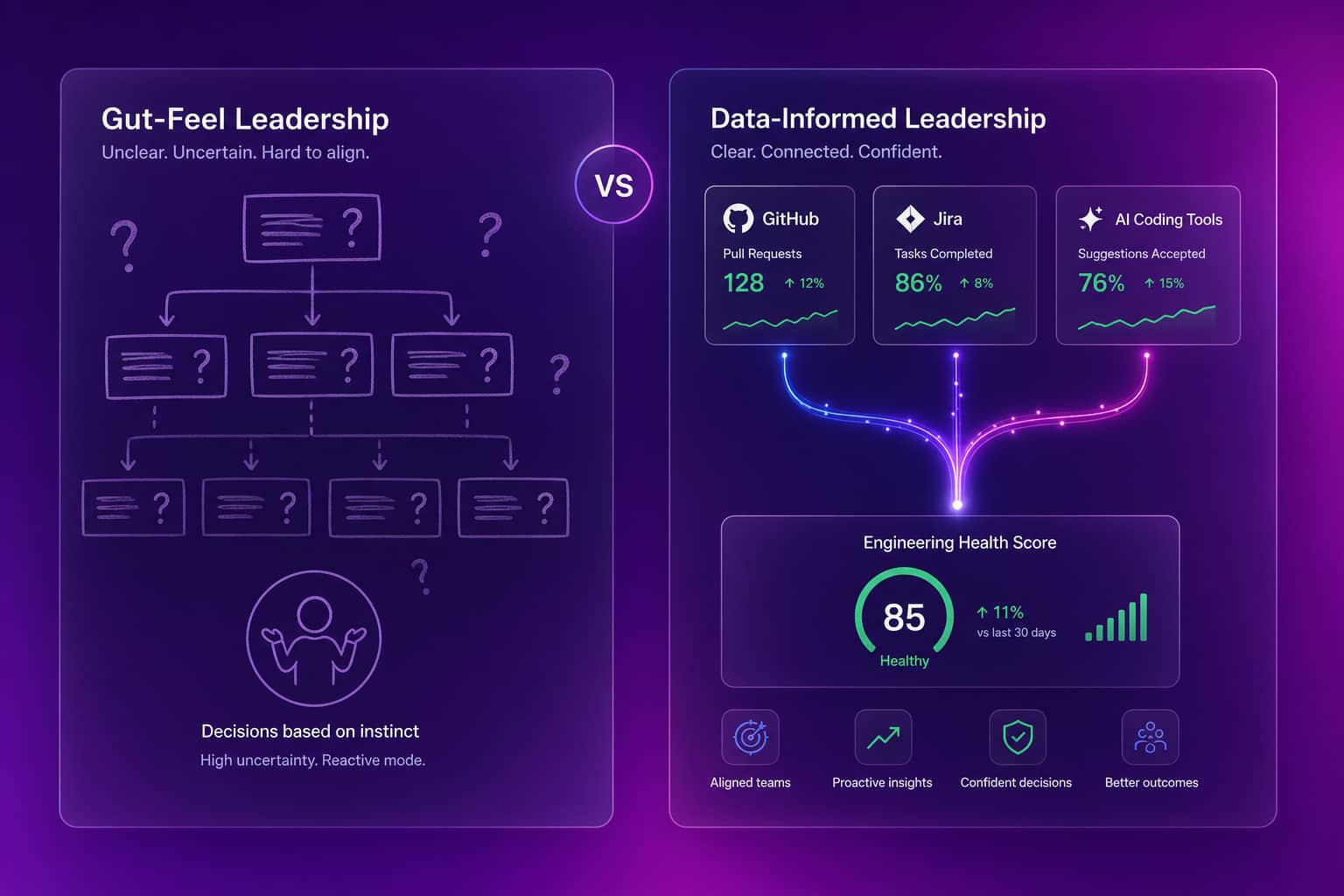
Most of the engineering leadership failures I see aren't dramatic, and they rarely trace back to a bad decision in a big meeting. They're small, invisible chores that eat a leader's calendar until there's no time left for the judgment calls that actually needed a human: chasing people for updates instead of trusting a dashboard, assembling the same status report by hand every week, and buying tools without ever checking whether they paid off. Each one individually looks like diligence. Stacked together, they're the reason a leader can be working sixty hours a week and still get blindsided by a problem their own data would have surfaced a month earlier. The pattern usually looks like this:
- Chasing three different people for the same status update because nobody trusts the dashboard
- Copy-pasting metrics from Jira, GitHub, and a spreadsheet into a slide deck every Friday
- Approving a new AI tool subscription with no plan to ever check if it paid off
- Finding out a reviewer is a bottleneck for most of the team's PRs only after someone complains in a retro
- Discovering capacity is maxed out the week a director asks "can we take on one more thing"
None of these require a bad leader. They require a leader whose visibility runs on people remembering to tell them things, instead of on connected data that surfaces the pattern before someone has to complain about it.
The metrics engineering leadership actually needs to track
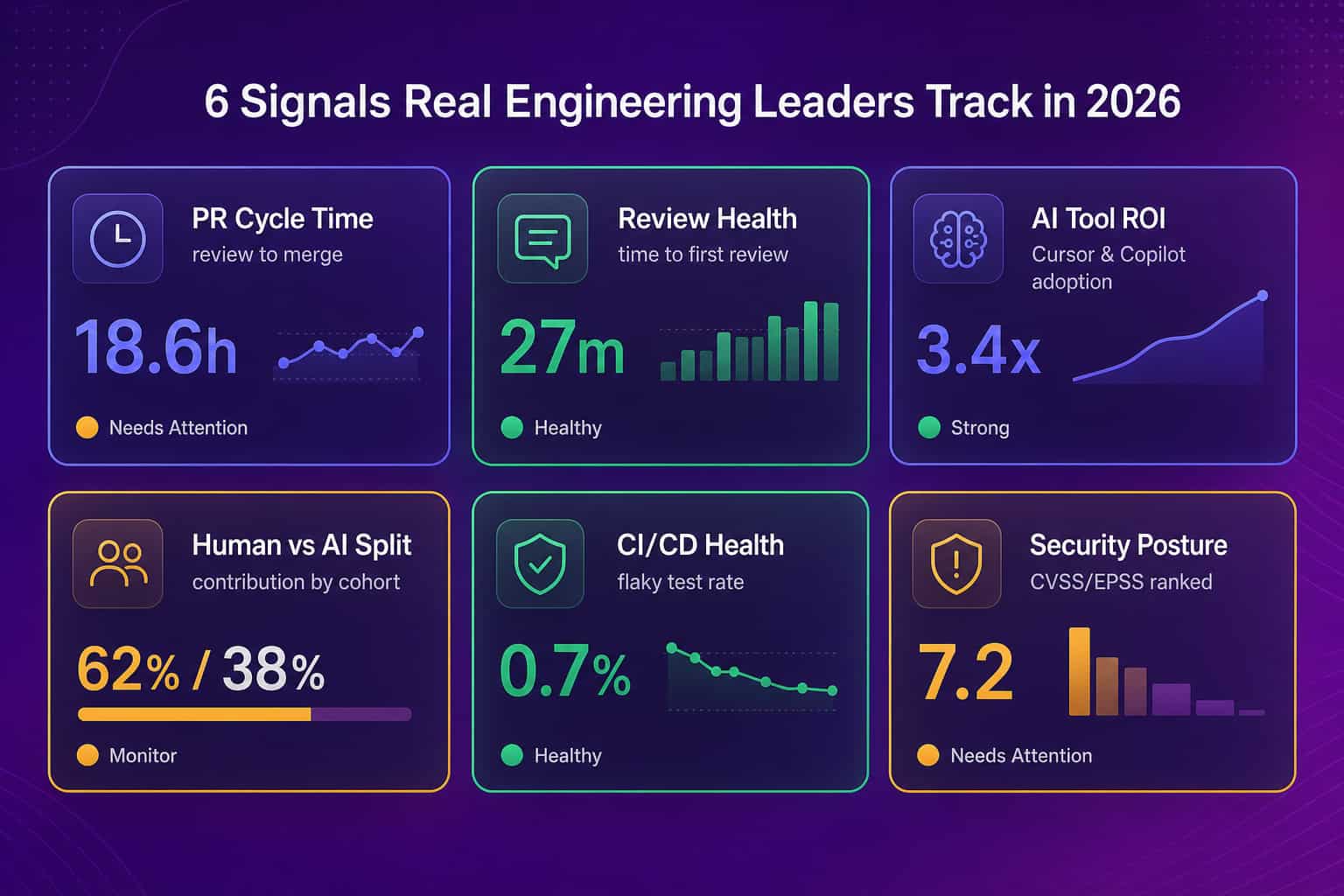
A short list of metrics separates engineering leadership that catches problems early from leadership that finds out in the postmortem, and the list is shorter than most people expect: PR cycle time and time to first review (how fast work actually moves once it's written), the four DORA metrics banded Elite through Low (deployment frequency, lead time for changes, change failure rate, and MTTR), and AI-tool adoption correlated against output rather than seat count. Security posture belongs on the list too, specifically Dependabot and code-scanning findings ranked by real exploit probability, because a leader who's blind to delivery speed and blind to security risk is managing on hope twice over. None of this replaces judgment. It replaces guessing at the inputs judgment needs.
How to build a data-informed engineering leadership practice
Building a data-informed engineering leadership practice takes less setup than most leaders assume, and it starts with connecting the systems where work already happens rather than adding a new process for people to maintain. Connect GitHub (or GitLab or Bitbucket) and your task tracker first, since PR flow and delivery metrics come straight out of that pairing within about ten days, no manual rollup required. Add your AI coding tools next, Cursor, Claude Code, Copilot, so adoption and ROI show up next to delivery data instead of living in a separate license report. From there, set a cadence: a weekly or biweekly brief that goes to you, not one you have to build. Bloomy, Abloomify's AI Chief of Staff, can be scheduled to pull that brief automatically ("every Monday, summarize PR velocity, review health, and anything stalled") and email it as a decision-ready report, with a resumable chat behind it if you want to push further on any number. Dashboards ask you to check them. This is built to check in on you instead.
Evaluating tools that support engineering leadership
Most tools built for engineering leadership fall into one of three camps, and knowing which camp a tool is in tells you what it will and won't answer for you: task trackers like Jira show what moved, not how fast or why it stalled; engineering-analytics point solutions like Jellyfish and LinearB add real DORA dashboards but stop at the engineering org, with no view into whether AI tools are paying off or how engineering capacity connects to the rest of the company; and full-org platforms like Abloomify connect GitHub and your task tracker to the same capacity, meeting-load, and AI-adoption signals a COO is already tracking elsewhere, so an engineering leader isn't the only one in the building working off different numbers. None of this is about replacing your judgment as a leader. It's about making sure the judgment calls you're already making are working from a real picture instead of a partial one. Big companies bring quarterly dashboard reviews. The leaders who move fastest just ask Bloomy on a Tuesday.
FAQ
What does engineering leadership mean in 2026?
It means pairing the coaching and prioritization work with a real answer to "where is the team's time going." Leaders who can name their PR cycle time, review health, and AI-tool ROI from memory are working with better information than leaders who are still guessing off standup vibes and the last retro.
What metrics should an engineering leader track?
PR cycle time, time to first review, deployment frequency, change failure rate, and MTTR (the four DORA metrics), plus AI-tool adoption and human-vs-AI contribution now that coding assistants are part of the workflow. Abloomify pulls all of these directly from GitHub and Jira, banded Elite to Low, instead of leaving them scattered across three dashboards nobody opens on the same day.
How is engineering leadership different from engineering management?
Management is the operational layer: 1:1s, sprint planning, performance reviews, hiring. Leadership is the judgment layer on top of it: deciding what to build, what to cut, and where the team is actually stuck versus where it just feels stuck. Both jobs get easier with real delivery data. Leadership specifically gets harder without it, because the decisions carry more weight and more people are affected when the read is wrong.
Can engineering leadership be data-driven without monitoring developers?
Yes, and the distinction matters. Abloomify is privacy-first and PII-free by architecture: no screenshots, no keyloggers, no reading code content. It measures PR flow, review patterns, and delivery signals from GitHub, Jira, and 100+ other connected tools, the same way a CFO reads a P&L without watching an accountant's screen. Roughly 1 in 6 workers say they'd quit over surveillance, per 2026 survey research, which is exactly the trust cost this architecture is built to avoid.
Does AI tool adoption change what engineering leaders need to measure?
It adds a line item that didn't exist three years ago. Leaders now need to know adoption by team, AI-assisted lines versus human-written lines, and whether heavy Cursor or Copilot users actually ship faster and review quicker, not just whether the seats got purchased. Abloomify imports usage directly from Cursor, Claude Code, and GitHub Copilot and correlates it with output, which is the difference between a license report and an ROI answer.
Real engineering leadership in 2026 still starts with people. It just doesn't stop there anymore. If your read on PR cycle time, AI tool ROI, and team capacity is still coming from memory and a Friday status meeting, see how Abloomify gives engineering leaders that picture without monitoring anyone →
You can go deeper on the specific pieces: engineering velocity metrics for VPs of Engineering, how to find and fix engineering bottlenecks with productivity data, the engineering productivity analytics solution, and the for engineering leaders overview. If Cursor is already part of your stack, the Cursor integration page covers what usage data comes across.

Amir Tavafi
Co-Founder & CEO
Product leader and innovator with over 15 years of experience in the tech sector, grounded in AI and robotics. Previously led product development in fraud detection and AI solutions at Nasdaq Verafin.