Cross-Functional Team Collaboration: What Actually Breaks It
August 24, 2026
Amir Tavafi
8 min read

Cross-functional team collaboration usually gets diagnosed with a survey and fixed with a Slack channel. Neither one finds the actual problem, which almost always lives in the three days a ticket sits unassigned between engineering and support, not in whether the teams like each other. Abloomify surfaces that gap from the tools teams already use, PII-free, without reading a single message.
Key Takeaways
Q: What is cross-functional team collaboration?
A: It is how work moves between teams with different functions toward a shared goal, measured at the handoff, not the meeting. Abloomify tracks response latency and handoff time across GitHub, Jira, Slack, and CRM tools to show where cross-team work actually stalls.
Q: Why do most collaboration fixes not work?
A: Most fixes target visible symptoms (too many meetings, unclear ownership) instead of the underlying delay pattern. A new Slack channel does not shorten the three days a support ticket waits for an engineering response.
Q: What is the fastest way to spot a collaboration breakdown?
A: Look at response latency between teams, not within them. A team that replies to its own tickets in two hours but takes four days to respond to a request from another department has a cross-functional collaboration problem, not a productivity problem.
Q: Does measuring this require monitoring employees?
A: No. Abloomify measures collaboration through 100+ PII-free API integrations (GitHub, Jira, Slack, CRM) that surface response timing and handoff patterns between teams, never message content, screenshots, or keystrokes.
Why cross-functional team collaboration actually breaks down
Cross-functional team collaboration breaks down at the handoff between teams, almost never inside a single team, because that is the one place nobody owns the wait. A support ticket needs an engineering answer. A sales deal needs a product commitment. A marketing campaign needs an engineering integration shipped on time. Inside any one of those teams, work has an owner, a status, and usually a Slack channel where someone will eventually notice it stalled. The moment work crosses the line between two teams, ownership gets fuzzy, and fuzzy ownership is where delay hides. Nobody is lying about the collaboration being fine. They just cannot see the three-day gap between "support opened the ticket" and "an engineer looked at it," because that gap does not live inside either team's dashboard.
I have watched this play out from both sides: a founder waiting on an engineering answer for a sales deal, and an engineer wondering why sales keeps escalating something that was already answered in a thread nobody read. Big companies bring ceremony to this problem: steering committees, RACI charts, a cross-functional collaboration training deck. Startups usually just add a Slack channel and hope. Neither one measures the actual wait.
Why surveys and status meetings miss the real signal
The first sentence rule applies here: an engagement survey asking "how well do teams collaborate" gets you a sentiment score, not a location. A 1-to-10 rating tells you people feel friction somewhere, but not where the friction actually costs time, and by the time a quarterly survey catches a pattern, three months of stalled handoffs have already happened. Status meetings have the opposite problem: they surface whatever the loudest person in the room remembers being stuck, which is recency bias wearing a project-update hat. The handoff that quietly took eleven days last month never comes up, because nobody in the meeting was still annoyed about it. What actually works is looking at the artifacts the work leaves behind: a ticket's assignment history, a PR's time-to-first-review across teams, a CRM note waiting on an engineering estimate. Those artifacts do not forget, and they do not need anyone to remember to bring them up.
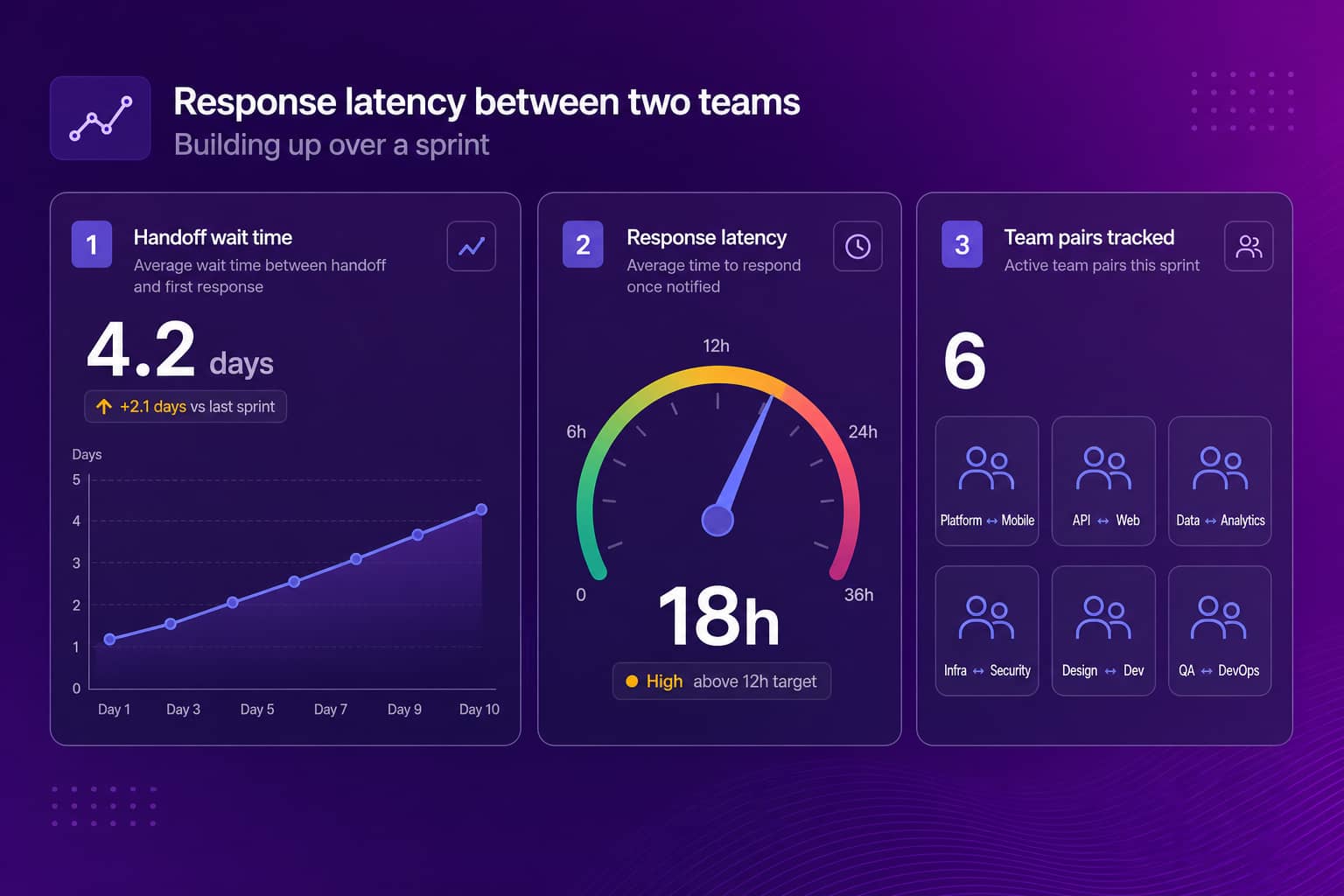
What a real collaboration signal looks like
A real cross-functional collaboration signal is boring on purpose: how long does a request wait between the moment one team hands it to another and the moment the receiving team acts on it, tracked over time, by team pair. That single number, watched weekly instead of guessed at quarterly, tells you more about collaboration health than any survey question ever will, because it is measuring the thing that actually costs money and morale: the wait. Abloomify pulls this from GitHub (cross-team PR review time), Jira and Linear (cross-team ticket handoff time), Slack (thread response latency between team channels, aggregated only, never message content), and CRM tools (deal-stage waits tied to another team's input). None of it requires reading what anyone wrote. It requires knowing when a request landed and when it got a real response.
How to measure cross-functional team collaboration without monitoring anyone
Start by picking the two or three team pairs where a handoff actually matters to a customer outcome, engineering to support, sales to product, marketing to engineering, instead of trying to map every possible interaction in the company at once. For each pair, track response latency (how long a request sits before the receiving team engages) and completion time (how long from first engagement to resolution), pulled directly from the tools already recording that work: Jira ticket timestamps, GitHub PR review requests, CRM stage changes. Abloomify's collaboration and workforce intelligence connects these sources automatically and surfaces the pattern without anyone filling out a form or a survey. The point is not to rank teams against each other. The point is to see the wait building up before it turns into a missed renewal or a shipped feature nobody asked for anymore.
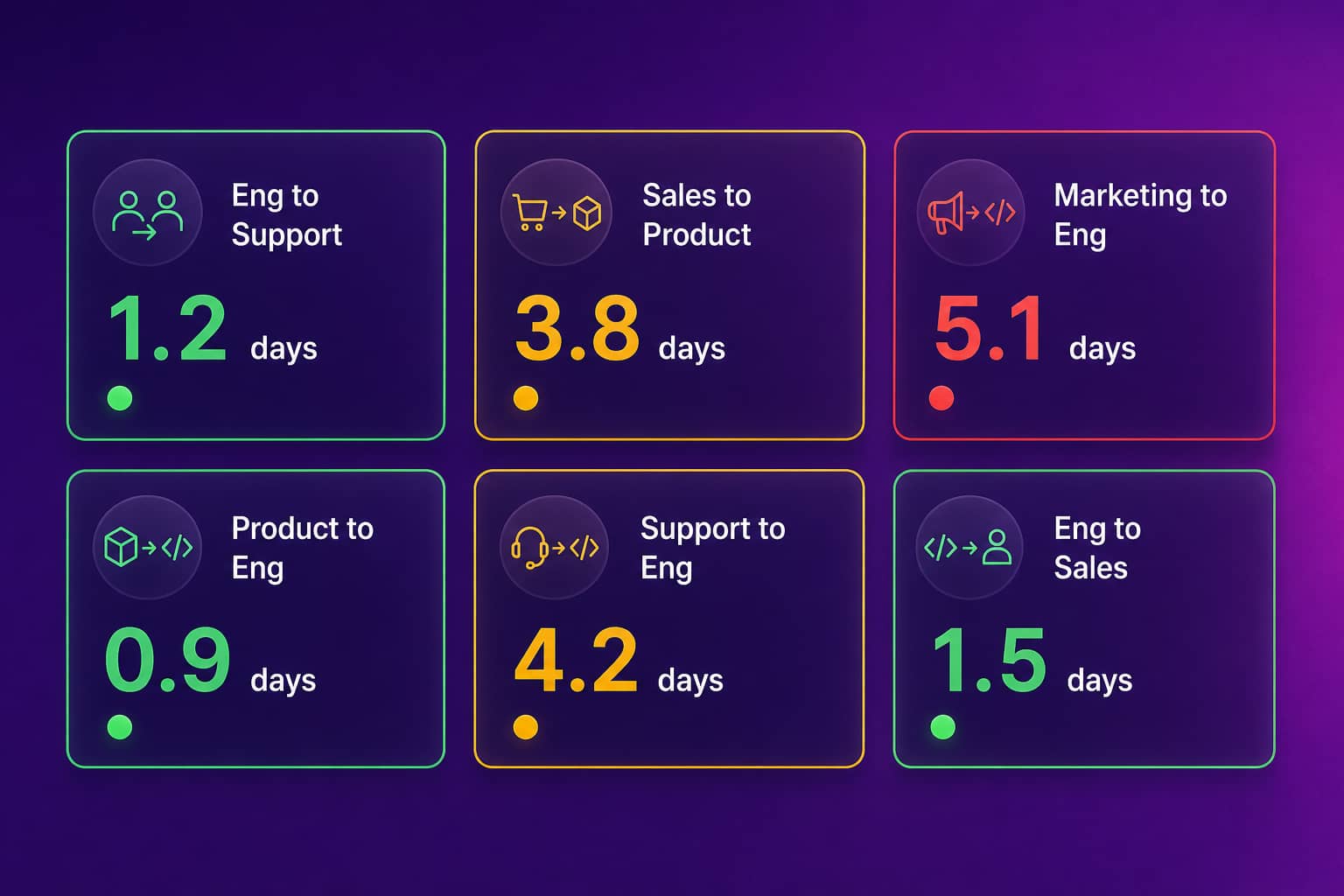
Once you can see it, the fix is usually smaller than the org chart redesign everyone was dreading. A support-to-engineering handoff that consistently takes four days might just need a named triage owner on the engineering side, not a new committee. A sales-to-product handoff that stalls might need a weekly async sync instead of another status meeting nobody prepares for. Big companies bring ceremony. Small, well-instrumented fixes bring outcomes.
Turning the signal into a habit, not a one-time audit
A single audit of cross-functional team collaboration is worth doing, but it goes stale the moment the org chart changes or a new tool gets adopted, which is why the teams that actually fix this treat it as a standing weekly check instead of a one-time project. Abloomify customers running this through Bloomy, our AI Chief of Staff, schedule a Monday brief that flags any team pair whose handoff time moved in the wrong direction that week, so a manager catches the drift before it becomes a customer-facing problem. That is the actual difference between measuring collaboration and managing it: measuring happens once and gets forgotten, managing happens every week because the report shows up whether anyone asks for it or not.
Our guide on reducing status meetings by 50 percent covers the meeting side of this same problem, and measuring engineering collaboration without invasive monitoring goes deeper on the engineering-specific version of this signal. See how Abloomify surfaces cross-team handoffs without watching anyone →
FAQ
What is cross-functional team collaboration?
Cross-functional team collaboration is how work moves between teams with different functions (engineering, product, sales, support) toward a shared outcome. It is a workflow problem, not a rapport problem. Most breakdowns happen at the handoff between teams, not inside either team, which is why it needs to be measured at the seam, not the org chart.
Why does cross-functional collaboration break down?
It breaks down at handoffs: a ticket sits unassigned for three days, a Slack thread waits 48 hours for a reply, a request bounces between two teams because ownership was never clear. None of that shows up in an engagement survey or a project board status, which only shows the last event, not the wait before it.
How do you measure cross-functional team collaboration?
Measure response latency and handoff time between teams across the tools they already use (Jira, GitHub, Slack, CRM), not survey sentiment. Abloomify pulls this from 100+ integrations PII-free: no message content is read, only response timing and handoff patterns between teams.
Can you improve collaboration without monitoring employees?
Yes. Abloomify measures collaboration at the team and workflow level using response latency, handoff time, and workload balance across connected tools, PII-free by architecture: no screenshots, no keyloggers, no content capture. The signal is where work waits, not who is slow.

Amir Tavafi
Co-Founder & CEO
Product leader and innovator with over 15 years of experience in the tech sector, grounded in AI and robotics. Previously led product development in fraud detection and AI solutions at Nasdaq Verafin.