Burnout Jobs in 2026: Tech Roles Where It Hits Hardest
May 13, 2026
Amir Tavafi
9 min read

Most lists of burnout jobs in 2026 still rank roles by industry, like nurses, teachers, lawyers, and bankers. That misses what is actually happening in tech. The job title is not the cause. The work pattern is. After three customers and a few hundred leadership calls, the burnout jobs we see in 50 to 3,500-person tech companies cluster in five roles, and the data signal shows up 60+ days before anyone hands in notice.
Key Takeaways
Q: What are the highest burnout jobs in tech in 2026?
A: Engineering managers, on-call SREs and platform engineers, customer support and CS leads, senior IC engineers carrying AI review load, and product managers running across five tools a day. The common thread is interrupt load and calendar density, not the title.
Q: Why are so many tech jobs labeled as burnout jobs in 2026?
A: Hiring slowdowns from 2023 to 2025 left fewer people doing the same work, and AI coding tools quietly shifted humans from building to reviewing AI output. Both show up as work-pattern signals well before they show up on a survey.
Q: How do leaders catch burnout in burnout jobs before someone quits?
A: Watch the work patterns, not the engagement survey. Meeting load creeping up, after-hours commits, deep-work blocks shrinking, collaboration dropping. Abloomify flags these from Google Workspace, M365, GitHub, and Jira 60+ days early, without screenshots.
Q: Is burnout in tech jobs a real category or just a vibe?
A: It is a measurable pattern. A 2026 Visier survey reported that 70% of burnt-out employees would leave their current job. Monitoring tools do not fix it. Personnel Psychology's meta-analysis found no evidence that surveillance improves performance.
What actually makes a job a burnout job in 2026?
A burnout job in 2026 is a role where the work pattern, not the role's mission, runs the person down. The classic burnout indicators (long hours, high emotional load, ambiguous outcomes) still apply, but in tech the modern driver is structural. People used to ship in 90-minute focus blocks. Now their calendar is a wall of 30-minute syncs, their Slack is at 200 messages by lunch, and their commits creep past 9 PM because that is the first quiet moment in the day. Engagement surveys catch this 90 days after the person has already mentally checked out. Work-pattern data catches it 60+ days before they quit. The difference between a healthy high-stakes job and a burnout job is whether the recovery window still exists. In tech today, the recovery window is the first thing to disappear.
The framing matters because it changes the fix. If you believe burnout is caused by the role, you swap the person. If you believe burnout is caused by the work pattern, you fix the pattern. The second one is the only one that compounds.
The 5 tech burnout jobs we see most often
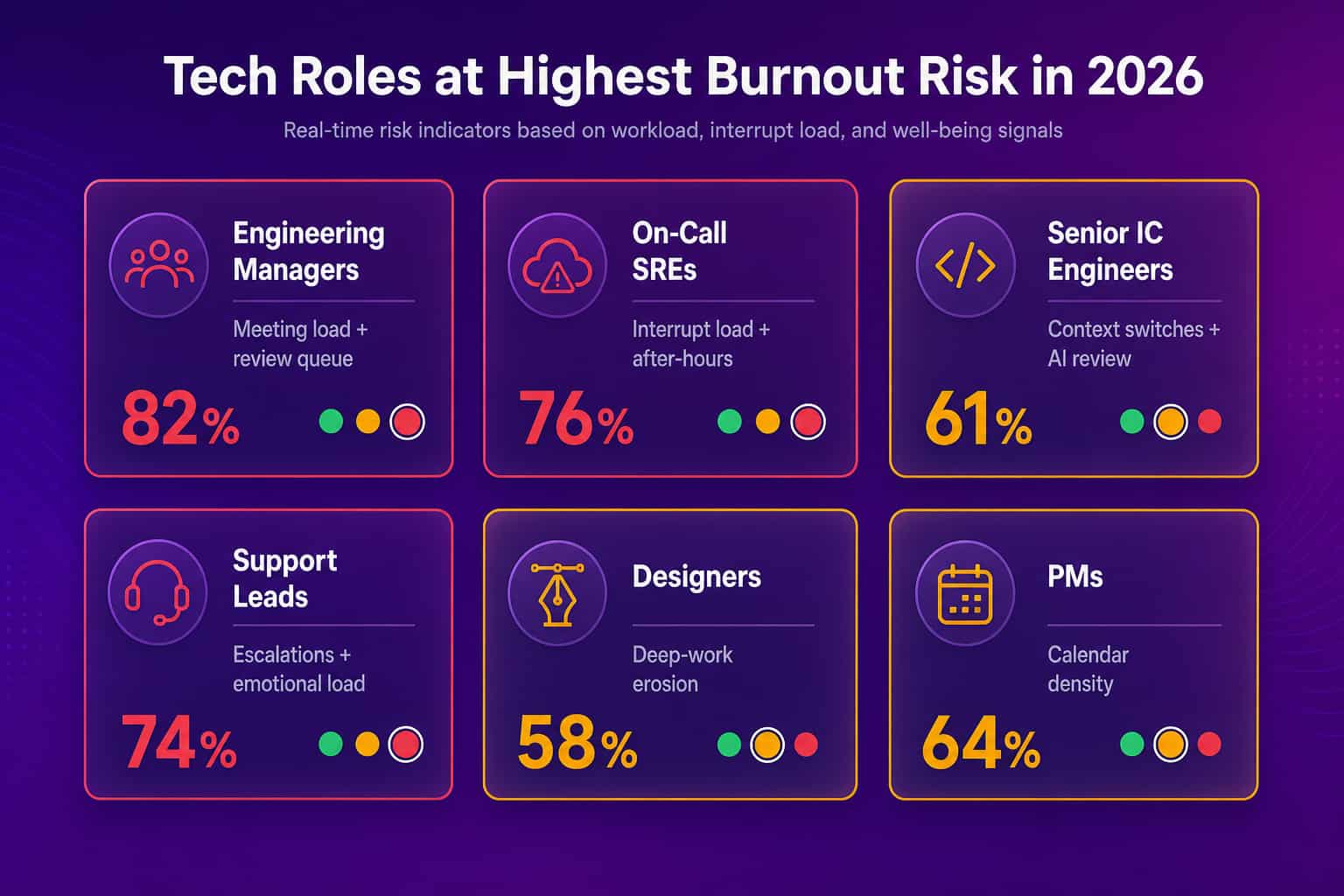
The tech roles that burn out fastest in 2026 are predictable once you look at the work signal under each title. Engineering managers carry the worst combination of any role in tech, calendar density of 60 to 80% in meetings, plus a review queue, plus emotional load from 1:1s and performance conversations. On-call SREs and platform engineers run interrupt-driven days where deep work is impossible by design. Customer support and CS leads carry escalations across time zones with no recovery window. Senior IC engineers are now the de facto AI reviewers, spending their day reading Cursor and Claude Code output instead of building, which feels less satisfying than writing the code themselves. Product managers, especially in 50 to 500-person companies, run across five tools (Jira, Linear, Figma, Notion, Slack), and the context switching itself is the load. None of these are surprising. What surprises leaders is the signal pattern is the same across all five.
Why these jobs burn out (and it is not "just hard work")
The structural reason these roles are burnout jobs is that four work-pattern signals quietly compound on each other until the person tips over. Meeting load climbs week over week and crosses 60% of the workweek somewhere around month two. After-hours work creeps in because the only quiet block left is 9 PM to midnight. Deep-work blocks (45 minutes or longer of uninterrupted focus) shrink from 8 a week to 2 a week, and the person stops noticing because everyone else's calendar looks the same. Then collaboration starts dropping, fewer messages, fewer reviews, fewer 1:1s attended, and that is the signal the person has emotionally checked out. None of these are visible on a survey until it is too late, and none of them require any kind of screen monitoring to detect. They are visible in calendar, email metadata, Slack metadata, and Git activity that already lives in the systems you run today.
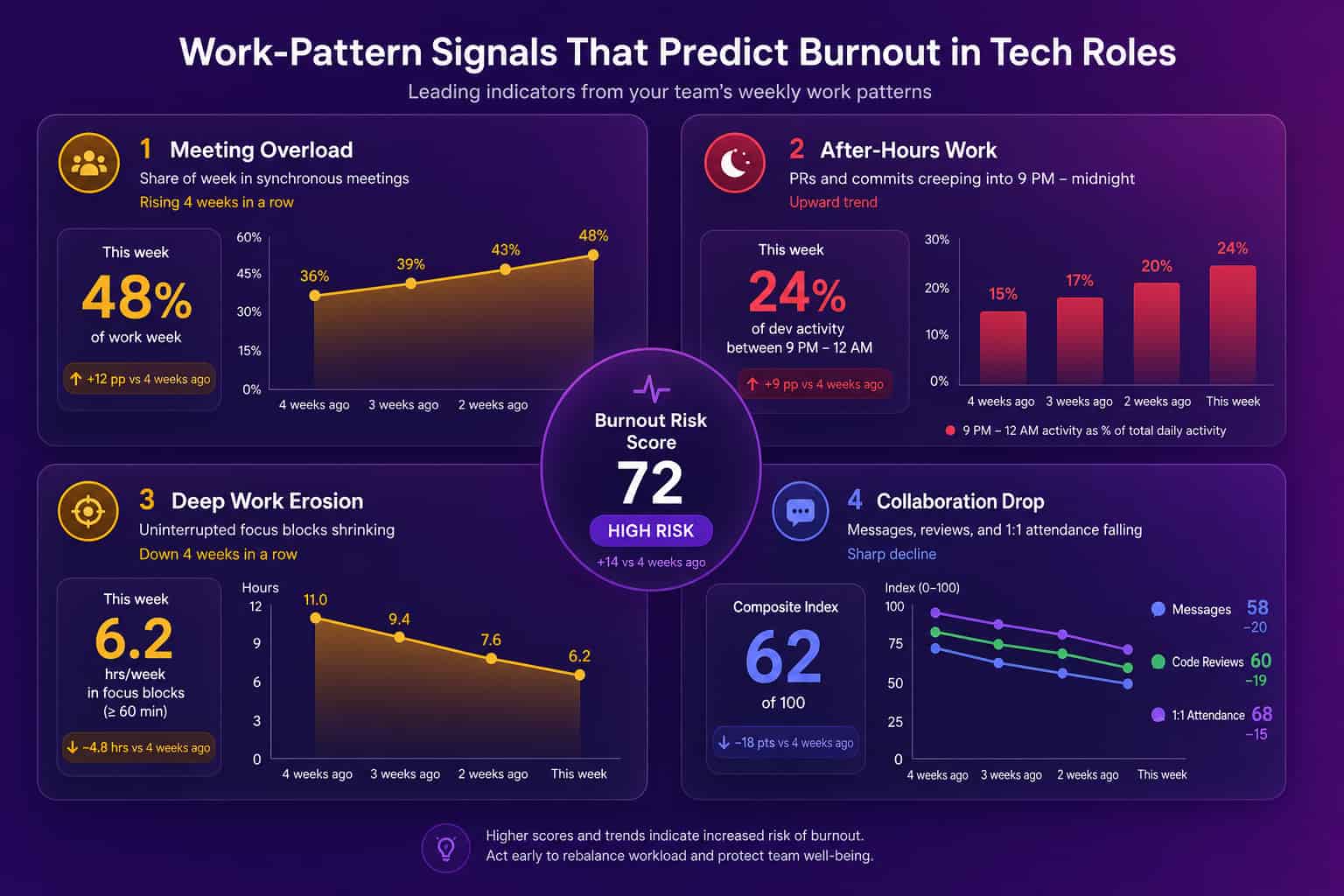
This is the part that traditional burnout content misses. The role is not the problem. The pattern under the role is the problem. Two engineering managers with the same job title at the same company can have wildly different burnout risk profiles, and the data shows it long before HR notices.
How tech leaders catch burnout 60+ days early
The leaders who get ahead of burnout in burnout jobs do three things their peers do not. They stop treating engagement surveys as a leading indicator (they are a lagging one). They connect work-pattern data from the tools the team already uses (Google Workspace, M365, GitHub, Jira, Slack) into a single view per person and per team. And they act on the early signals at the manager level, not the HR level, because manager-level interventions (rebalancing on-call, killing a recurring meeting, redistributing review load) are the only ones that move the pattern. Abloomify is built for this exact loop. The 100+ API integrations connect to the systems already in place, the privacy-first device agents add aggregated app usage (no screenshots, no keyloggers, no screen recording), and the AI People Manager surfaces burnout risk to the right manager 60+ days before someone hands in notice. The architecture is PII-free by design, so engineers do not push back the way they would on ActivTrak or Insightful.
If you want the longer playbook for how this works in practice, we wrote a full burnout-detection guide for remote teams and a ranked list of burnout-detection solutions that covers the category beyond Abloomify.
What to measure (and what to ignore) in burnout jobs
For each burnout job in tech, the measurement set is short. Track meeting load as a percentage of the workweek, after-hours work as a share of total work, deep-work block count per week (45+ minutes uninterrupted), collaboration volume (messages and reviews) trended week over week, and on-call interrupt frequency for the roles where it applies. Ignore screen time, idle time, mouse movement, and "active vs passive" classifications. Those numbers fueled the ActivTrak and Time Doctor product roadmaps for a decade and produced zero peer-reviewed evidence that the resulting reports made anyone less burnt out. The Personnel Psychology meta-analysis on surveillance is clear, monitoring does not improve performance. The 2026 research finding that 1 in 6 workers would quit over surveillance is the same problem from the other side. The cost of installing a screenshot tool in a tech company in 2026 is usually higher than the cost of the burnout it claims to solve.
Two leaders, same role, same headcount. One uses pattern data and a manager-level intervention loop. The other uses surveys and screenshots. Six months later, one has lower turnover and steadier shipping velocity. The other has a churned senior engineer and a Glassdoor problem. Big companies bring ceremony. Small companies bring patterns.
FAQ
Are burnout jobs the same across industries in 2026?
No. Nurses, teachers, and lawyers still top the cross-industry burnout job lists in 2026, and the drivers there are emotional load and shift structure. In tech specifically the drivers shift to calendar density, on-call interrupt patterns, and AI review load. The job titles change but the underlying pattern (no recovery window) is the same.
Can monitoring tools fix burnout in tech burnout jobs?
No, and they usually make it worse. There is no peer-reviewed evidence that surveillance monitoring improves performance, per the Personnel Psychology meta-analysis. 1 in 6 workers say they would quit over surveillance, per 2026 research. Privacy-first workforce intelligence (Abloomify's category) is the inversion, pattern signals without screen capture, so engineers do not push back.
Why is engineering management the worst burnout job in tech right now?
Because the role has the worst combination of meeting density, review load, and emotional 1:1 work, and very little structural support. We covered the structural fix in how to reduce middle management without losing performance. The short version, you do not fire managers, you redistribute the synchronous load that is killing them.
How does Abloomify detect burnout without screenshots or keyloggers?
By reading metadata, not content. The 100+ API integrations and optional device agents collect aggregated work patterns (meeting density, after-hours commits, deep-work block counts, collaboration volume) from systems your team already uses. PII-free by architecture. No email content, no message content, no screen recording. Burnout risk gets flagged 60+ days before someone resigns, per our AI People Manager outcomes. See the burnout detection solution page for the full picture.
What is the fastest way to find burnout risk in my team this quarter?
Run a 30-day diagnostic. Connect Google Workspace or M365 and your Git repo, let Abloomify surface meeting load, after-hours work, deep-work erosion, and collaboration drop per person and per team. If we find nothing actionable, no further obligation. Request a demo and we will scope the pilot.

Amir Tavafi
Co-Founder & CEO
Product leader and innovator with over 15 years of experience in the tech sector, grounded in AI and robotics. Previously led product development in fraud detection and AI solutions at Nasdaq Verafin.