Async Communication: What Works and What to Keep Live
November 9, 2026
Amir Tavafi
10 min read

Async communication means the sender and the receiver do not have to be online at the same moment, and when a team does it well, a lot of meetings quietly disappear. When it goes badly, you get the same meetings plus a pile of unread threads. I have seen both at Abloomify, and the difference was never the tool. It was whether anyone decided what belongs in writing.
Key Takeaways
Q: What is async communication?
A: Async communication is any exchange where the reply does not have to happen in real time. A written update, a shared doc with comments, a recorded walkthrough, and a pull request review all qualify. The receiver answers when they have the focus to do it properly.
Q: Does async communication replace meetings?
A: No. It replaces the meetings that exist only to move information from one head to another. Conflict, brainstorming, and sensitive feedback still work better live. The goal is a smaller number of better meetings, not zero.
Q: Why does async communication fail on most teams?
A: Teams adopt the tools without the rules. Nobody agrees on response times, what goes in writing, or where decisions get recorded. Messages pile up, people feel they must watch Slack all day, and the team ends up with the cost of both modes.
Q: How do you know it is working?
A: Meeting hours per person should fall, uninterrupted focus time should rise, and pull request review wait should not grow. Abloomify measures these from calendar, GitHub, and Jira signals, which are PII-free, so nobody reads anyone's messages.
What is async communication?
Async communication is any exchange where the sender and the receiver are not required to be present at the same time, so the reply can come minutes, hours, or a day later. Email is the oldest example. In a modern team it also includes written status updates, decision documents with comments, recorded video walkthroughs, comments on a Jira ticket, and a pull request with its review thread. The defining feature is the gap between message and reply, and the point of that gap is that the receiver chooses when to respond. That choice is what protects focus time. Synchronous communication is the opposite: a meeting, a call, or a live chat where both people are there and the reply is expected right now. Most teams use both, whether they planned to or not.
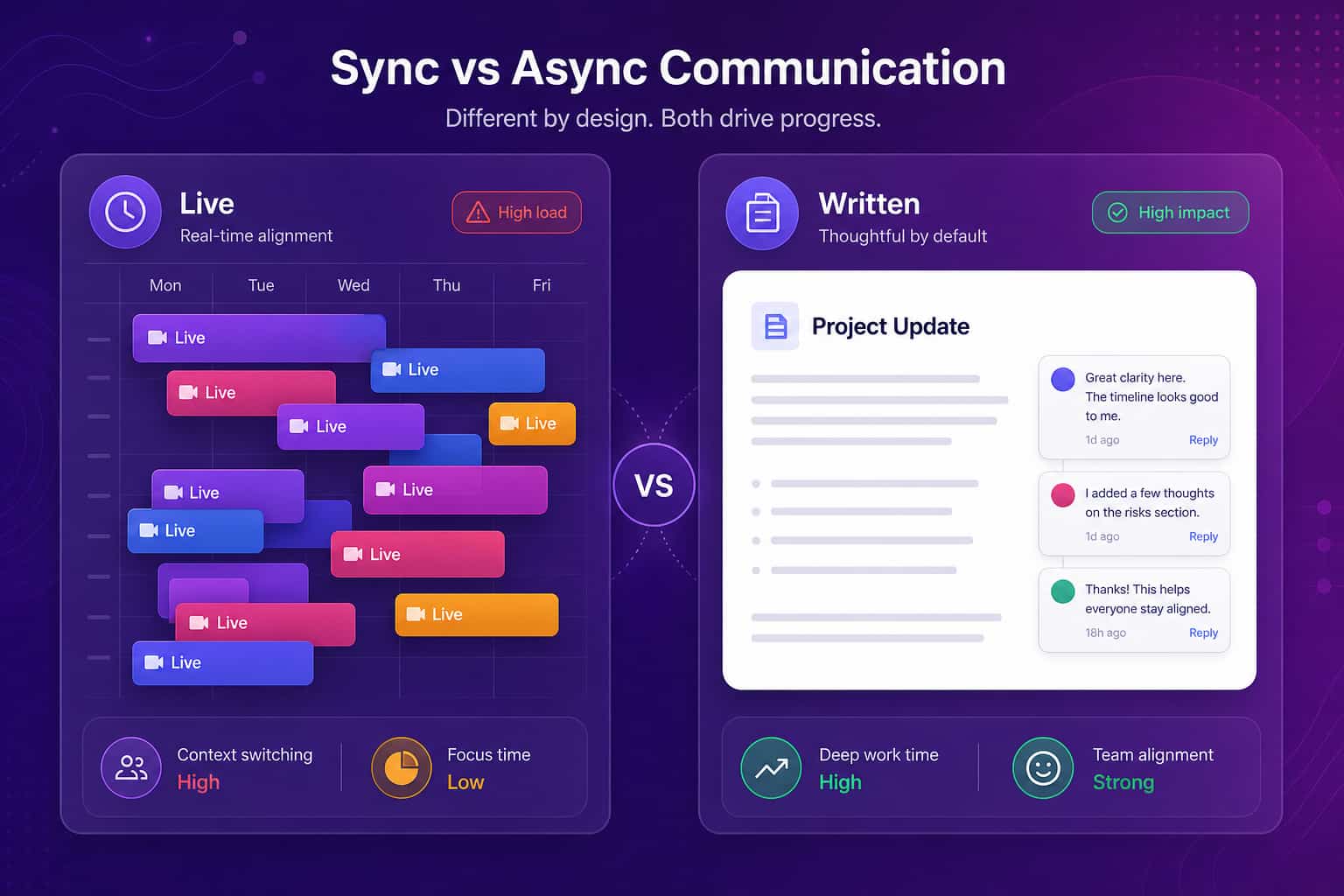
A useful way to think about it: sync buys speed on ambiguous problems and costs everyone's attention at once. Async buys focus and a written record and costs some speed. Neither is better. The skill is matching the mode to the job.
When should you use async communication instead of a meeting?
Use async communication when the content is information, not negotiation. If the goal is to tell people something, collect input that needs thought, or record a decision, a written format usually works better than a live call. Status updates are the clearest case. A 30-minute standup where eight people each say what they did is a transfer of information that could be read in two minutes. Reviews work well in writing too, because the reviewer can read carefully instead of reacting in real time. Time zones push the same direction: if two people overlap for two hours a day, spending those hours on updates wastes the only window you have for the conversations that need voices.
Keep it live when the situation is emotional, unclear, or high stakes. Conflict, brainstorming, a difficult piece of feedback, or a project that has gone sideways all need tone and quick back-and-forth. Writing a long message to resolve a disagreement mostly produces a longer disagreement.
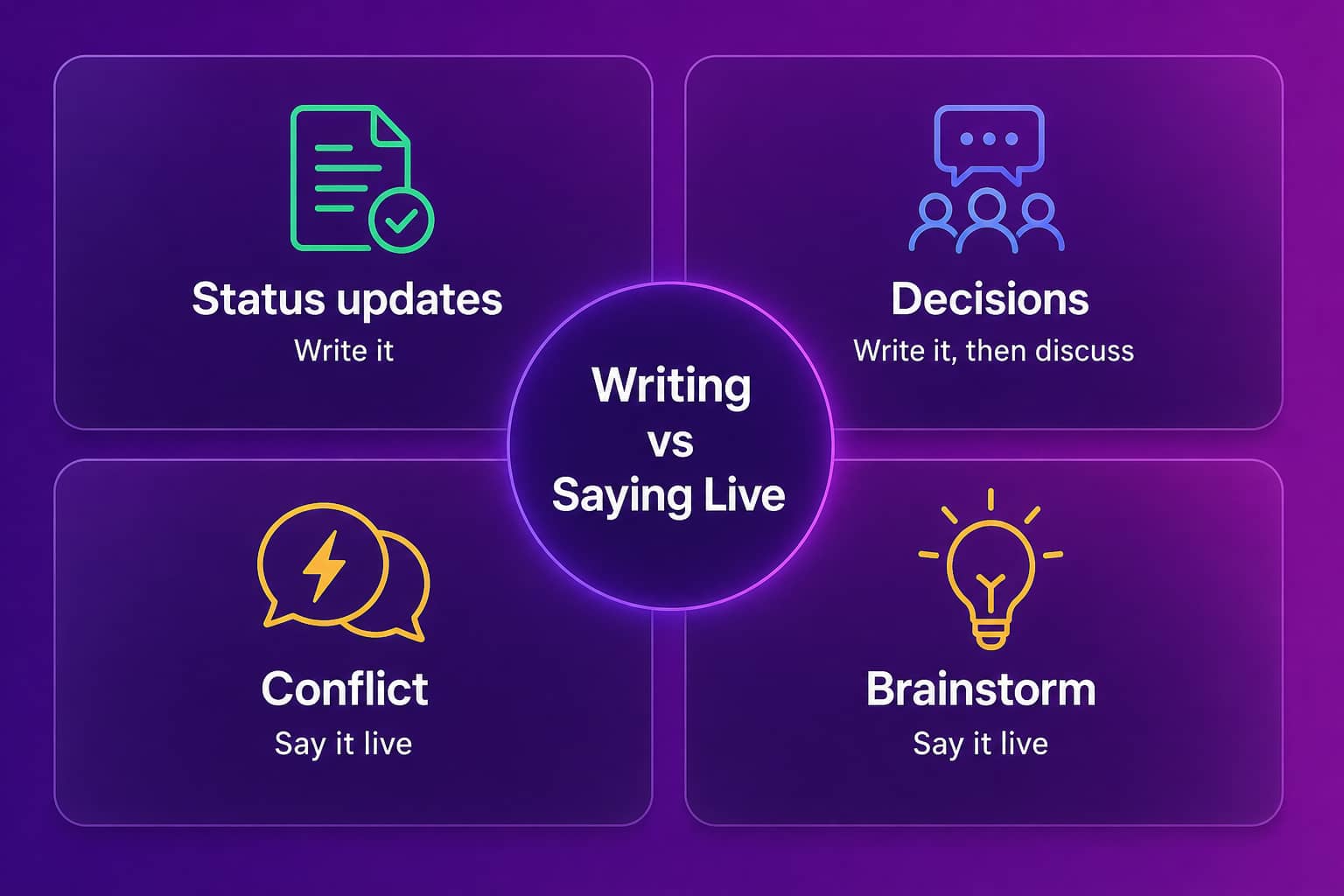
My rule of thumb is simple. If the message could be sent as a doc and nobody would be hurt by waiting a day, write it. If you would want to see the other person's face when they read it, call them.
What are good examples of async communication?
Good examples are the ones where the writing does real work: a weekly update with a clear ask, a decision doc with a deadline for comments, a pull request description that explains the why, a ticket comment that names the blocker, and a short recorded walkthrough for something that would take ten minutes to type. What these have in common is that the receiver can act without asking a follow-up question. A message that forces a reply of "what do you mean?" has turned an async exchange into a slow sync one, which is the worst of both.
| Situation | Async format | Why it works |
|---|---|---|
| Weekly progress | Written update in a shared doc | Read in two minutes, searchable later |
| Choosing between options | Decision doc with comment deadline | People think before they react |
| Code changes | PR description plus review comments | Context and feedback live next to the code |
| Blocked work | Ticket comment naming the blocker and owner | No meeting needed to unblock |
| Complex how-to | Short recorded walkthrough | Faster to show than to type |
Engineering teams have run on async for years without calling it that. A pull request is a written proposal, a review is a written response, and the merge is the decision. The trouble starts when the review sits for three days. That is an async process with no response-time rule, and it shows up directly in PR cycle time.
What rules make async communication work?
Async communication works when the team agrees on four things in writing: what goes in writing, how fast people are expected to respond, where decisions get recorded, and what counts as urgent. Without those four, async turns into constant partial attention, because everyone assumes a message might be urgent and checks all day. With them, people can close the chat window for two hours and trust nothing is on fire. Set response windows by type of message, not by tool. A pull request review might get one business day. A question in a thread might get a few hours. A real emergency goes to a phone call, and the team should know exactly what an emergency is.
Here is what I would write down on day one:
- Updates, decisions, and reviews go in writing. Conflict and brainstorming go live.
- Every thread that ends in a decision gets a one-line summary in a place people can find later.
- Response windows are named: same day for questions, one business day for reviews.
- Urgent means a phone call, and the definition fits on one line.
It sounds almost too basic. Most teams I talk to have never written any of it down, and then wonder why Slack feels worse than meetings.
How do you measure whether async communication is working?
Measure it with three signals: meeting hours per person, uninterrupted focus blocks, and review wait time on pull requests. If async is working, meeting hours go down, focus blocks get longer, and review wait does not grow. If meeting hours fall but review wait doubles, you have not gone async, you have just slowed down. Look at these at the team level, not per person. Abloomify reads these from calendar, GitHub, and Jira data through API integrations, and it does this PII-free, so there is no message reading, no screenshots, and no keyloggers. Teams get the trend without anyone feeling watched, which matters more than it sounds. Measuring async by reading people's chat would kill the trust the whole practice depends on.
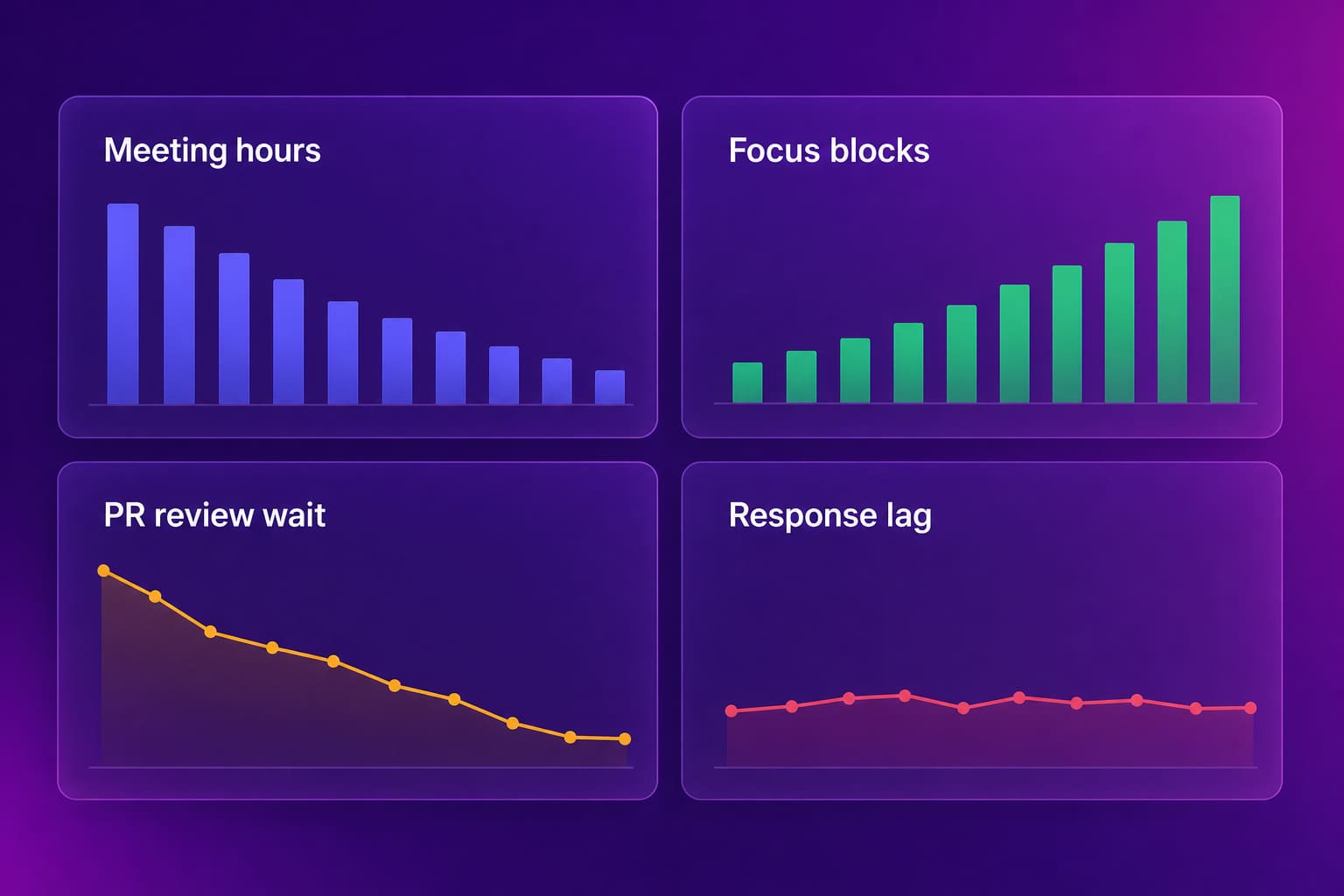
The dashboard above is illustrative, but the shape is what you want to see. Our meeting optimization software page covers the calendar side, and the meeting cost calculator is a quick way to put a dollar figure on the meetings you are hoping to replace. On the engineering side, engineering productivity analytics shows PR cycle time and review health, which is where async either holds up or falls apart.
What mistakes make async communication backfire?
The most common mistakes are going async on everything, never setting response times, and letting decisions get buried in threads. Going async on everything is the overcorrection: a team cancels all its meetings, discovers that hard conversations got worse, and brings them back. No response times means people stay on alert. Buried decisions mean the same question gets asked three weeks later, which is a meeting with extra steps. One more I have seen often: leaders announce the shift but keep scheduling live check-ins for themselves. People copy what the leader does, not what the memo says. If you are cutting status meetings, our guides on reducing status meetings by 50 percent and why meeting-free days fail cover the traps in detail.
I should be honest that async is not free. It takes longer to write a good update than to say it, and some people hate writing. Some days I still pick up the phone because a Slack thread was going nowhere. That is fine. The goal is to choose on purpose.
If you want to see where your team's time actually goes before changing anything, book a demo and we will look at your calendar and engineering signals together.
FAQ
What is the difference between synchronous and asynchronous communication?
Synchronous communication happens in real time, such as a meeting, a call, or a live chat where both people are present. Asynchronous communication has a gap between message and reply. Sync is faster for ambiguity and conflict. Async is better for updates, decisions that need thought, and anything spanning time zones.
Is async communication better than meetings?
Not always. Async is better for status updates, reviews, and decisions that benefit from time to think. Meetings are still better for conflict, brainstorming, and sensitive conversations. Most teams get the best result by moving updates to writing and keeping live time for the things that need it.
What are examples of async communication?
Common examples are a written weekly update, a decision doc with comments, a recorded walkthrough, a pull request review, a comment thread on a Jira ticket, and an email. In engineering, a PR description plus review comments is probably the most widely used async workflow in the world.
How do you measure whether async communication is working?
Watch meeting hours per person, uninterrupted focus blocks, and review wait time on pull requests. If meeting hours fall and focus time rises while review wait does not grow, the shift is working. Abloomify reads these signals from calendars, GitHub, and Jira without reading message content.
How fast should people respond to async messages?
Set the window by message type. Many teams use same day for questions and one business day for reviews. Anything urgent should go to a phone call. The exact numbers matter less than writing them down, so nobody has to guess whether a message is waiting on them right now.

Amir Tavafi
Co-Founder & CEO
Product leader and innovator with over 15 years of experience in the tech sector, grounded in AI and robotics. Previously led product development in fraud detection and AI solutions at Nasdaq Verafin.