AI Leadership: How Tech Leaders Actually Run Teams With AI (2026)
June 15, 2026
Amir Tavafi
11 min read

AI leadership is the practical skill of running a team when AI does a growing share of the work, and judgment becomes the scarce resource. Forget the certificate programs. The real test is a question a VP of Engineering now has to answer every sprint: who actually moved the needle, the human or the agent? Abloomify is built for that question, and the leaders who win treat AI as something to measure, not something to trust on faith.
Key Takeaways
Q: What is AI leadership?
A: AI leadership is the skill of running a team when AI does part of the work. It means deciding where to trust AI, measuring whether AI tools improve output, and keeping human judgment on the decisions that matter. It is a management discipline, not a prompt-engineering trick.
Q: What skills does an AI leader actually need?
A: Judgment under uncertainty, the habit of reading evidence over demos, comfort separating human work from AI output, and the discipline to lead AI adoption without surveillance. The named tools change every quarter. The ability to tell signal from hype does not.
Q: Will AI replace managers?
A: No. AI is eating the admin that fills a leader's week, like status chasing and deck building. It is not replacing coaching, accountability, or judgment. The leaders who only did the admin are exposed. The ones who do the real work get more valuable.
Q: How do you measure AI's impact on a team?
A: Tie AI tool usage to delivery output. Abloomify correlates Cursor, GitHub Copilot, and Claude Code usage with velocity, and separates human contribution from AI agent contribution across code and reviews, so AI ROI becomes a defensible number instead of a vendor claim.
What is AI leadership?
AI leadership is the practice of running a team effectively when AI handles a meaningful share of the work, which makes human judgment the bottleneck and the differentiator. It breaks into three jobs that most leaders are now doing whether they have named them or not. First, deciding where AI should be trusted and where a human stays in the loop, because the cost of a confident wrong answer scales with the decision. Second, measuring whether the AI tools you bought actually move output, instead of assuming they do because the demo was impressive. Third, keeping the team's trust while you push for the productivity gains, which is harder than it sounds once people sense that software is watching them. None of this is technical. It is management, applied to a workforce where some of the contributors are agents.
The reason this is suddenly a distinct skill is that the old version of leadership assumed every unit of work came from a person you could coach. That assumption is breaking. When an engineer ships a feature, part of the diff came from Cursor or Claude Code, part came from their own judgment about what to keep. A leader who cannot see that split is flying blind on their most important question: where is the leverage actually coming from, and where is it leaking?
The leader's job is changing, not disappearing
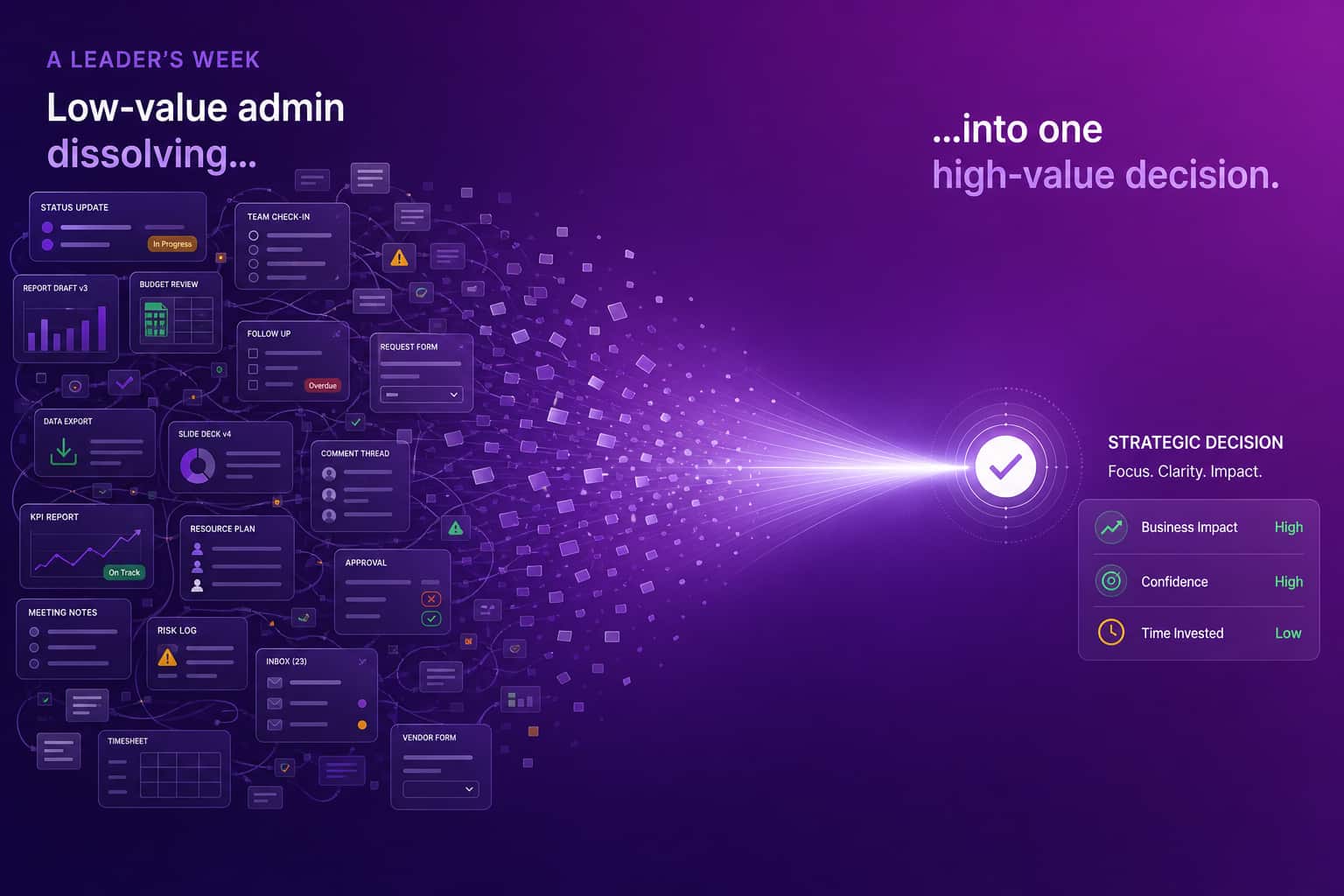
The fear that AI replaces managers gets the direction exactly backward, because AI is automating the part of leadership that was never leadership in the first place. When we started Abloomify, I thought we were building software for managers. The longer we ship, the clearer it gets that most of a manager's week is admin in disguise: chasing people for updates, copy-pasting metrics into decks, turning meeting notes into action items, filling review forms with things they already knew, and digging across five tools to answer a basic question like who is overloaded right now. That work feels like leadership because it fills the calendar. It is not. AI is very good at all of it, and that is good news for anyone whose job was actually the harder part.
What remains is the work that does not automate. Deciding what to build and what to kill. Telling a person a hard truth about their performance and helping them fix it. Holding a line on quality when the pressure is to ship. Reading a confident AI summary and asking the one question that exposes its weak assumption. These are judgment calls, and judgment is where leaders earn their keep.
There is a trap on the other side too. AI is good at making you feel confident about a weak decision, because a fluent answer reads as a correct one. The skill is to challenge the response, especially on the calls that matter, and to not bias your prompts toward the conclusion you already wanted. That habit, more than any tool choice, separates leaders who use AI well from leaders who get used by it.
What AI-native leaders actually measure
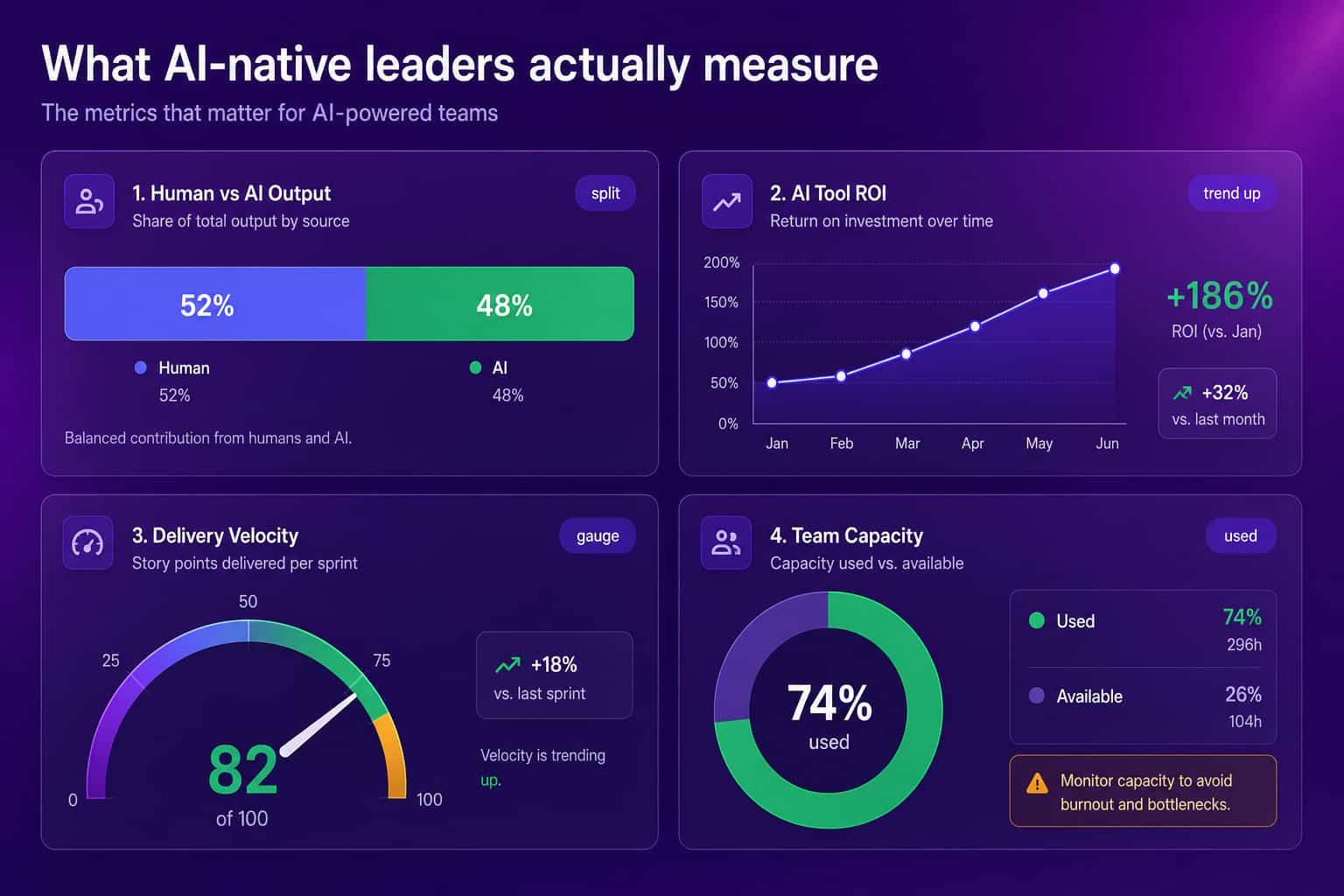
AI-native leaders measure outcomes, not activity, and the single most important new measurement is the split between human contribution and AI agent contribution. When part of every pull request comes from an AI coding tool, the old proxies for productivity stop meaning what they used to. Lines of code, commit counts, and ticket throughput all inflate when an agent is doing the typing, so a leader who tracks them ends up rewarding volume that an AI generated and a human barely reviewed. The better questions are sharper: is delivery velocity actually improving, are the AI tools we pay for correlated with that improvement, and which engineers are using AI to amplify good judgment versus to ship more unreviewed code. Abloomify connects to GitHub, GitLab, Jira, and AI coding tools like Cursor, GitHub Copilot, and Claude Code to answer exactly those questions, and it separates human work from agent work across tasks, code, and reviews so the picture is honest.
This is where most AI ROI claims fall apart. A vendor tells you their tool makes engineers 30% faster, and you have no way to check it against your own delivery data. Closing that gap is the difference between a board conversation built on evidence and one built on a slide. Our guide to measuring AI adoption impact goes deeper on connecting tool usage to output, and the same logic applies to measuring engineering velocity without crushing morale.
Why AI leadership fails without trust
AI leadership fails the moment a team decides the technology is being pointed at them instead of used to help them, and that is the most common way it goes wrong. The instinct, when a leader wants visibility into AI's impact, is to reach for monitoring: screenshots, keyloggers, activity scores. It backfires. Around 1 in 6 workers say they would quit over workplace surveillance, per 2026 survey research, and a Personnel Psychology meta-analysis found no evidence that monitoring improves performance. So the leader spends trust they cannot get back and gets worse data in return, because anxious people game whatever is being measured. The harder, better path is to get the same visibility from work signals that already exist, like delivery data, collaboration patterns, and capacity, without capturing what anyone typed or read. That is the privacy-first approach, and it is the only version of AI leadership that survives contact with a real team.
The stakes are not abstract. The waste you are trying to find is real money, and the trust you risk losing is what makes the team worth leading in the first place.
Abloomify is PII-free by architecture, with no screenshots, no keyloggers, and no content capture, because the goal is visibility a leader can defend to their team, not a feed they have to hide. The same principle is why privacy-first analytics protect leadership trust instead of eroding it.
The skills that separate AI-native leaders
The skills that separate strong AI leaders are not technical, and they are learnable. The leaders who run AI-heavy teams well share a recognizable profile, and it has very little to do with how many tools they can name.
- Judgment over fluency. They treat a confident AI answer as a draft to challenge, not a conclusion to accept, especially on high-stakes calls.
- Evidence over demos. They ask what a tool did to their actual delivery numbers, not how good the vendor's pitch looked.
- Comfort with the human-AI split. They want to see which output came from a person and which came from an agent, because that is where leverage and risk both live.
- Trust as a constraint, not an afterthought. They get visibility without surveillance, because they know a team that feels watched stops volunteering its best work.
- Bias toward killing busywork. They aggressively automate the admin so their people spend time on judgment, not on status updates and form-filling.
- Willingness to try the new tool. The big platforms are slower than they look, and the leaders who give smaller AI-native tools a real chance often find the better leverage first.
Notice what is not on the list: prompt-engineering certificates, a favorite model, or a position on whether AI is overhyped. Those are table stakes or distractions. The durable skill is reading reality clearly and acting on it, which is what good leadership always was.
How to start practicing AI leadership
To start, pick one question you currently answer with a guess and make it answerable with data. The most useful starting point for an engineering leader is the AI ROI question, because it is concrete and the spend is already on your books. Connect your GitHub and your AI coding tools, look at whether usage correlates with delivery, and separate the human contribution from the agent contribution so you know where the real leverage is. For an operations leader, start with capacity: find out where work is actually leaking before you make another headcount or tooling decision. Either way, you are replacing a confident opinion with evidence, which is the whole job. Bloomy, Abloomify's company-aware AI assistant, can answer those questions over your connected data, and our piece on why CEOs need an AI Chief of Staff covers how that role works in practice.
The leaders who will struggle are the ones waiting for AI to feel finished before they lead with it. It will not feel finished. It will stay double-edged and uneven for years, and the job is to lead through that, not around it. Measure what matters. Protect the trust. Kill the busywork. The rest is still leadership.
FAQ
What is AI leadership?
AI leadership is the skill of running a team when AI does a growing share of the work. It covers three jobs: deciding where AI should and should not be trusted, measuring whether AI tools actually improve output, and keeping human judgment in the loop on the decisions that matter. It is a management discipline, not a technical one.
What are AI leadership skills?
The core skills are judgment under uncertainty, reading evidence instead of demos, comfort separating human work from AI output, and the discipline to lead AI adoption without surveillance. Strong AI leaders challenge confident-sounding answers, tie tool spend to results, and protect team trust while pushing for real productivity gains.
Will AI replace leaders and managers?
No. AI is automating the admin that fills a leader's calendar, like status chasing, deck building, and meeting summaries. It is not replacing coaching, accountability, or judgment calls. The leaders most exposed are the ones whose week was entirely busywork. The ones doing the harder, unautomatable work get more valuable as AI clears the noise.
How do leaders measure AI ROI?
Tie AI tool spend to measurable output. Abloomify connects to GitHub, Jira, and AI coding tools like Cursor, GitHub Copilot, and Claude Code to correlate usage with delivery velocity, and it separates human contribution from AI agent contribution across code and reviews. That turns AI ROI from a vendor claim into a number a leader can defend.
How does Abloomify support AI leadership?
Abloomify is privacy-first workforce intelligence that shows leaders productivity, capacity, engineering velocity, and AI tool ROI without screenshots or keyloggers. Its AI assistant, Bloomy, answers leadership questions over connected company data. It is PII-free by architecture, so leaders get the visibility they need without the trust damage that monitoring tools cause.

Amir Tavafi
Co-Founder & CEO
Product leader and innovator with over 15 years of experience in the tech sector, grounded in AI and robotics. Previously led product development in fraud detection and AI solutions at Nasdaq Verafin.