AI in the Workplace: What It Actually Changes in 2026
June 24, 2026
Amir Tavafi
12 min read

AI in the workplace stopped being a forecast and became a fact sometime in the last two years, and most companies still cannot tell you what it changed. Part of every engineer's pull request now comes from Cursor or Claude Code. Drafts, summaries, and first passes across the company start as AI output. Abloomify exists because the important question is no longer whether AI is at work. It is how much of the work is AI, where it adds leverage, and where it quietly leaks value nobody is tracking.
Key Takeaways
Q: What does AI in the workplace mean in 2026?
A: It means AI tools and agents doing real work alongside people: code, reviews, drafts, summaries, and analysis. The new fact is that output is now a blend of human and AI contribution, which is why measuring that split matters more than debating whether AI belongs at work.
Q: What are the real benefits of AI at work?
A: Speed on routine tasks, fewer hours lost to admin, and faster first drafts in engineering and knowledge work. The benefits are real but usually assumed. Abloomify ties AI tool usage to delivery output so the gain becomes a number, not a vendor claim.
Q: Will AI replace workers?
A: AI is replacing tasks faster than jobs, mostly repetitive admin and first-draft work. The roles most exposed were mostly busywork. Judgment, coaching, and accountability do not automate, and they get more valuable as AI clears the noise around them.
Q: How do you measure AI's impact on work?
A: Connect the tools where work happens and correlate AI usage with output. Abloomify separates human contribution from AI agent contribution across code and reviews, and ties Cursor, GitHub Copilot, and Claude Code usage to velocity, so AI ROI is measurable.
What does AI in the workplace actually mean?
AI in the workplace means using AI tools to do or assist the actual work of a company, from writing and reviewing code to drafting documents, summarizing meetings, answering questions over business data, and analyzing operations. The phrase covered chatbots and pilots a few years ago. In 2026 it usually means something sharper: AI agents producing work that ships, not just suggestions a person might glance at. When an engineer merges a feature, some of that diff came from an AI coding assistant and some came from their own judgment about what to keep. When an analyst produces a report, the first draft was often generated and then edited. The work is now a blend, and the practical consequence is that the old unit of measurement, one person doing one unit of work, no longer describes what is happening. That is the real shift, and it is why "is AI in the workplace" is the wrong question and "how much, and to what effect" is the right one.
The hype cycle makes this harder to see clearly. Every vendor has an AI story, every feed is full of confident claims, and the noise drowns out the boring truth: AI is genuinely useful for some work, mediocre at other work, and oversold almost everywhere. A leader's job is to tell those apart with evidence instead of vibes.
Where AI shows up across the workplace
AI shows up unevenly across a company, concentrated in a few areas where it earns its keep and thin in others where the demos never matched reality. The clearest adoption is in engineering, where coding assistants like Cursor, GitHub Copilot, and Claude Code now touch a large share of the code that gets written and reviewed. Next is knowledge work, where drafting, summarizing, and research across docs, email, and calendars compress hours of routine output into minutes. Operations is quieter but real: capacity analysis, reporting, and meeting-load review that used to mean a manager living in spreadsheets. And then there is the governance layer, which most companies discover late, when they realize employees are already using AI tools nobody approved. These four areas behave differently, and a single "AI strategy" that treats them as one thing tends to over-invest in the loud parts and ignore the risky ones.
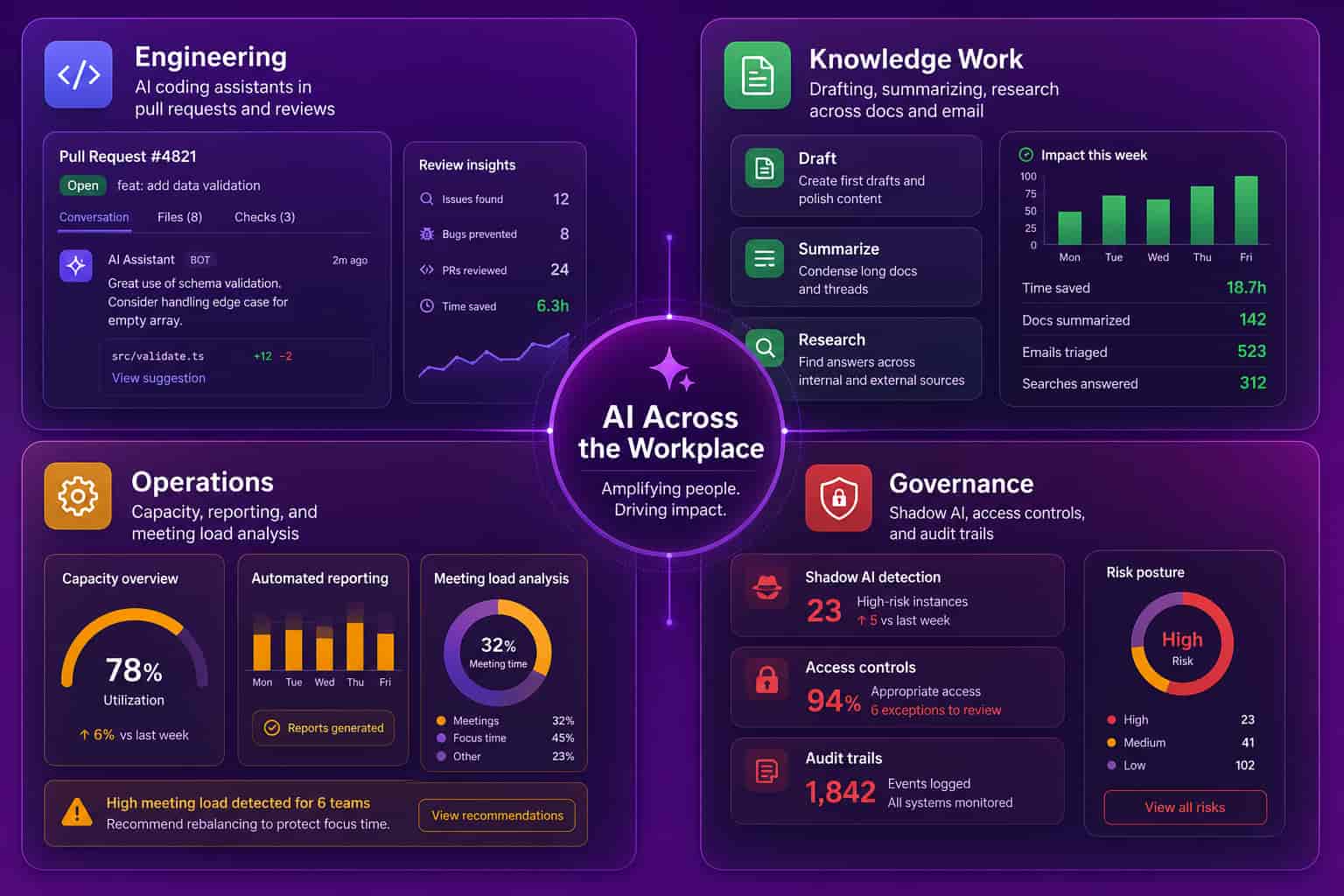
Mapped out, the landscape looks like this:
- Engineering. AI coding assistants in pull requests and reviews. The highest-adoption, highest-spend area, and the easiest to measure against delivery data.
- Knowledge work. Drafting, summarizing, and research across documents, email, and meetings. Broad but diffuse, and hard to tie to a clean output metric.
- Operations. Capacity planning, reporting, and meeting-cost analysis that AI now does continuously instead of once a quarter.
- Governance. Shadow AI, access controls, and audit trails. The area companies notice only after data has already left through an unapproved tool.
The benefits are real, and so is the hype gap
The benefits of AI in the workplace are real, and the most honest way to describe them is narrow but valuable: AI is very good at the routine first 80% of a task and weak at the judgment in the last 20%. That maps to concrete gains. Engineers spend less time on boilerplate and more on design. Managers reclaim hours that used to go to chasing updates, copy-pasting metrics into decks, and turning meeting notes into action items. Analysts skip the blank page. The pattern across all of it is the same: AI removes the busywork that fills a week and feels like work without being the work. That is a genuine productivity story, and it is why teams that adopt the right tools well do pull ahead.
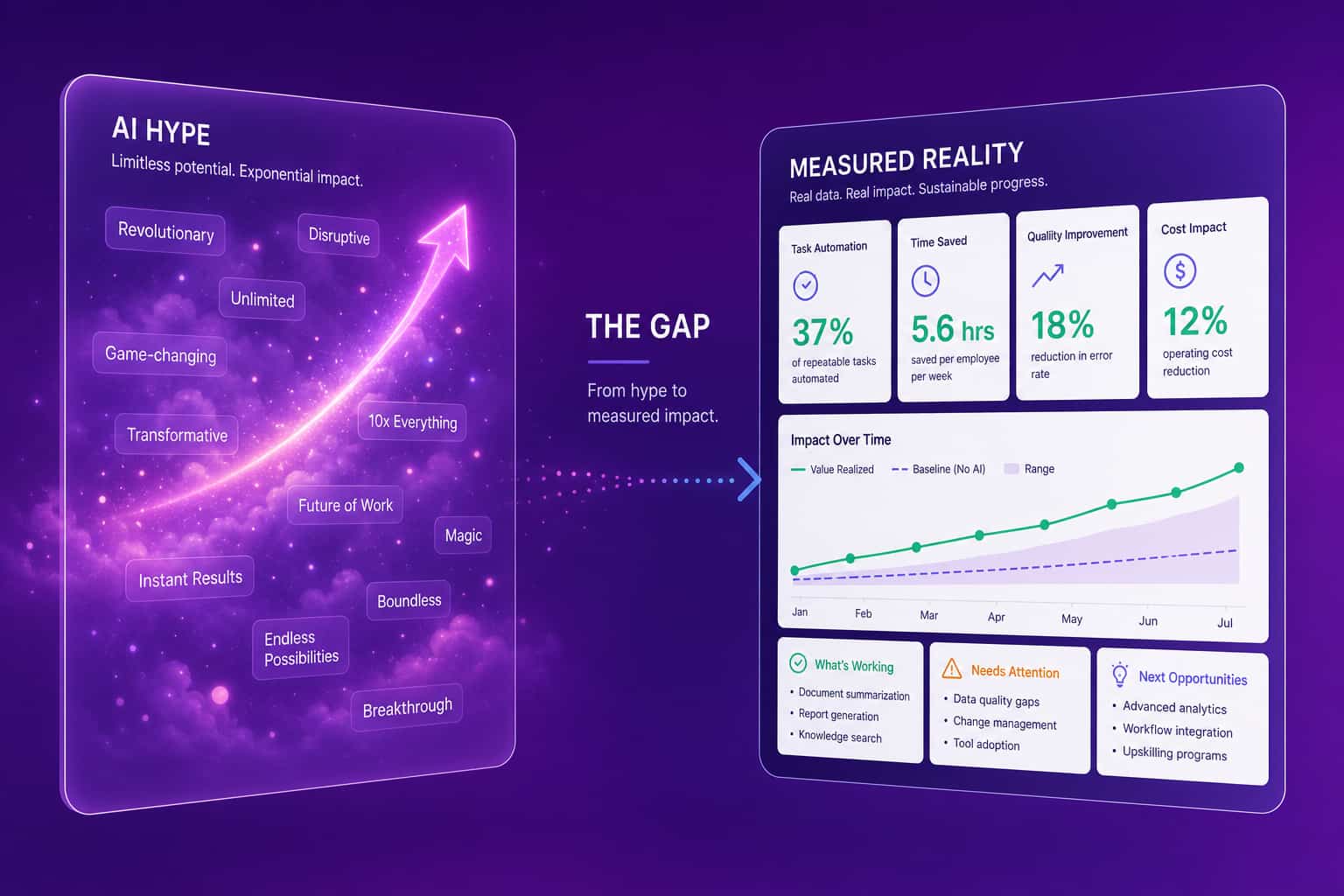
The gap is between that real benefit and the claimed one. A vendor says their tool makes engineers 30% faster, and most companies have no way to check it against their own delivery numbers, so they either believe the slide or dismiss it, and both are guesses. There is a sharper version of this worth saying out loud. In most organizations a small share of people do truly exceptional work, a slightly larger share is strong, a big middle is solid, and a meaningful tail adds little. That split was always true, demand just hid it. AI does not change the distribution, but it does expose it, because when the routine work gets automated, what is left is the judgment, and judgment is where the differences were hiding all along.
How to measure AI's impact instead of assuming it
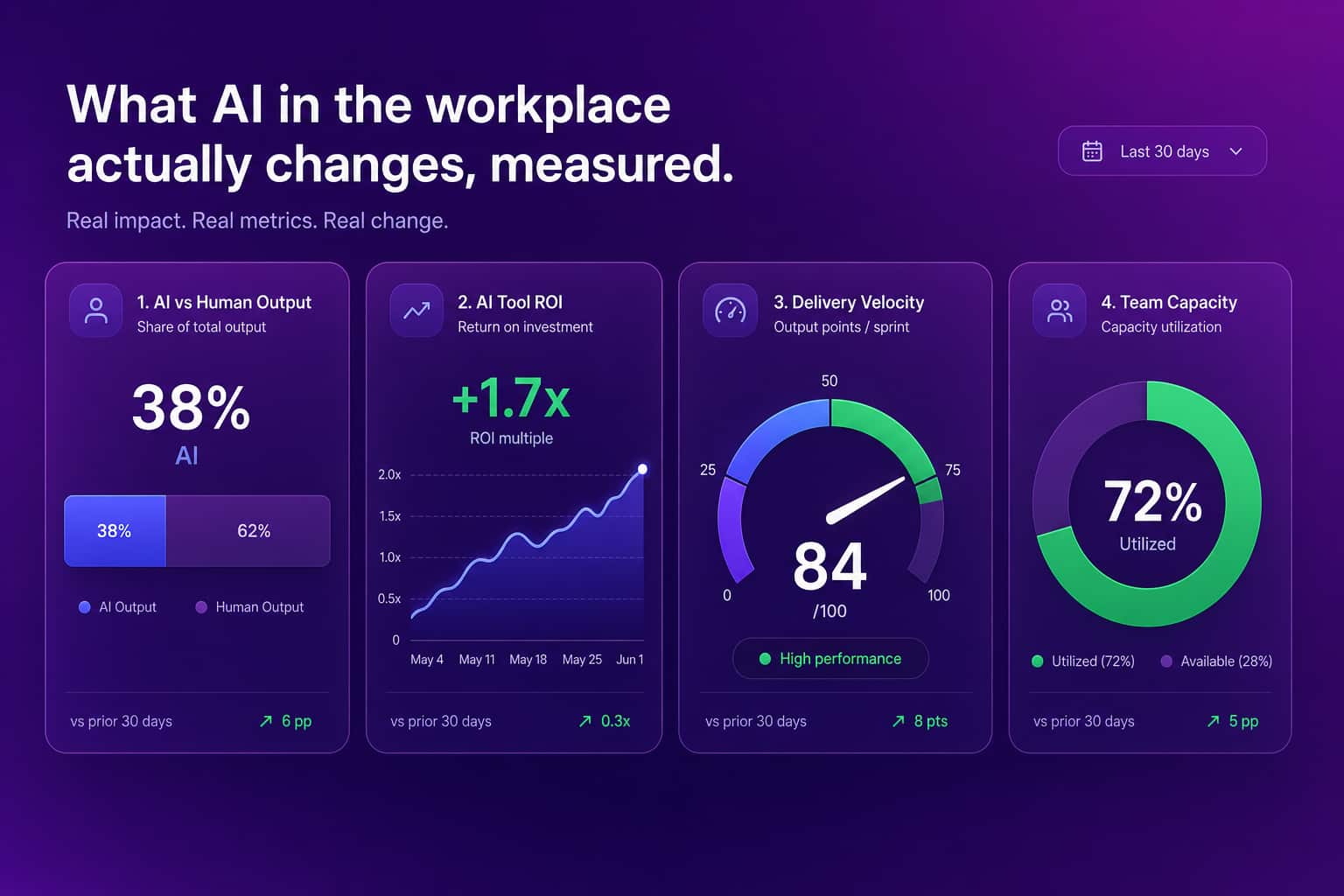
Measuring AI's impact means connecting the systems where work actually happens and tying AI usage to output, which is the one step most companies skip. The reason they skip it is that the old proxies break the moment an agent is in the loop. Lines of code, commit counts, and ticket throughput all inflate when AI is doing the typing, so a leader who tracks them ends up rewarding volume an AI generated and a human barely reviewed. The better measurements are comparative: is delivery velocity actually improving, are the AI tools you pay for correlated with that improvement, and which people are using AI to amplify good judgment versus to ship more unreviewed work. Abloomify connects to GitHub, GitLab, Jira, Google Workspace, and AI tools like Cursor, GitHub Copilot, and Claude Code, and it separates human contribution from AI agent contribution across tasks, code, and reviews, so the picture is honest instead of flattering. Our guide to measuring AI adoption impact goes deeper on the mechanics.
This is where AI ROI stops being a debate and becomes a number. When you can see usage next to output, the board conversation changes from "we think Copilot is helping" to "heavy adopters ship measurably more, here is the trend, here is the spend." The same evidence-first logic is the whole argument for measuring productivity without screenshots: you get the truth from work signals, not surveillance.
AI in the workplace fails without trust
AI in the workplace fails the moment employees decide the technology is being pointed at them instead of used to help them, and the fastest way to trigger that is to reach for surveillance. When a leader wants visibility into AI's impact, the tempting move is monitoring: screenshots, keyloggers, activity scores. It backfires twice. Around 1 in 6 workers say they would quit over workplace surveillance, per 2026 survey research, and a Personnel Psychology meta-analysis found no evidence that monitoring improves performance. So you spend trust you cannot rebuild and get worse data in return, because anxious people game whatever is being watched. The durable path is to get the same visibility from work signals that already exist, like delivery data, collaboration patterns, and capacity, without ever capturing what someone typed or read. Abloomify is privacy-first by design and PII-free by architecture, with no screenshots, no keyloggers, and no content capture, because the goal is a picture you can show your team, not a feed you have to hide.
The trust question gets bigger as AI adoption grows, not smaller. Employees are already using AI tools on their own, and a heavy-handed response pushes that usage underground into shadow AI, which is how data leaves a company through a tool nobody sanctioned. The answer is governance that enables rather than blocks, which is the case we make in what to put in an AI usage policy.
How to start measuring AI at work
The way to start is to pick one question you currently answer with a guess and make it answerable with data, because a broad "AI transformation" program almost always stalls and one concrete answer almost always compounds. For an engineering leader, the highest-value starting point is AI tool ROI: the spend is already on your books, so connect GitHub and your AI coding tools, look at whether usage correlates with delivery, and separate human contribution from agent contribution to see where the leverage actually is. For an operations leader, start with capacity and find where work is leaking before the next headcount or tooling decision. Either way you are replacing a confident opinion with evidence, which is the real skill behind running an AI-heavy company. Bloomy, Abloomify's company-aware AI assistant, can answer those questions over your connected data, and our piece on why CEOs need an AI Chief of Staff shows how that works in practice.
A 50-person SaaS customer did exactly this. Their COO had been calculating engineering and capacity numbers by hand in a spreadsheet, then checked them against Abloomify's data. The numbers matched, and the manual work disappeared. Big programs bring ceremony. One answered question brings momentum.
FAQ
What does AI in the workplace mean?
AI in the workplace means using AI tools to do or assist real work: writing and reviewing code, drafting and summarizing documents, answering questions over company data, and analyzing operations. In 2026 it usually means AI agents producing work alongside people, which is why measuring the split between human and AI contribution now matters.
What are the benefits of AI in the workplace?
The main benefits are speed on routine work, fewer hours lost to admin like status chasing and report building, and faster first drafts in engineering and knowledge work. The catch is that benefits are usually assumed rather than measured. Tying AI tool usage to delivery output turns a vendor claim into a number you can defend to a board.
Will AI replace jobs in the workplace?
AI is automating tasks faster than whole jobs, especially repetitive admin and first-draft work. The roles most exposed are the ones that were mostly busywork. The durable work is judgment: deciding what to build, telling people hard truths, and holding a line on quality. AI raises the value of that work, it does not remove it.
How do you measure AI impact at work?
Connect the tools where work happens and tie AI usage to output. Abloomify connects to GitHub, Jira, Google Workspace, and AI tools like Cursor, GitHub Copilot, and Claude Code to correlate usage with delivery velocity, and it separates human contribution from AI agent contribution across code and reviews. That makes AI ROI measurable instead of anecdotal.
How does Abloomify help with AI in the workplace?
Abloomify is privacy-first workforce intelligence that shows productivity, capacity, engineering velocity, and AI tool ROI without screenshots or keyloggers. It separates human work from AI agent work, and its assistant Bloomy answers questions over connected company data. It is PII-free by architecture, so you get visibility without the trust damage monitoring tools cause.

Amir Tavafi
Co-Founder & CEO
Product leader and innovator with over 15 years of experience in the tech sector, grounded in AI and robotics. Previously led product development in fraud detection and AI solutions at Nasdaq Verafin.