AI Governance Tools in 2026: Govern AI Use Without Slowing Teams
July 27, 2026
Reza Vatani
12 min read

AI governance tools are supposed to give leaders control over how their company adopts and uses AI. Most of the ones on a typical shortlist govern the models you build in-house. Very few govern the thing actually creating risk at a 100 to 500-person tech company: employees pasting customer data into ChatGPT, Copilot, and Cursor with nobody watching. Abloomify sits in that second category. This guide covers both, and what to evaluate before you buy.
Key Takeaways
Q: What are AI governance tools?
A: AI governance tools are the policies, controls, and software that decide how AI is adopted, accessed, and monitored across a company. They split into two camps: platforms that govern the AI models you build in-house, and platforms like Abloomify that govern how your workforce uses third-party AI tools such as ChatGPT, Copilot, and Cursor.
Q: What is the difference between AI model governance and AI usage governance?
A: Model governance covers systems you build and ship: bias testing, model risk, and regulatory mapping. Usage governance covers systems your employees adopt on their own: shadow AI discovery, access controls, audit trails, and spend visibility across ChatGPT, Copilot, Claude Code, and Cursor. Most tech companies hit the usage problem first.
Q: Do AI governance tools stop shadow AI?
A: The good ones surface it. Abloomify detects unapproved AI tools in use, gives IT role-based controls to gate access, and offers a permission-scoped gateway so employees get a sanctioned path to company data. Detection plus a safe alternative works better than a blanket ban that gets bypassed.
Q: What should a mid-market tech company look for in AI governance tools?
A: Shadow AI discovery, role-based access and model controls, audit trails, AI usage and cost analytics, a secure gateway to company data, and a privacy-first architecture that captures no content. Governance that only blocks tools gets routed around. Governance that gives people a safe path gets adopted.
What AI governance tools actually do
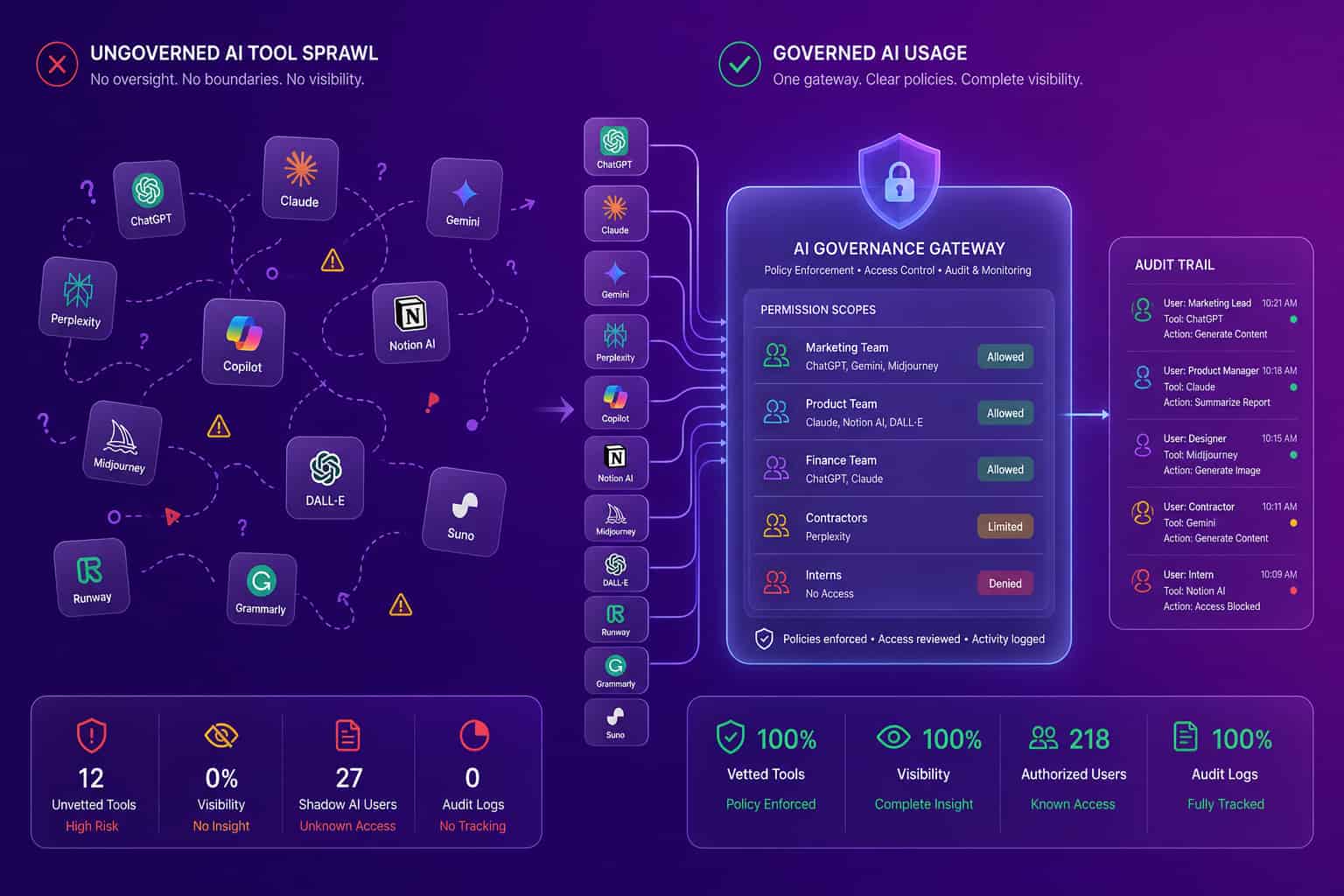
AI governance tools are the software and policies that control how AI is adopted, accessed, monitored, and paid for across an organization, so that innovation happens inside guardrails instead of in the dark. In practice that means four jobs: discovery (which AI tools are actually in use, sanctioned or not), control (who can access which tools and models, and with what data), accountability (audit trails and evidence that hold up under a compliance review), and economics (what all of this AI is costing and whether the spend maps to output). The category exists because AI adoption moved faster than any procurement process. Companies now run 7 or more AI tools on average, up from about 2 in 2023, and most IT teams can name only a fraction of them. Governance is the layer that turns that sprawl back into something a leader can see, defend, and steer. The mistake is assuming governance means locking AI down. Done well, it does the opposite: it gives teams a sanctioned, monitored path so they stop improvising with public tools.
The two categories of AI governance tools most buyers confuse
The phrase "AI governance tools" covers two different products aimed at two different problems, and buyers routinely shop for one when they need the other. The first category is AI model and system governance: the Credo AI, IBM watsonx.governance, and Holistic AI camp, plus data-governance suites like Microsoft Purview. These govern the AI you build and deploy: model risk, bias testing, documentation, and regulatory mapping for systems you are shipping to customers or running in production. The second category is AI usage governance: controlling how your employees use the third-party AI tools they already adopted, like ChatGPT, GitHub Copilot, Claude Code, and Cursor. This is where shadow AI lives, where data leakage happens, and where most of the 2026 risk actually sits for a company that is a consumer of AI, not a builder of foundation models. If you are a 100 to 500-person tech company, you almost certainly have the usage problem before you have the model-risk problem. Abloomify is built for that second category.
| AI model / system governance | AI usage governance | |
|---|---|---|
| Governs | Models and AI systems you build | Third-party AI tools employees use |
| Typical buyer | ML / data science, risk, legal | COO, CIO, IT, security |
| Core jobs | Bias testing, model risk, regulatory mapping | Shadow AI discovery, access controls, usage and cost |
| Example tools | Credo AI, IBM watsonx.governance, Holistic AI | Abloomify |
| First need for most tech SMBs | Later | Now |
Six capabilities to evaluate in AI governance tools
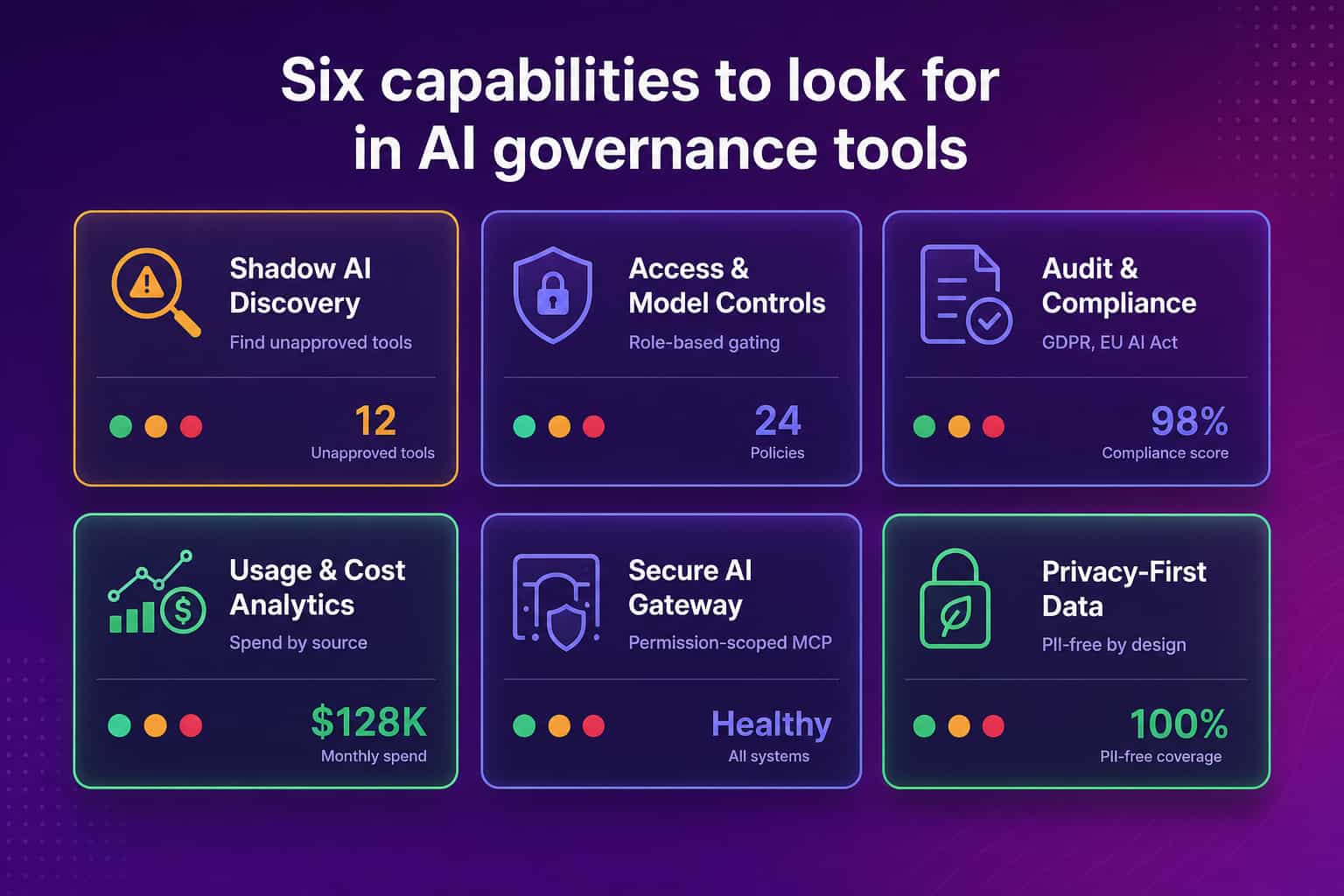
The right way to evaluate AI governance tools is by the specific capabilities they deliver, not by the "governance" label on the box, because most of the risk at a tech company comes from usage nobody sanctioned rather than models nobody documented. Six capabilities separate a real usage-governance platform from a policy PDF. Discovery tells you which AI tools are actually running. Access control decides who gets which tools and models. Audit trails give you the evidence a regulator or customer will ask for. Usage and cost analytics tie the AI bill to real output. A secure gateway gives employees a governed path to company data instead of a public chat box. And privacy-first architecture makes sure the governance layer itself is not collecting the sensitive content you are trying to protect. Score any tool you consider against these six.
- Shadow AI discovery. The platform should surface which unapproved AI tools employees are using before you can govern anything. Abloomify detects shadow AI in use and turns an unknown sprawl into an inventory.
- Access and model controls. Role-based access decides who can use which AI tools and models, gated per company and per user by an admin. Governance without a control surface is just a report.
- Audit trails and compliance evidence. Audit logs record who used what, when, and against which data, so you can evidence lawful basis under GDPR and the EU AI Act instead of hoping nobody asks.
- AI usage and cost analytics. The platform should break AI spend out by source, for example live chat versus scheduled task runs versus an email assistant, with budget guards on automated runs so an agent loop does not quietly burn the quarter's credits.
- Secure AI gateway to company data. A permission-scoped gateway lets sanctioned tools like Cursor, Claude Code, and ChatGPT answer from your company knowledge, scoped to what each person is already allowed to see and revocable instantly.
- Privacy-first architecture. The governance layer should capture no screenshots, no keystrokes, and no message or file content. PII-free by design is what lets you deploy it without creating a new privacy problem.
Where Abloomify fits: governing how your workforce uses AI
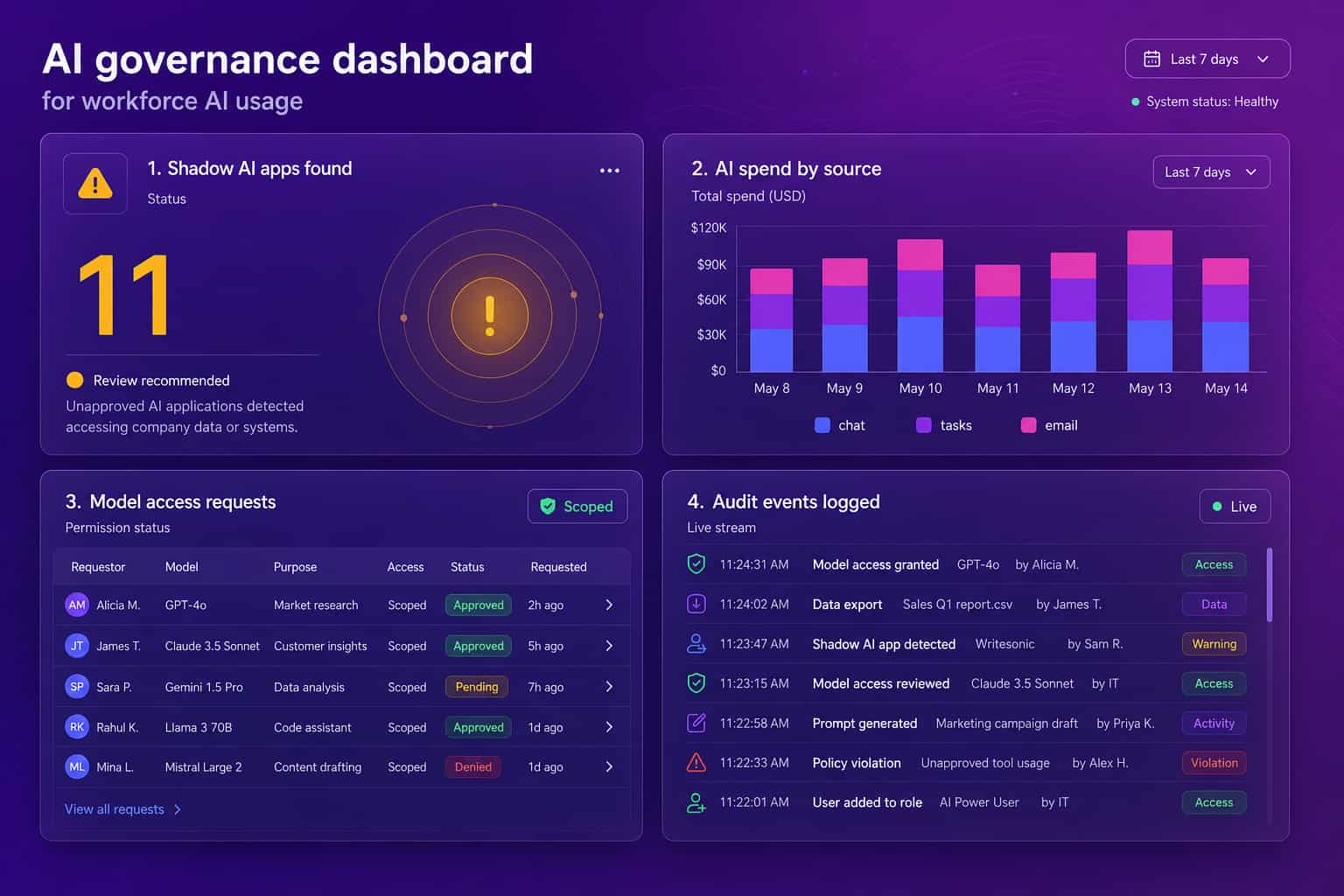
Abloomify is an AI usage governance layer for tech companies that are consumers of AI, giving IT and operations leaders shadow AI detection, role-based model and access controls, audit logs, and AI usage and cost analytics in one place, on a privacy-first architecture. It connects to more than 100 work systems and AI tools through API, PII-free, so no email content, no message content, and no file content is ingested. On top of detection and control sits the part most governance tools miss: a sanctioned alternative. Through Abloomify's secure gateway, the AI tools your team already pays for (Cursor, Claude Code, Claude Desktop, ChatGPT, OpenAI Codex) can answer from your company's own knowledge, each connection scoped to what that person is already allowed to see and revocable in one click. That flips governance from "block the tools" to "give people a governed path," which is the only version that survives contact with a motivated engineering team. It is SOC 2 Type II certified, GDPR and EU AI Act compliant by design, and available in a single-tenant private cloud for regulated buyers. A 400-person fintech that started with workforce analytics expanded into exactly this: a private-cloud secure AI gateway with PII scrubbing.
Two things to keep straight. Abloomify governs how your workforce uses AI tools. It is not a model-risk platform for teams shipping their own foundation models, and it does not pretend to be. If your primary problem is bias testing and regulatory documentation for models you build, pair a model-governance platform with Abloomify for the usage side. For deeper background, see our guide on AI governance and reducing enterprise risk without blocking innovation and the detailed breakdown of shadow AI enterprise risk, detection, and governance.
How to evaluate AI governance tools in 30 days
A 30-day evaluation is enough to tell whether an AI governance tool will earn its place, and the test is simpler than most buyers expect. Week one, connect the tool to your work systems and AI tools and let it discover what is actually in use. The first output that matters is the shadow AI inventory: if the platform cannot tell you which unapproved AI tools your teams are already running, it cannot govern them. Week two, turn on controls for one department and watch what breaks. Good governance tooling lets you gate access by role without a helpdesk queue forming. Week three, pull the audit log and the usage-and-cost view in front of whoever owns compliance and the AI budget, and ask two questions: could we evidence lawful basis under GDPR and the EU AI Act from this, and does the spend map to output. Week four, decide. The platform either showed you AI activity you could not see before and gave you a governed path forward, or it handed you another policy document. Two questions to ask before you sign: does this collect employee content we would then have to protect, and does it give people a sanctioned route or just a longer list of blocked tools.
For the adjacent problems, the same signals show up in how to measure AI adoption impact and in Abloomify's AI governance software and secure AI platform. Governance and ROI are the same question asked twice. One asks whether AI use is safe. The other asks whether it pays.
FAQ
What are AI governance tools used for?
AI governance tools are used to control how AI is adopted, accessed, monitored, and paid for across a company. That covers discovering which AI tools are in use, gating access by role, keeping audit trails for compliance, and tracking AI usage and cost. Abloomify focuses on the usage side: governing how a workforce uses third-party AI tools like ChatGPT, Copilot, and Cursor.
Are AI governance tools required for GDPR or the EU AI Act?
Not by name, but the evidence they produce is. GDPR and the EU AI Act require lawful basis, transparency, and proportionality for how AI processes personal data. Audit logs, role-based access controls, and a PII-free architecture are how you demonstrate that in a review. Abloomify is SOC 2 Type II certified and GDPR and EU AI Act compliant by design, with private cloud deployment for regulated buyers.
How do AI governance tools detect shadow AI?
Usage-governance platforms detect shadow AI by connecting to the work systems and AI tools a company runs and surfacing which unapproved tools are actually in use. Abloomify turns that sprawl into an inventory, then gives IT role-based controls to gate access and a permission-scoped gateway so employees get a sanctioned path to company data instead of pasting it into public AI tools.
What is the difference between an AI governance platform and an AI governance framework?
An AI governance framework is the set of principles and policies you write down. An AI governance platform or tool is the software that enforces and evidences them. A framework without tooling is a document nobody can prove they followed. Tooling without a framework is controls with no intent behind them. You want both, and Abloomify is the enforcement layer for the usage side.
Can Abloomify replace a dedicated AI model governance platform?
No, and it does not try to. Abloomify governs how your workforce uses third-party AI tools: shadow AI discovery, access and model controls, audit trails, usage and cost analytics, and a secure gateway to company data. If you build and ship your own models, pair a model-risk platform for bias testing and regulatory documentation with Abloomify for the usage governance most tech companies need first.

Reza Vatani
Co-Founder & CAIO
AI-driven entrepreneur with a strong background in robotics and advanced analytics. PhD from Old Dominion University and former Product Development leader at Nasdaq Verafin.