AI Agent Governance: A Practical Framework (2026)
September 21, 2026
Reza Vatani
11 min read

AI agent governance is the discipline of deciding, before an autonomous AI agent runs, what it can touch, what it can do, who can shut it off, and what it costs, instead of just reviewing the output after a human already approved the prompt. Abloomify runs this framework on its own agent, Bloomy, and sells the same permission model, audit trail, and cost guardrails to customers governing Cursor, Claude Code, and every other AI tool connected to company data.
Key Takeaways
Q: What is AI agent governance?
A: AI agent governance is the set of permission scopes, audit logs, and cost guardrails that decide what an autonomous AI agent, like a scheduled Bloomy Tasks run or an MCP-connected Cursor session, can access and do without human approval. It differs from AI usage governance, which covers a chat tool a person prompts one step at a time.
Q: How is this different from shadow AI governance?
A: Shadow AI governance finds unapproved chat tools employees signed up for on their own. AI agent governance covers agents the company already sanctioned, like a scheduled task or an MCP connection, and asks whether each one has scoped permissions, a revocable connection, and a visible cost.
Q: What permissions should an AI agent have by default?
A: Only what the person who created or triggered it already has. Abloomify scopes every MCP connection and Bloomy Tasks run to personal, team, department, or company-level access, capped at the requester's own permissions, with instant revocation from admin controls.
Q: Can you track what an AI agent costs to run?
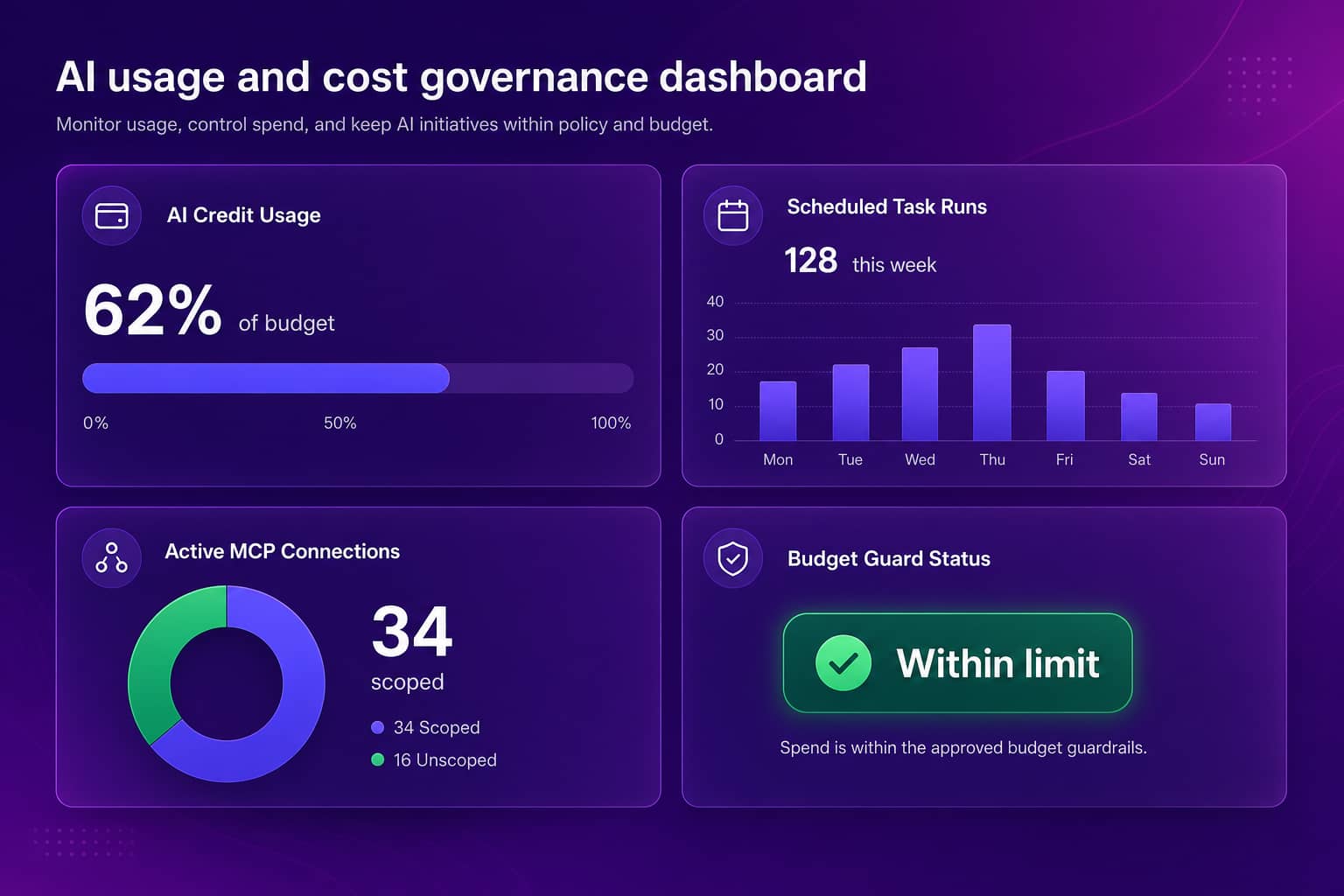
A: Yes, if the platform tracks usage by source. Abloomify breaks AI credit consumption out by live chat, scheduled Bloomy Tasks runs, and the email assistant, with company budget guards on automated runs.
Q: Does AI agent governance slow teams down?
A: Not when it is scoped access plus an audit trail instead of a blanket block. A personal MCP connection takes under a minute while IT keeps role-based gating and full usage visibility over every agent running.
What AI agent governance means now that agents act on their own
AI agent governance is the practice of controlling what an autonomous AI agent can access, what actions it can take, who can revoke it, and what it costs, evaluated before the agent runs rather than after a human reviews its output. That last part is the whole shift. A chat assistant waits for a prompt, does one thing, and stops. An agent, whether that's Bloomy running a scheduled Monday engineering brief, Cursor operating in agent mode against a repo, or Claude Code executing a multi-step task, keeps working across a chain of actions with nobody watching each step. Governance built for the first kind of AI (role-based chat access, a content filter, a usage dashboard) doesn't answer the questions that matter for the second kind: which data sources can this specific agent touch, does its access expire, who gets notified if it does something unexpected, and can someone kill it mid-run. Most companies still have policies written for assistants and agents already running.
| AI usage governance | AI agent governance | |
|---|---|---|
| Governs | A person prompting a chat tool | An agent acting across a chain of steps, unattended |
| Core question | Who can access which AI tool? | What can this specific run touch, and who can stop it? |
| Failure mode | An employee pastes sensitive data into ChatGPT | A scheduled or triggered agent takes an action nobody reviewed |
| Typical control | Role-based tool access, content policy | Scoped permissions, audit log per run, instant revocation, per-run cost |
| Where it lives today | Reasonably mature at most tech companies | Thin to nonexistent at most tech companies |
Why this became urgent in 2026
This matters now because AI agents stopped waiting to be asked. One of our own engineers at Abloomify got a recruiting pitch from an AI sales agent named Boardy. They never replied. Bloomy, our internal AI analyst, answered on their behalf, because Bloomy already runs scheduled work against our GitHub and calendar data without a human kicking off each session. That's the pattern spreading across the industry: ChatGPT's Scheduled Tasks are generally available, Claude has scheduled tasks and cloud routines, and Copilot ships the broadest connector catalog of the three. None of that is unique to any one vendor anymore. What's still rare is the combination that makes autonomous work safe to turn on at a company: permission-scoped access tied to the requester's own role, a visible audit trail per run, and cost guardrails that catch a misconfigured schedule before it burns budget. Skip that combination and every scheduled agent, ours or a competitor's, is a chat tool with the safety rails removed.
Where governance breaks without a framework
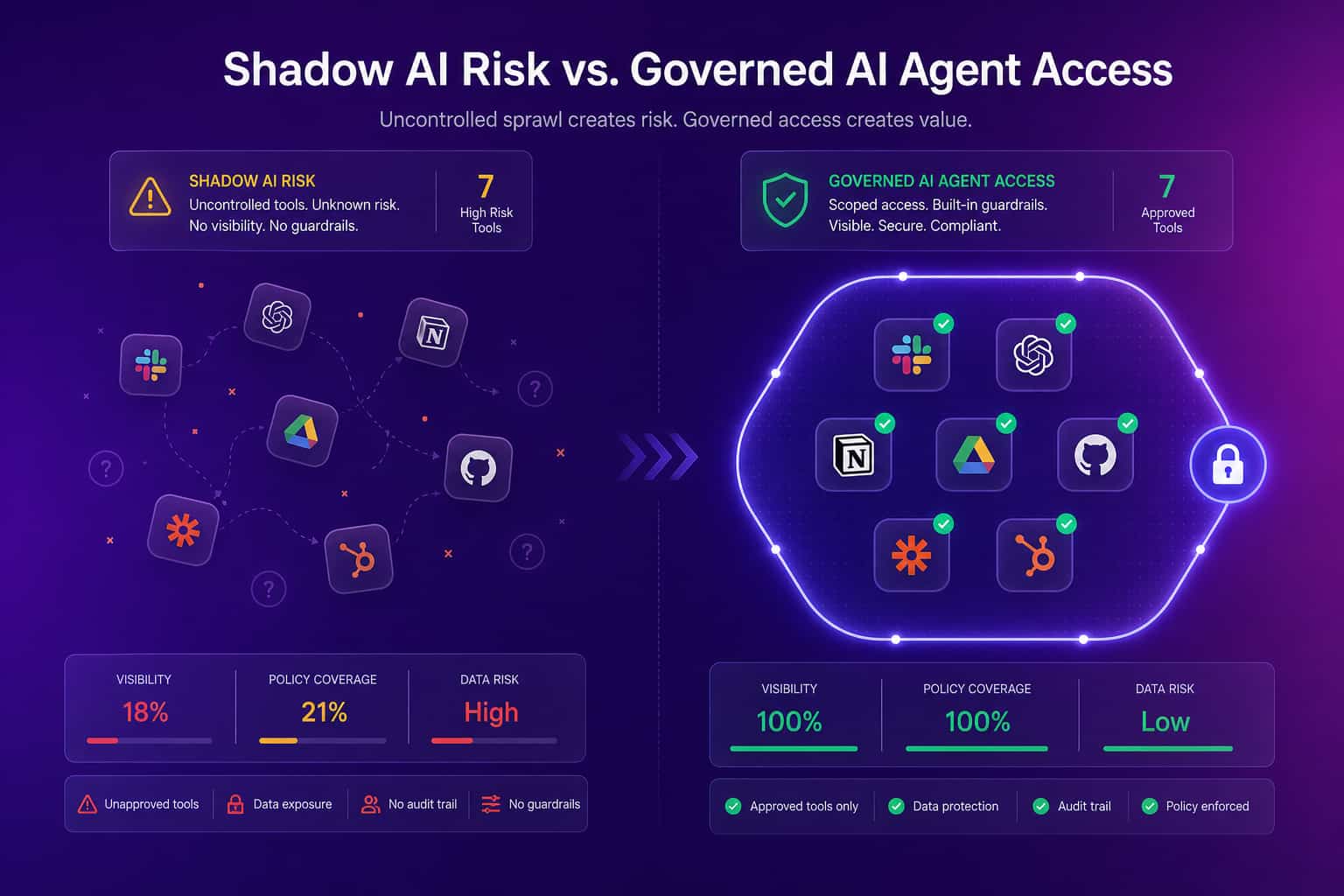
Four failure modes show up almost every time a company skips agent-specific governance and just extends its existing AI usage policy. Shadow agents are the first, the agent-shaped version of the shadow AI problem most IT leaders already track: someone connects a personal AI tool to a shared codebase or CRM via an unmanaged API key, and nobody in IT knows the connection exists, let alone what it can touch. Missing audit trails are the second: when a scheduled run does something wrong, like surfacing a metric it shouldn't have had access to, there's no record of what data it read or what triggered the run. Runaway cost is the third: a scheduled task set to run hourly instead of weekly, or a loop that re-triggers itself, can burn through AI spend for days before finance notices the invoice. Unrevocable access is the fourth and the one that turns a minor mistake into an incident: a contractor's MCP connection stays live for months after they leave, because nobody owns the job of turning it off.
Six pillars of a working AI agent governance framework
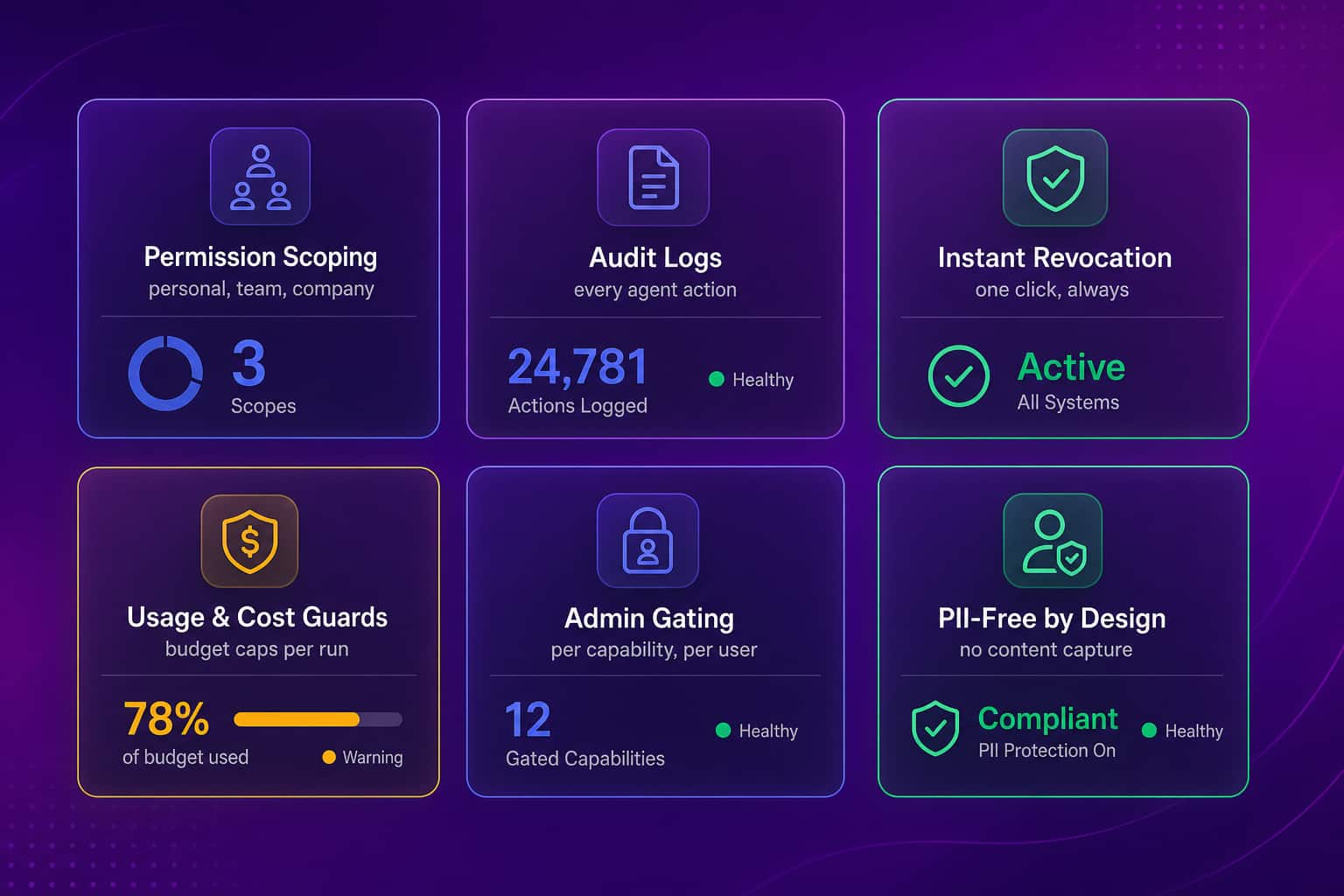
A framework that actually holds up covers six things, and most gaps trace back to skipping one of them rather than skipping all six. Permission scoping caps every agent's access at whatever the person who created or triggered it is already allowed to see, whether that's personal, team, department, or company-wide, so an agent can never see more than its owner could. Audit logs record every agent action, not just the final output, so a security review can reconstruct what a run touched and why. Instant revocation means any admin can kill a connection or a scheduled run the moment it looks wrong, with the change taking effect immediately, not at the next sync. Usage and cost guards track spend by source (live chat, scheduled runs, an email assistant) and cap automated runs against a budget before they can compound into a surprise bill. Admin gating turns agent capabilities on per company and per user, so a new capability doesn't reach every employee the day it ships. PII-free-by-design architecture means the agent works from signals and metadata rather than raw content, which shrinks the blast radius of any governance gap that slips through.
How Abloomify governs its own agent stack
Abloomify builds these six pillars into Bloomy and into External AI Access, the MCP layer that connects Cursor, Claude Code, Claude Desktop, ChatGPT, and OpenAI Codex to a company's Abloomify knowledge. Every MCP connection is scoped at creation to personal, team, department, or company-wide access, capped at what the connecting employee can already see, and revocable instantly from admin controls, whether it's a single engineer's one-minute personal connection or one admin-created connector shared company-wide. Bloomy Tasks, the scheduled side of the same agent, runs on the same permission model: a Monday engineering brief pulled from GitHub only reaches whoever was already allowed to see that GitHub data. AI credit usage is tracked and broken out by source, live chat, scheduled task runs, and the email assistant, with company budget guards on automated runs so a misconfigured schedule doesn't run unchecked. Admins gate Bloomy Tasks and live tool access per company and per user. And underneath all of it sits the same PII-free architecture Abloomify uses everywhere else: no email content, no message content, no file content, SOC 2 Type II certified, with private cloud and BYOC deployment available for companies that need data to stay in their own environment. This is the same control set behind Abloomify's AI governance software, applied specifically to agents instead of chat tools.
How to roll it out without slowing teams down
Start with an inventory, not a policy. Before writing rules, list every AI agent already running against company systems, including personal MCP connections, scheduled tasks, and any Cursor or Claude Code sessions with repo access, because you cannot govern what you cannot see. From there, set the default to scoped-by-role rather than open-by-default: new agent connections inherit the requester's existing permissions instead of starting with broad access that someone has to remember to narrow later. Turn on audit logging before you turn on scheduling, not after, since a governance framework with no history of what already happened is a policy document, not a control. Set budget guards on anything that runs unattended, even at a small dollar amount, because the first month of a new agent capability is exactly when a misconfiguration is most likely. None of this requires slowing the rollout. It requires deciding the defaults before the first agent goes live, not after the first incident forces the question, which is the same case Abloomify makes to IT leaders governing AI adoption broadly.
FAQ
How is AI agent governance different from AI model governance?
Model governance covers systems you build and ship: bias testing, model risk, regulatory mapping for AI you train or fine-tune. AI agent governance covers autonomous agents you didn't build but connected to company data, like Cursor, Claude Code, or Bloomy Tasks, and asks what each one can touch, log, and be billed for. Most tech companies hit the agent problem before the model problem.
What happens to an AI agent's access when an employee leaves?
If the connection was scoped to that employee's permissions, as Abloomify scopes every personal MCP connection, it should be revoked the moment their account is deactivated. A framework without instant revocation leaves former employees' AI connections live indefinitely, exactly the kind of gap agent governance is built to close.
Does AI agent governance apply to Bloomy Tasks, or every connected AI tool?
Both. Abloomify applies the same permission scoping, audit logging, and cost guardrails to its own scheduled agent, Bloomy Tasks, and to every external tool connected through MCP: Cursor, Claude Code, Claude Desktop, ChatGPT, and OpenAI Codex. Governance that only covers your own product and ignores the tools employees already use leaves the bigger gap open.
Is AI agent governance required for GDPR or the EU AI Act?
Not by that name, but the outcomes are. Both require lawful basis, transparency, and proportionality for how AI processes data, including data an autonomous agent touches on its own. Audit logs, scoped permissions, and PII-free architecture are how a company evidences that. Abloomify is SOC 2 Type II certified and built to be GDPR and EU AI Act compliant by design.
Can a small IT team realistically govern every AI agent in the company?
Yes, if the defaults do the work instead of manual review. Scoping every new connection to the requester's existing permissions, logging every run automatically, and gating capabilities per user means IT sets the rules once instead of reviewing each agent individually. That's the difference between a governance framework and a full-time job.

Reza Vatani
Co-Founder & CAIO
AI-driven entrepreneur with a strong background in robotics and advanced analytics. PhD from Old Dominion University and former Product Development leader at Nasdaq Verafin.