Return to Office in 2026: What the Data Says About Productivity
July 1, 2026
Amir Tavafi
11 min read

Return to office is the loudest workplace fight of 2026, and most of it misses the point. Mandating badge swipes measures attendance, not output. Abloomify was built on a simpler idea: you can see who is actually productive from the work itself, across 100+ tools, privacy-first, without a single screenshot. The office argument is really a visibility argument. Solve that, and where people sit matters far less.
Key Takeaways
Q: Does returning to the office increase productivity?
A: Not on its own. Presence measures attendance, not output. Stanford researchers who track hybrid work find well-structured hybrid setups do not lower productivity. Abloomify measures the signals that actually predict output, like delivery velocity, review health, and deep work, so location becomes a smaller variable.
Q: What is the real reason companies push return to office?
A: Visibility. Leaders can see a full parking lot but not who is delivering, so presence becomes a proxy for productivity. The fix is better measurement, not more mandates. Abloomify provides that visibility from 100+ work tools, PII-free, with no surveillance.
Q: Can you measure remote productivity without monitoring software?
A: Yes. Monitoring tools take screenshots and log keystrokes, which damages trust and proves little. There is no evidence monitoring improves performance. Abloomify reads aggregated, PII-free signals from GitHub, Jira, calendar, and CRM, so you see output without watching anyone.
Q: What should leaders measure instead of office attendance?
A: Outcomes. PR cycle time, delivery velocity, review health, meeting load, and deep-work hours tell you more than a badge swipe ever will. Abloomify pulls these from the tools a team already runs and turns them into a clear read on real output.
Q: Do return to office mandates cause turnover?
A: They can, especially among your strongest people who have options. Forced presence also drives quiet overload and burnout. Abloomify flags burnout risk 60+ days early from work patterns, so you catch the cost of a mandate before it walks out the door.
Why return to office became the 2026 fight
Return to office moved from a quiet HR preference to a public standoff because the incentives on both sides finally collided in 2026. Executives are under board pressure to prove efficiency, and a full office feels like proof, even when it is not. Employees who spent years delivering from home read a mandate as a demotion of trust, and the strongest performers, the ones with the most options, are the first to push back or leave. Meanwhile the question that started the whole thing, are remote and hybrid teams actually productive, still has no agreed answer at most companies, because nobody set up the measurement to answer it. So the debate gets fought on vibes, anecdotes, and the occasional viral memo instead of on data about what people actually shipped. That vacuum is the real story.
The tell is how the argument sounds. One side cites collaboration and culture. The other cites focus and reclaimed commute hours. Both are guessing, because presence and productivity were never the same measurement. A leader can watch attendance climb and still have no idea whether output moved. Big companies bring ceremony to this problem. The mandate is the ceremony.
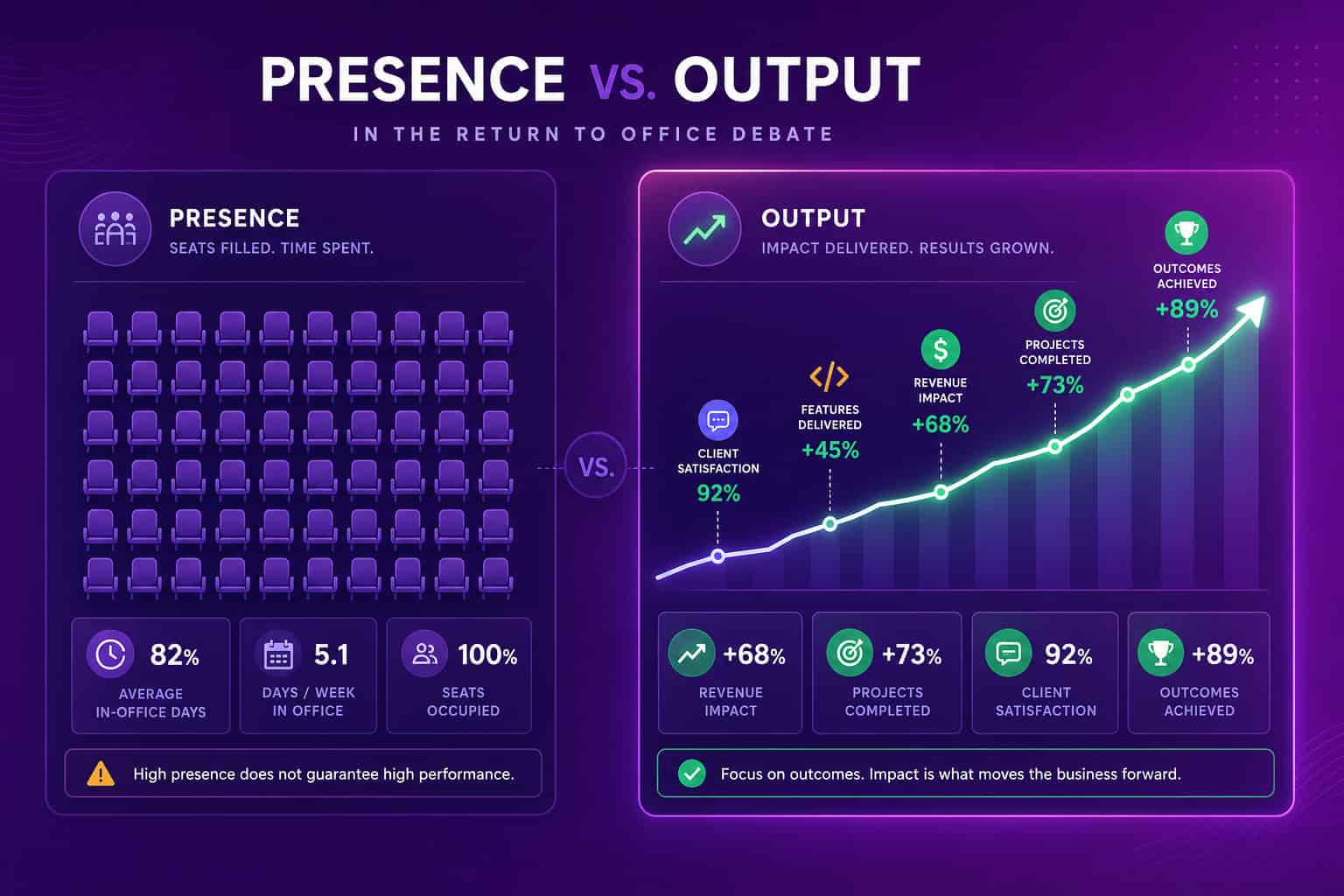
Presence is not productivity
Presence is not productivity, and treating the two as interchangeable is the most expensive mistake in the entire return to office conversation. A person at their desk from nine to five can produce almost nothing, and a person working four focused hours from home can ship the feature that moves the roadmap. Attendance is easy to see, which is exactly why leaders reach for it, but ease of measurement is not the same as usefulness of measurement. The research backs this up. There is no evidence that monitoring physical presence or screen activity improves performance, and the Personnel Psychology meta-analysis on workplace monitoring found no reliable link between watching people work and getting better work out of them. What actually changes outcomes is clarity about outputs, workload, and where the real bottlenecks sit, none of which a badge reader can tell you.
Researchers at Stanford who have tracked remote and hybrid work for years keep landing in the same place: well-structured hybrid arrangements do not reduce productivity, and in many cases they help retention. That does not mean every team should be remote. It means the location decision is an empirical question, and you are allowed to answer it with your own numbers instead of a competitor memo.
What the return to office debate is really about
The return to office debate is really a visibility debate wearing a real estate costume. Leaders do not actually care where a chair sits, they care whether the work is happening, whether capacity is being wasted, and whether someone is quietly checked out. An office gives the comforting illusion of an answer, because you can walk the floor and see busy people, but busy is not the same as productive, and a floor walk does not scale past a few dozen desks. The companies that feel most anxious about remote work are almost always the ones with the weakest instrumentation. They cannot see output, so they fall back on the one signal they can see, which is bodies in a building. Fix the visibility problem and the location problem shrinks, because now you can tell a thriving remote team from a struggling in-office one on the merits.
This is where a single weak signal fails you. One Abloomify customer, a 3,500-person enterprise, started with Google Workspace engagement data alone to spot quiet quitters. The honest result: one source under-proved the case. Real signal comes from triangulating several. The same trap catches return to office mandates that lean on one metric, badge swipes. Attendance is a single, weak, gameable number. People badge in and go quiet.
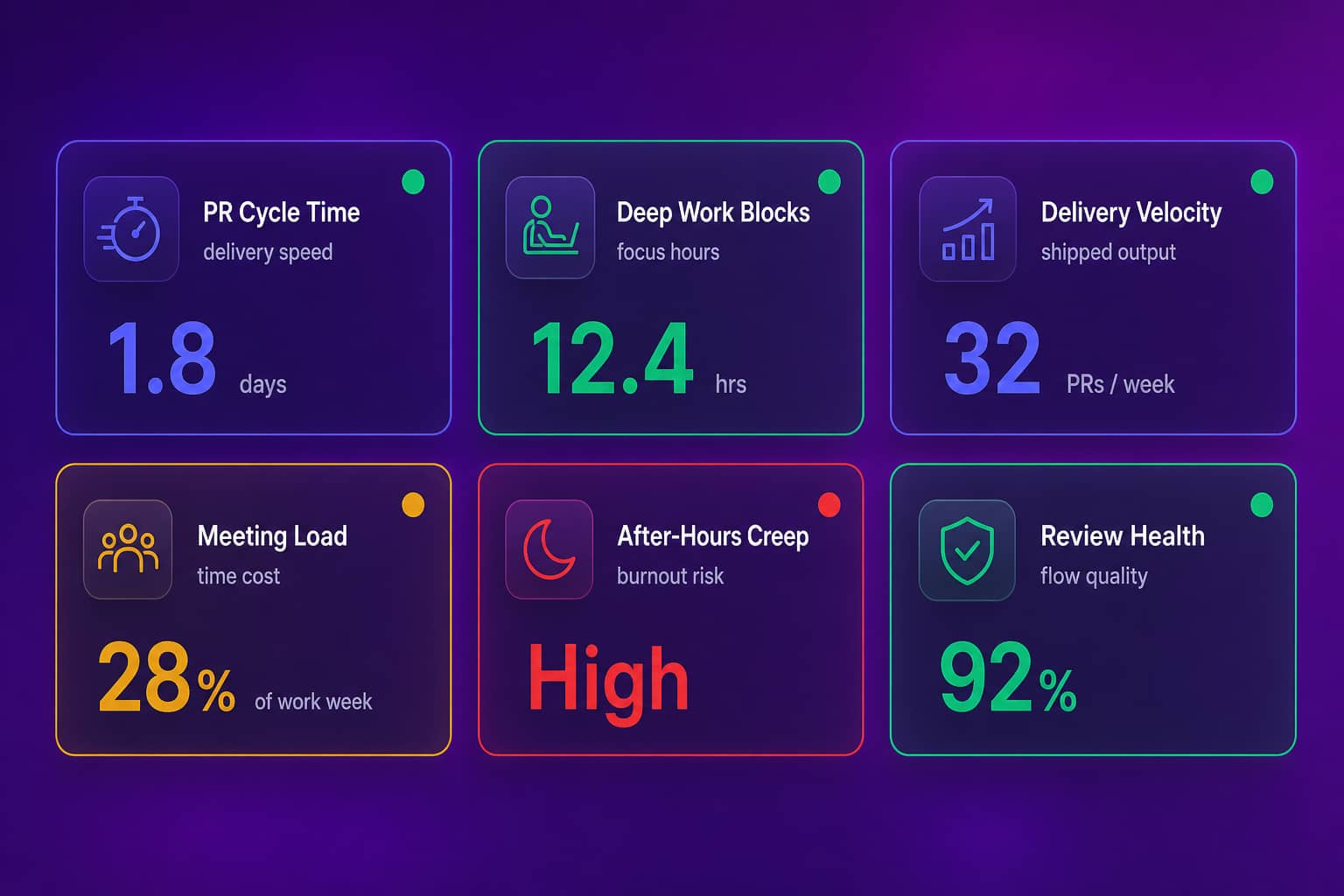
How to measure output without surveillance
You measure output without surveillance by reading the work itself, not the worker, through the tools a team already runs on. Abloomify connects to more than 100 systems, including GitHub, Jira, Linear, Google Workspace, Microsoft 365, Slack, calendar, and CRM, and pulls aggregated, PII-free signals: how long pull requests take to merge, where reviews pile up, how much of the week disappears into meetings, whether anyone has deep-work blocks left, and where after-hours work is creeping up. No screenshots. No keyloggers. No screen recording. No content capture. The optional device agents, when a company uses them, collect metrics by application category, not what was typed or read. The result is a picture of real output and real capacity that holds whether the person sits in the office, at home, or in a different time zone, which is exactly the picture the return to office fight is missing.
This is the same approach behind measuring productivity without screenshots and our work on hybrid and remote productivity. The point is not to prove remote is better or office is better. It is to give a leader a fair read on output either way, so the return to office decision stops being a proxy war over trust.
Picking a return to office model with data, not a mandate
Picking a return to office model works best when you start from the work and back into the policy, instead of announcing a policy and hoping the work adapts. There is no universal right answer, because a support team, a sales floor, and a distributed engineering group have genuinely different collaboration needs, and a single blanket rule will overserve some and punish others. The four common models, full in-office, structured hybrid, remote-first, and flexible by team, each optimize for something different, and the only way to choose well is to know what your teams actually need more of: spontaneous collaboration, uninterrupted focus, coverage across time zones, or simple retention of people who would leave over a mandate. Data tells you which. If your engineers already ship fast with deep focus and your bottleneck is review latency, dragging them to a desk five days a week solves a problem you do not have.
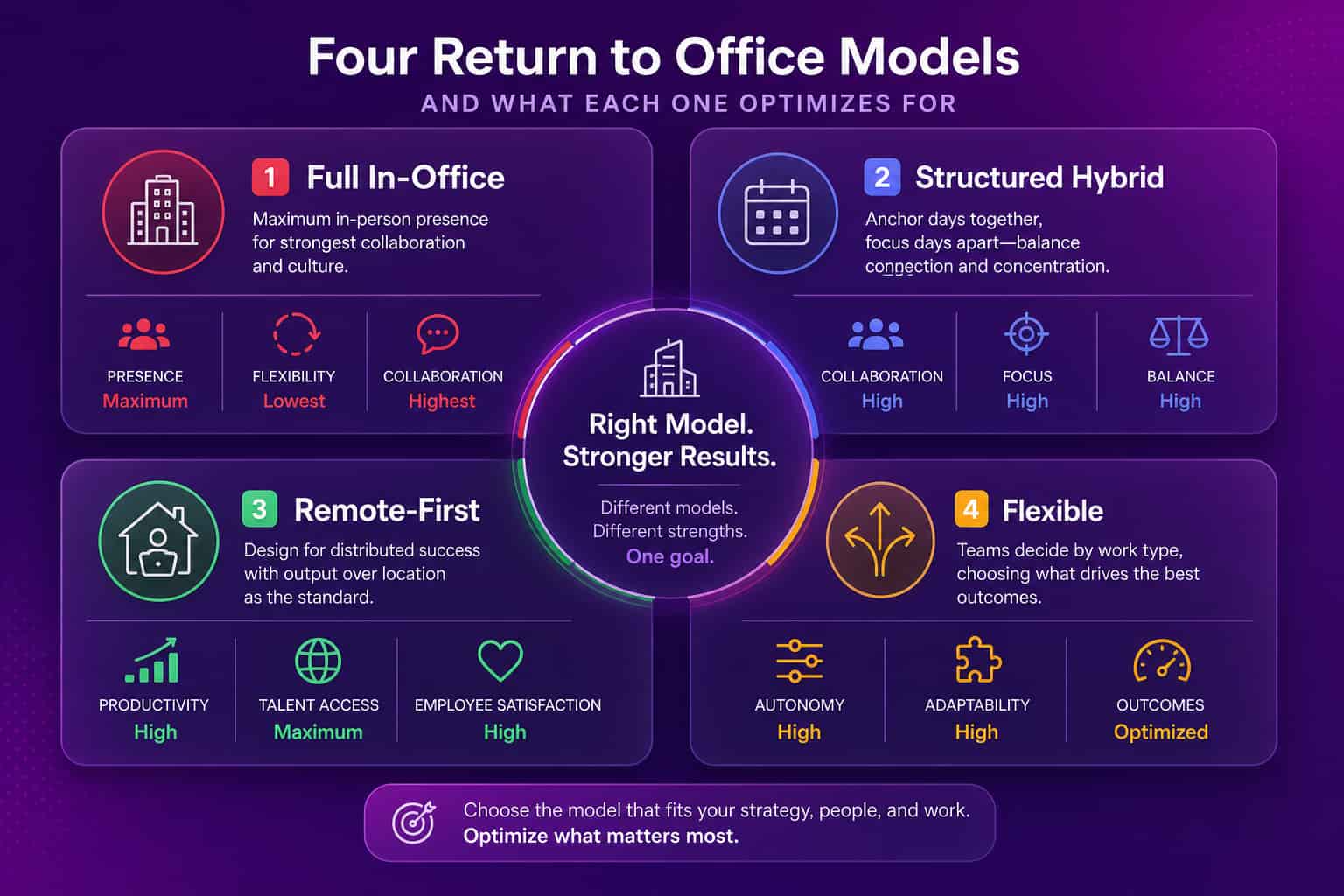
Blanket RTO mandate
Data-backed model
Before you mandate return to office, read the work
Before you mandate a return to office, get honest about what problem you are actually solving, because most mandates answer a measurement gap with a real estate policy. If the real issue is that you cannot see who is productive, a mandate will not fix it, it will just move the invisible work into a building. Start by instrumenting output: connect the tools your teams run on, watch delivery velocity, review health, meeting load, and capacity, and give it a few weeks. You will usually find the problem was never location. It was a handful of overloaded people, a review bottleneck, and two or three quietly disengaged folks that no amount of office time would surface on its own. Then decide the policy from evidence. Some teams will genuinely benefit from more in-person time. Others will lose your best engineers the week the memo drops.
Run the honest math on what a policy shift actually saves or costs with the remote work ROI calculator, and use it alongside your delivery data, not instead of it. Operations leaders can see the whole picture, capacity, output, and cost, in one place with Abloomify for operations.
Presence is easy to count. Output is what you actually pay for. Count the thing that matters.
FAQ
Is return to office still happening in 2026?
Yes, and it is intensifying at large employers, with several moving from hybrid to stricter in-office schedules. But adoption is uneven, and many technology companies keep hybrid or remote-first arrangements because their output has not suffered. Abloomify helps leaders decide from their own delivery data rather than copying another company memo.
Why are employers pushing for return to office?
Mostly for visibility and a sense of control. Presence is easy to see, so it becomes a stand-in for productivity that leaders cannot otherwise measure. Some also cite collaboration and culture. The honest fix is measuring output directly. Abloomify surfaces real productivity and capacity signals from 100+ tools, PII-free, so presence stops being the only proxy.
What is the meaning of return to office?
Return to office, often shortened to RTO, refers to policies that bring employees back to a physical workplace after remote or hybrid work, ranging from a few anchor days to a full five-day schedule. The term describes the location policy, not whether the work is getting done, which is a separate question best answered with data.
Does return to office reduce or increase turnover?
Mandates often raise turnover risk, especially among high performers who have other options, and forced presence can drive quiet overload and burnout. Abloomify detects burnout and disengagement signals 60+ days early from work patterns, so leaders can see the human cost of a policy before it turns into resignations.
How do you measure productivity for a hybrid team?
Measure outcomes, not hours or attendance. Track delivery velocity, pull request cycle time, review health, meeting load, and deep-work capacity, and compare them across in-office and remote days. Abloomify pulls these signals from the tools a hybrid team already uses, so the comparison is based on shipped work rather than who was seen at a desk.

Amir Tavafi
Co-Founder & CEO
Product leader and innovator with over 15 years of experience in the tech sector, grounded in AI and robotics. Previously led product development in fraud detection and AI solutions at Nasdaq Verafin.