Productivity Paranoia: What It Is and How Leaders Fix It
October 30, 2026
Amir Tavafi
11 min read

Productivity paranoia is what happens when a leader can no longer see people working and starts to assume the worst. It is a visibility problem more than a people problem, and it is expensive. At Abloomify we see it in almost every leadership conversation about hybrid teams.
Key Takeaways
Q: What is productivity paranoia?
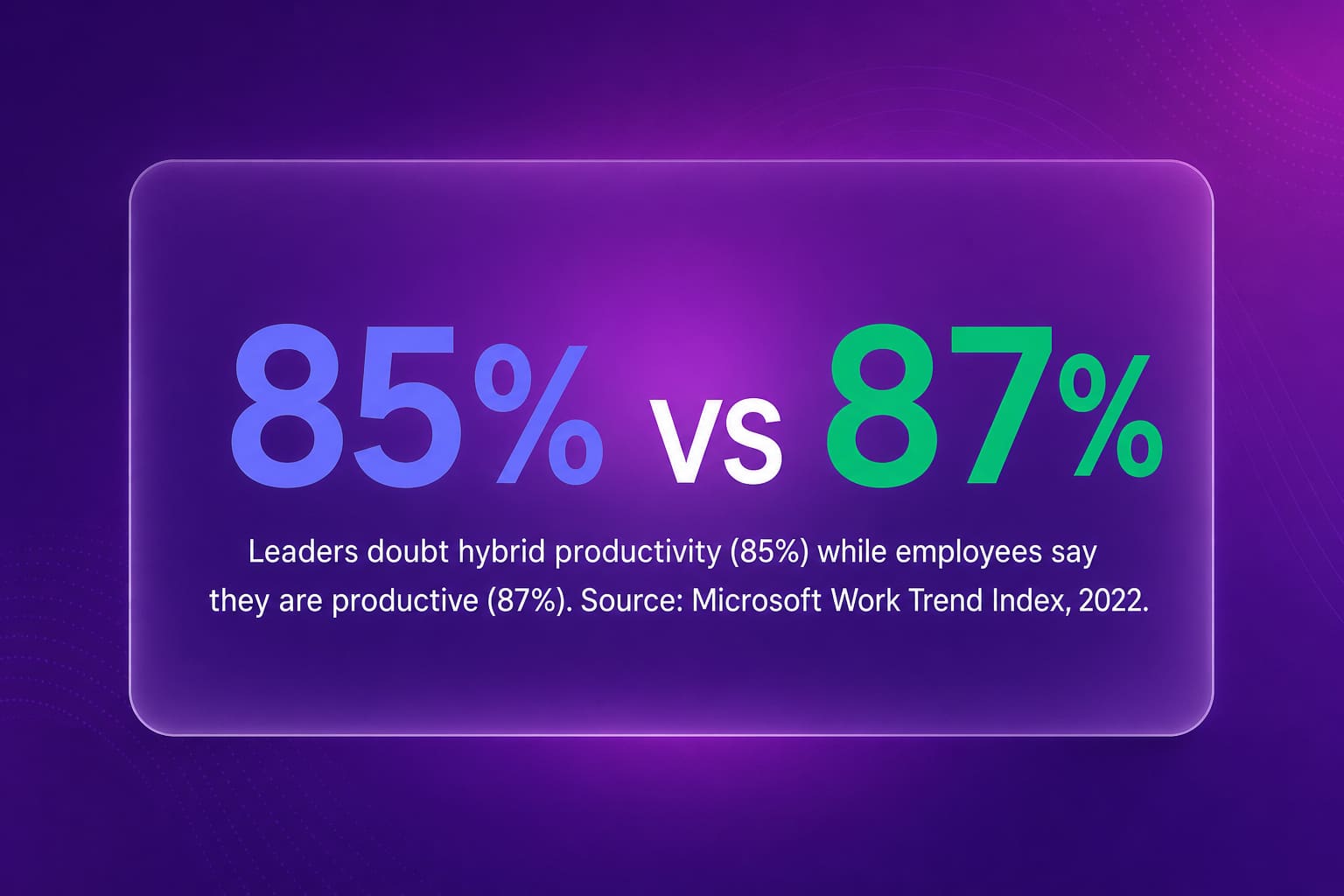
A: It is leaders doubting that remote or hybrid employees are productive because they cannot observe the work. Microsoft's 2022 Work Trend Index gave it the name after finding 85% of leaders struggled to feel confident in productivity while 87% of employees said they were productive.
Q: Why does it happen?
A: Offices let managers use presence as a stand-in for output. Remote work removes the stand-in and nothing replaces it. Doubt fills the gap, and it grows when no one can answer a simple question like who is overloaded and who is blocked.
Q: Does monitoring software fix it?
A: Mostly it moves the problem. Activity data (clicks, screen time, screenshots) does not measure output, and workers react badly to it. The better fix is outcome data from the tools where work already happens, which Abloomify collects PII-free.
Q: What do I measure instead?
A: A few outcome signals per team, such as PR cycle time, review speed, ticket flow and capacity load, reviewed weekly with the team. Pick numbers a person can influence, and talk about them in one-on-ones, not in a surveillance dashboard.
What is productivity paranoia?
Productivity paranoia is the gap between what leaders fear is happening and what employees report is happening when work is no longer visible in person. Microsoft put the term on the map in its 2022 Work Trend Index, which found that 85% of leaders said the shift to hybrid work makes it challenging to be confident their employees are productive, while 87% of employees said they were productive at work. Two groups looked at the same company and reached opposite conclusions. Neither is necessarily lying. The employees know what they shipped. The leaders know what they can no longer see. The real subject here is what leaders do next, because that decision shapes whether the gap closes or gets worse, and most reach for the wrong tool first.
I should be fair to the leaders. Doubt is a reasonable reaction to missing information. If you used to walk the floor and now you see a green dot in Slack, you have lost most of your signal. The mistake is treating the lost signal as proof of a performance problem.
Why does productivity paranoia happen?
Productivity paranoia happens because office work taught managers to read presence as output, and hybrid work breaks that shortcut without offering a replacement. In an office, a manager sees who arrives early, who stays late, who is in a meeting room with a laptop open. None of that measures anything. It just feels like evidence, so it quietly became the default way of judging effort. Once people go remote, the shortcut stops working, and the manager is left with three sources: status updates, self-reports and gut feeling. All three are noisy and slow. Meanwhile the questions get harder to answer, such as which team is stretched, whether a project is slipping, and whether the new AI tools are paying off. A leader who cannot answer those starts to worry, and worry looks a lot like control.
Here is how it usually shows up on a team:
- Daily check-in meetings that exist only so the manager can see people
- Requests for activity reports that nobody reads past the first line
- Mandatory office days with no change in how work gets done
- Slack status policing, and questions about why someone was "away" for an hour
- A quiet rollout of screen capture or keystroke tools, often without telling the team
The last item is where it turns costly.
What does productivity paranoia cost a company?
Productivity paranoia costs a company in trust, time and talent, and the bill usually arrives before any measurable gain does. The trust cost is the largest. Research cited across the monitoring debate says 1 in 6 workers would quit over surveillance, and a Personnel Psychology meta-analysis found no evidence that monitoring improves performance. So the typical response to paranoia, which is to watch people more closely, adds a retention risk and does not fix the underlying doubt. The time cost is quieter. Managers spend hours chasing updates, copy-pasting metrics into decks and sitting in status meetings, which is leadership time spent on reassurance instead of decisions. The talent cost shows up as your best people, who have the most options, leaving first. Teams that feel watched also learn to look busy, which makes the data you collect worse than the data you had before.
If you want the long version of this argument, our piece on how to measure productivity without screenshots covers it in detail, and the ActivTrak comparison shows what the surveillance-first approach looks like next to an outcome-first one.
Why doesn't employee monitoring cure productivity paranoia?
Employee monitoring does not cure productivity paranoia because it replaces one weak signal (presence) with another weak signal (activity), and it adds a trust problem on top. A tool that tracks mouse movement, active windows or screenshots can tell you someone was at a computer. It cannot tell you whether the pull request they were working on got reviewed, whether the ticket was the right ticket, or whether the customer got what they needed. Worse, activity numbers are easy to game. A developer who spends an hour thinking through an architecture problem looks idle. A person who wiggles a mouse looks great. You end up rewarding the wrong behavior and learning nothing about the real constraint, which is usually a blocked review, an overloaded person or a meeting-heavy calendar. Monitoring answers "were they there" when the question you actually had was "is the work moving."
The better comparison is between two kinds of signal:
| Signal type | Example | What it tells you | Side effect |
|---|---|---|---|
| Activity | Screen time, keystrokes, screenshots | That a person was at a device | Distrust, gaming, resignation risk |
| Presence | Green dot, badge swipe, office days | That a person was reachable | Performative busyness |
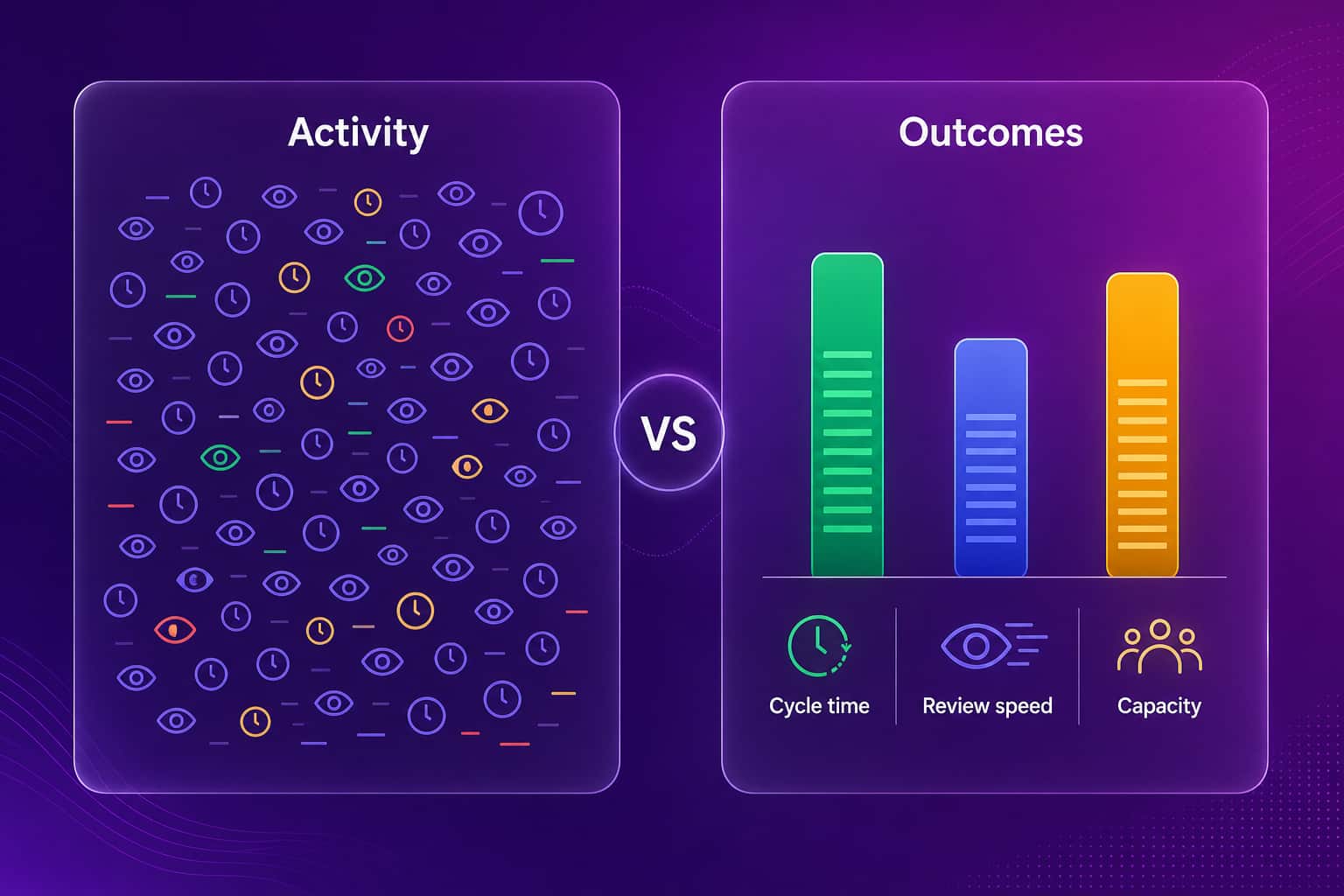
| Outcome | PR cycle time, review speed, ticket flow, capacity load | Whether work is moving and where it waits | Low, since it reads from systems of record |
I have watched this play out. Customer 1's COO told us, "What I did manually this week in a spreadsheet is exactly what I think Abloomify should be doing automatically." Nobody there wanted to watch people. They wanted to stop assembling the picture by hand.
How do you fix productivity paranoia without surveillance?
You fix productivity paranoia by replacing the lost visibility with outcome data from the tools where work already happens, and by agreeing with the team on which numbers matter. This does not need cameras or screen capture. Engineering work already leaves clear traces in GitHub and Jira: how long pull requests take from open to merge, how long they wait for a first review, how much work is in progress per person. Capacity shows up in calendars and meeting load. Abloomify reads these through 100+ API integrations and reports PII-free signals, with no email content, message content or file content, and optional device agents that send aggregated metrics only. The point is that a leader can see where work waits and who is stretched, without anyone being watched. Start small and be open about it. Tell the team what is measured and why, and show them the same numbers you see.
A simple starting routine looks like this:
- Pick three or four outcome signals per team, such as PR cycle time, time to first review and capacity load.
- Share the definitions with the team before you share any dashboard.
- Review the numbers weekly, as a team, and ask what is slowing things down.
- Use one-on-ones to cover the why behind the data, since a number can show where to look and nothing more.
- Drop any metric that people start to game.
For engineering teams specifically, engineering productivity analytics covers the flow and review-health numbers in more depth. For the wider company, hybrid and remote productivity shows how the same approach applies across functions.
What should managers do differently?
Managers should stop using presence as a proxy and start managing to agreed outcomes, with data as the conversation starter and the one-on-one as the place for context. That sounds obvious and it is hard in practice, because it asks the manager to give up a comfort. Checking a green dot takes two seconds and feels like oversight. Asking "what is blocking you this week" takes five minutes and sometimes gives you an answer you do not like. The second one is the job. A few habits help. Define what good output looks like per role in plain words. Ask about blockers before asking about status. Look at team-level trends before individual numbers, since most delivery problems come from the system and not from one person. And be willing to say "I do not know yet" when the data does not answer the question, which builds more credibility than a confident guess.
To be honest, none of this removes the discomfort overnight. Some leaders will still feel uneasy for a while, and I think that is fine. The goal is to give that unease a better target than the employee in the next time zone.
FAQ
What is productivity paranoia?
Productivity paranoia is the term Microsoft used in its 2022 Work Trend Index for leaders who doubt their teams are productive because they can no longer see them work. In that research, 85% of leaders said hybrid work makes it hard to be confident in productivity, while 87% of employees said they were productive.
What causes productivity paranoia?
Visibility loss. In an office, managers use presence as a stand-in for output. When people move to remote or hybrid work, that stand-in disappears and nothing replaces it. Without outcome data from work systems, doubt fills the gap, and it tends to grow with every unanswered question about who is busy and who is stuck.
Does employee monitoring fix productivity paranoia?
Usually not. Monitoring measures activity, such as mouse movement or screen time, which is a poor proxy for output. A Personnel Psychology meta-analysis found no evidence that monitoring improves performance, and 1 in 6 workers say they would quit over surveillance. It trades manager anxiety for employee distrust.
How do you measure remote productivity without surveillance?
Read outcomes from the tools where work already happens. Pull request cycle time and review speed from GitHub, ticket flow from Jira, capacity and meeting load from calendars. Abloomify connects to these through 100+ API integrations and reports PII-free signals, with no screenshots, keyloggers or content capture.
What should managers do instead of checking if people are online?
Agree on what good output looks like for each role, then review a small set of outcome numbers weekly with the team. Use one-on-ones to ask about blockers, since the data shows where to look but not why. The online indicator tells you who is at a keyboard, nothing about what got finished.

Amir Tavafi
Co-Founder & CEO
Product leader and innovator with over 15 years of experience in the tech sector, grounded in AI and robotics. Previously led product development in fraud detection and AI solutions at Nasdaq Verafin.