People Analytics Tools: 7 Worth a Tech Leader Shortlist (2026)
June 8, 2026
Amir Tavafi
12 min read

Most people analytics tools answer one question well: what does your headcount look like? Tenure, turnover, compensation, the HRIS demographics. Useful, but it stops at the org chart. The 100 to 500-person tech companies I talk to want a harder answer: is that headcount actually productive, and where is capacity leaking? This is the honest 2026 shortlist of people analytics tools, ranked for tech leaders who want work-data signals, not just survey results.
Key Takeaways
Q: What are people analytics tools used for?
A: People analytics tools turn workforce data into decisions about hiring, retention, productivity, and capacity. Most read from HRIS systems like Workday or BambooHR. A smaller group, including Abloomify, connects 100+ work tools so analytics reflect real delivery, not just headcount and tenure.
Q: Which people analytics tool is best for a tech company?
A: For a 100 to 500-person tech company, the best fit is one that sees engineering and operational work, not just HR records. Abloomify connects GitHub, Jira, calendar, and CRM with a privacy-first, PII-free architecture, so a COO or VP Engineering can see capacity and velocity, not demographics alone.
Q: Are people analytics the same as employee monitoring?
A: No. Monitoring tools capture screen content tied to a named person (screenshots, keystrokes, recordings). People analytics tools like Abloomify measure aggregated patterns from systems people already use. No content is captured, which is why employee resistance stays low.
Q: What data sources do people analytics tools use?
A: Traditional platforms use HRIS data: headcount, compensation, turnover, survey responses. Work-data platforms add operational signals: PR cycle time, meeting load, capacity utilization, and AI tool adoption. The data source is the single biggest difference between vendors, and it decides what questions the tool can answer.
What people analytics tools actually do (and where most stop)
People analytics tools collect workforce data from across an organization, then analyze it to help leaders make better decisions about staffing, retention, engagement, and productivity. The category started inside HR, built on the HRIS as the system of record, so the default data set is demographic: headcount, tenure, compensation bands, turnover rates, diversity metrics, and survey responses. That data answers real questions. Who is leaving and why. Where pay is inequitable. How engagement trends quarter over quarter. The limit is that the HRIS only knows who you employ and what you pay them. It does not know whether an engineer is buried in review queues, whether a team is 30% over capacity, or whether the Cursor licenses you bought are producing anything. Most people analytics tools inherit that blind spot, because they read from the same demographic source. The result is analytics that describe the org chart accurately and the actual work barely at all.
That gap is the reason a lot of leaders still answer basic questions by hand. Reza and I built Abloomify after watching operators dig across five tools to answer something as simple as "who is overloaded right now?" The HRIS could not tell them. Neither could a people analytics dashboard sitting on top of it.
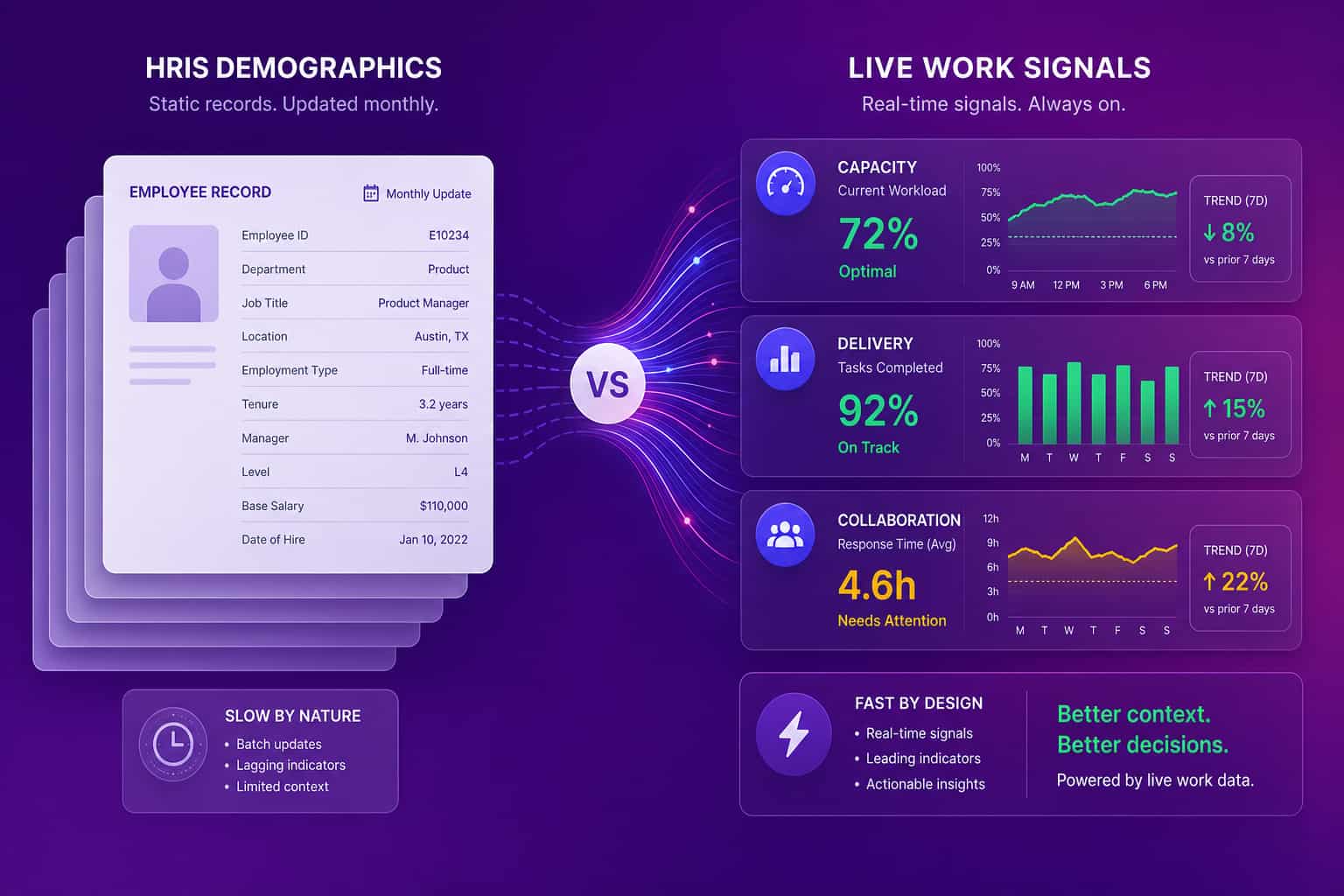
The fix is not more survey questions. It is a second data layer. When people analytics connect to the systems where work actually happens, the same platform can tell you that turnover risk is concentrated on the team with the worst meeting load and the slowest PR cycle, not just that turnover went up. That is the line this 2026 shortlist is sorted on.
The best people analytics tools in 2026 (7 picks for tech leaders)
The best people analytics tool depends entirely on what the buyer needs to see: a large enterprise HR team optimizing compensation and DEI reporting will rank Visier at the top, a fast-scaling startup planning headcount will lean toward ChartHop, an M365 shop measuring collaboration will look at Worklytics or Microsoft Viva Insights, and a 100 to 500-person tech company that wants to know whether its headcount is actually productive should put Abloomify on the shortlist before buying anything HRIS-only. The seven picks below are ranked by fit for a tech leadership buyer, with an honest read on what each does well and where each runs into the work-data limit. Names are grouped by the question they were built to answer, because that is what actually decides the right tool.
1. Abloomify (best for tech leaders who want people data plus work data)
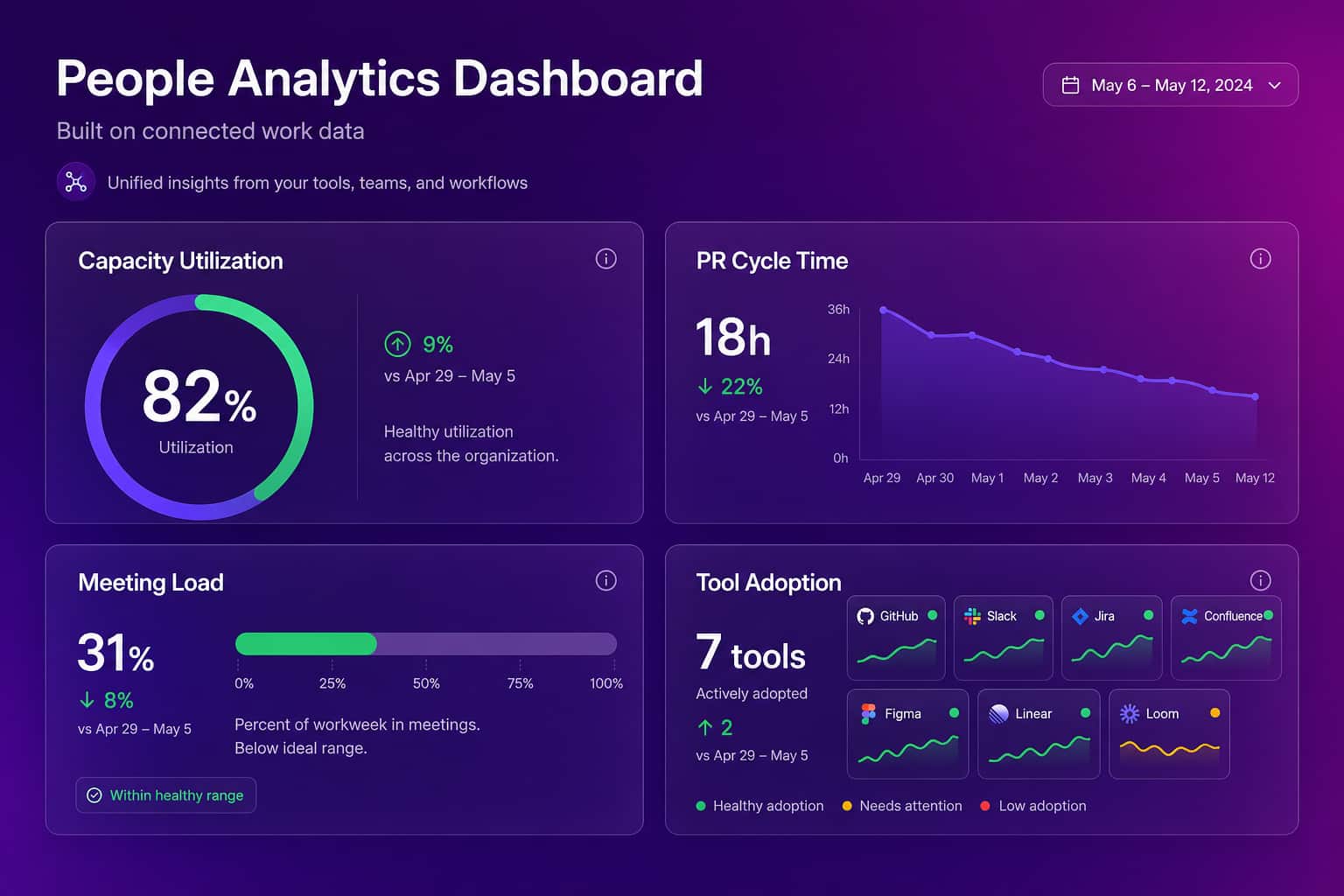
Abloomify is privacy-first workforce intelligence built for technology companies. It connects 100+ tools (Google Workspace, M365, GitHub, Jira, Linear, CRM, HRIS) plus optional device agents that capture aggregated metrics, never screenshots or keystrokes. That means people analytics that go beyond demographics: capacity utilization, meeting load, PR cycle time, AI tool ROI, burnout signals, and a full performance suite on every plan. Bloomy, the AI analyst, answers questions across all of it in plain language instead of a weekly report cycle. The honest caveat: Abloomify is newer (founded 2024) and does not yet carry analyst recognition or the deep compensation analytics a dedicated HR platform offers. If your only need is pay equity benchmarking, look elsewhere. If you want to know whether your team is productive, this is the pick.
2. Visier (best for large-enterprise HR analytics)
Visier, founded in 2010, is the recognized standard in the people analytics category. Its strengths are deep HRIS-based analytics: compensation, pay equity, DEI reporting, and headcount planning for very large organizations. If you are a 10,000-person company and your primary buyer is the head of People Analytics, Visier is hard to beat on that data set. The trade-offs for a tech-company buyer are real. Visier sees HR data, not engineering delivery, tool usage, or meeting load. Deployments commonly run three to six months, and pricing targets enterprise budgets. For the work-data question, see the Abloomify vs Visier breakdown.
3. ChartHop (best for modern org and headcount planning)
ChartHop pairs people analytics with org design and headcount planning in a clean, modern interface. It is strong for fast-scaling companies that need to model reorganizations, plan headcount, and visualize the org as it changes. Like most of the category, its analytics are built on HRIS and compensation data. It will tell you what the org looks like and how it should change. It will not tell you which team is bottlenecked in code review or whether your AI coding tools are producing output, because that data lives outside the HRIS.
4. Worklytics (best for collaboration analytics on M365 or Google Workspace)
Worklytics is the closest pure-play overlap with the work-data approach. It analyzes collaboration patterns from Microsoft 365 and Google Workspace: meeting load, focus time, network analysis, and communication flows. For an organization that wants to understand collaboration health, it is a genuinely useful lens. Where it stops is engineering intelligence and AI tool ROI. It does not connect GitHub or measure PR cycle time, and it does not separate human from AI agent contribution, so it sees one slice of work rather than the delivery picture a VP Engineering needs.
5. Microsoft Viva Insights (best for M365-native teams)
Viva Insights (formerly Workplace Analytics) brings productivity and collaboration analytics natively into the Microsoft 365 stack. For a company fully standardized on Microsoft, it is a logical starting point with low friction, since the data is already in M365. The constraint is the stack itself. Viva sees Microsoft signals. If your engineers live in GitHub and your team runs on Google Workspace or a mixed environment, large parts of the work are invisible to it, and there is no engineering velocity or AI tool ROI layer.
6. Culture Amp (best for engagement and survey-based people analytics)
Culture Amp is a leader in engagement measurement, built on surveys and a large benchmarking data set. If your priority is structured employee feedback, eNPS, and engagement benchmarking, it does that category well. The honest limit is that surveys are self-reported and periodic. They tell you how people say they feel, not what the work signals show. Observed work data (delivery, capacity, collaboration) is a different and often earlier signal than a quarterly engagement score, which is why work-data platforms pair the two.
7. Lattice (best for performance plus light people analytics)
Lattice combines performance management (goals, reviews, one-on-ones) with engagement surveys and the analytics that come from them. For an HR team that wants reviews and check-ins in one place, it is a solid system of workflow. Its people analytics are a byproduct of that workflow data and survey responses. Reviews built on manager memory and self-reports carry the usual bias. Abloomify takes the opposite approach, tying performance reviews to real work data so the rating reflects delivery, not just who wrote the most confident self-assessment.
People analytics tools compared: HRIS data vs work data
The clearest way to choose between people analytics tools is to sort them by data source, because that single decision determines which questions the tool can ever answer. HRIS-based platforms (Visier, ChartHop, and most of the category) read demographic and compensation data: who you employ, what you pay, who is leaving. They are excellent at workforce planning, comp analysis, and DEI reporting. Work-data platforms (Abloomify, and partially Worklytics and Viva) add operational signals from the systems where work happens, so they can connect a retention risk to the capacity overload that is driving it. Neither is universally better. A head of People Analytics at a 12,000-person company gets more from Visier comp analytics than from PR cycle time. A COO at a 300-person SaaS company gets the opposite. The comparison below is the version I would draw for a tech leadership team.
HRIS-based people analytics (e.g. Visier)
Work-data workforce intelligence (Abloomify)
How to choose people analytics tools for a tech company
Choosing people analytics tools for a tech company comes down to four questions, and most buyers skip the one that matters most. First, what data sources does it read? HRIS-only platforms cannot answer operational questions no matter how good the dashboards are. Second, is the data live or periodic? A quarterly survey is a lagging signal; connected work data updates continuously. Third, is there an analyst layer, or do you have to read every chart yourself? Bloomy answers questions on demand instead of waiting for a reporting cycle. Fourth, how is employee privacy handled? Privacy-first, PII-free architecture keeps trust intact, which matters when about 1 in 6 workers say they would quit over surveillance. Score any tool on those four and the right pick for your stack gets obvious fast.
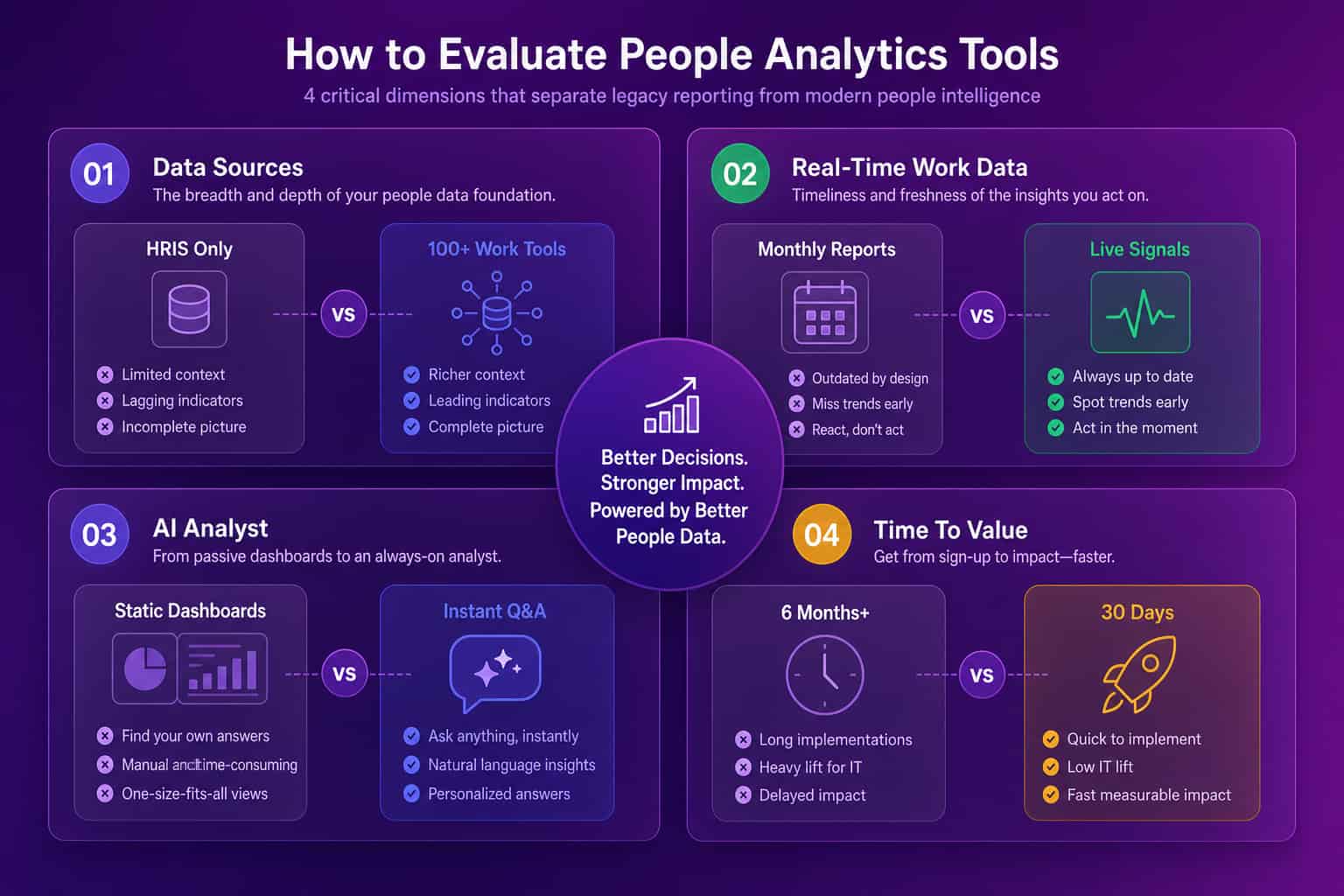
If your buyer is a head of People Analytics optimizing compensation across a global enterprise, a dedicated HRIS-based platform earns its price. If your buyer is a COO or VP Engineering at a tech company asking "where is leverage leaking, and is my team actually productive," the tool has to see the work. That is the whole argument. People analytics built on the org chart describe your company. People analytics built on work data run it. You can explore the privacy-first workforce analytics approach or start with what people analytics is if you are early in the research.
Big platforms describe the headcount. Work data tells you if it is working.
FAQ
What are people analytics tools?
People analytics tools collect and analyze workforce data to guide decisions on staffing, retention, productivity, and capacity. Most read from HRIS data like headcount, tenure, and compensation. A newer group, including Abloomify, adds live work-system signals from Jira, GitHub, calendar, and CRM so analytics reflect real delivery, not just the org chart.
Is Abloomify a Visier alternative?
For a tech-company buyer, yes. Visier is built for large-enterprise HR analytics on HRIS data. Abloomify is privacy-first workforce intelligence that combines people data with work data from 100+ tools, with engineering velocity and AI tool ROI included. Mid-market companies that want operational visibility, not just headcount analytics, treat it as a direct alternative.
Do people analytics tools work without surveys?
Yes. Survey-based tools like Culture Amp rely on periodic self-reports. Work-data platforms like Abloomify analyze observed signals from connected systems (capacity, delivery, collaboration) continuously, with no survey fatigue. Many teams use both: surveys for sentiment, work data for the earlier, harder signal of how the work is actually going.
Are people analytics tools a privacy risk?
They do not have to be. Abloomify is PII-free by architecture: no screenshots, no keyloggers, no screen recording, no message content, and it is SOC 2 Type 2 certified. It analyzes aggregated work patterns, not individual content. That privacy-first design is what keeps employee trust intact while still giving leaders real visibility.
How much do people analytics tools cost?
Enterprise platforms like Visier are custom-priced and often run six figures a year for large deployments. Mid-market workforce intelligence costs far less. Abloomify is $9 per seat per month billed annually, with workforce analytics, engineering metrics, AI tool ROI, and a performance suite included on every plan.

Amir Tavafi
Co-Founder & CEO
Product leader and innovator with over 15 years of experience in the tech sector, grounded in AI and robotics. Previously led product development in fraud detection and AI solutions at Nasdaq Verafin.