Overemployed Staff: How to Spot Dual Jobs Without Surveillance
June 17, 2026
Amir Tavafi
11 min read

Somewhere in your company, an overemployed engineer may be quietly holding down a second full-time job on your clock. This is not a meme from Reddit anymore. Boards spent 2026 asking COOs where payroll leaks, and a single over-employed hire can sit comfortably inside the $500K to $2M in hidden workforce waste that many tech companies carry. The hard part is finding it without turning your company into a surveillance state.
Key Takeaways
Q: What does it mean to be overemployed?
A: Overemployed means holding two or more full-time jobs at the same time, usually remote, without telling either employer. The term comes from the r/overemployed community. For employers it shows up as a worker whose attention and capacity are split across two companies that both think they have 100%.
Q: Is being overemployed illegal?
A: Usually not for the employee, unless it breaches an exclusivity clause or non-compete, or involves billing two employers for the same hours. The bigger risk for companies is confidentiality, conflicts of interest, and split capacity. Most cases are a contract and performance issue, not a criminal one.
Q: What are the signs someone is overemployed?
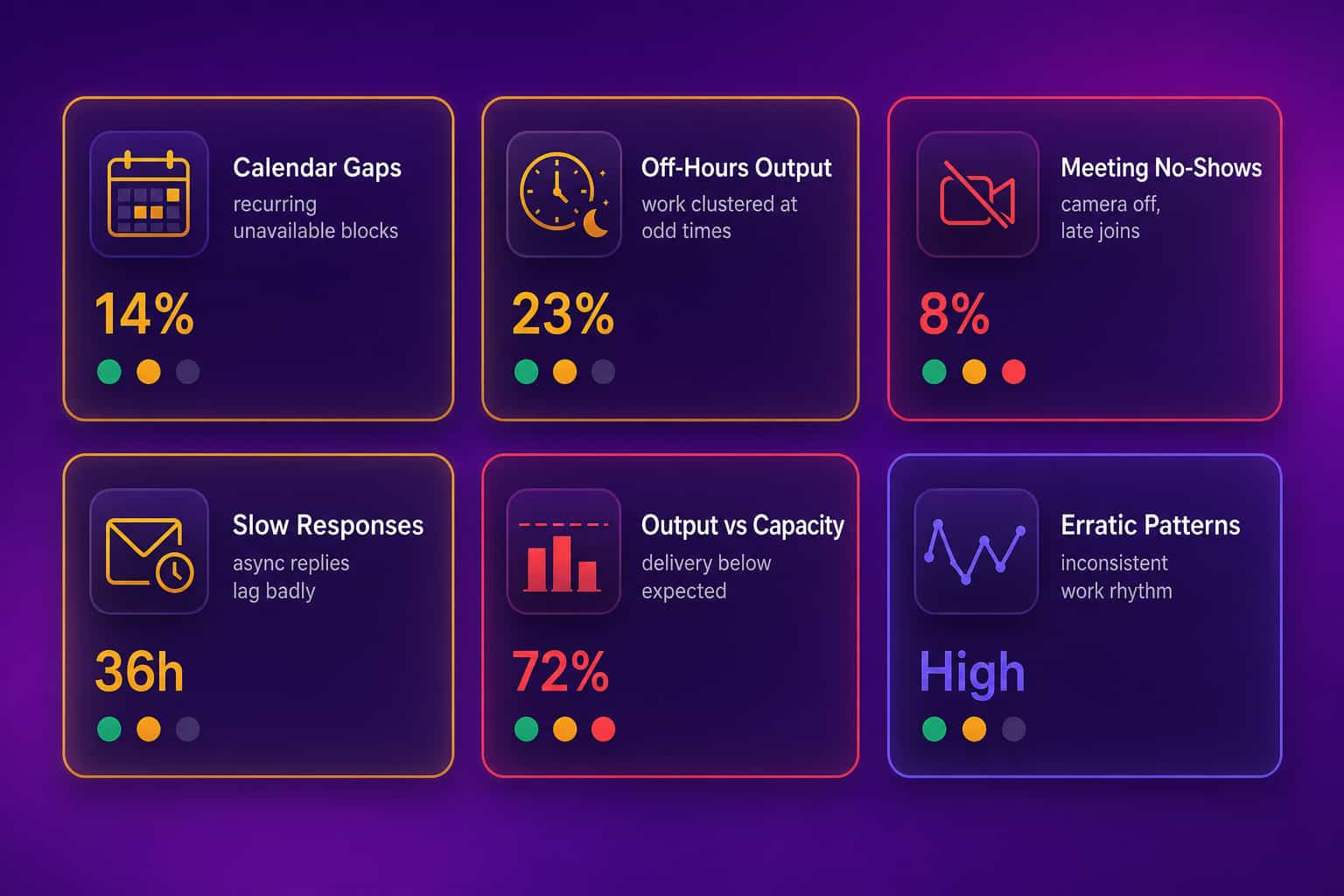
A: Recurring calendar gaps, chronic meeting no-shows with camera off, output that lags well behind capacity, and response times that spike during business hours. No single signal proves anything. The pattern across calendar, delivery, and collaboration data is what matters.
Q: How do you detect overemployment without spying?
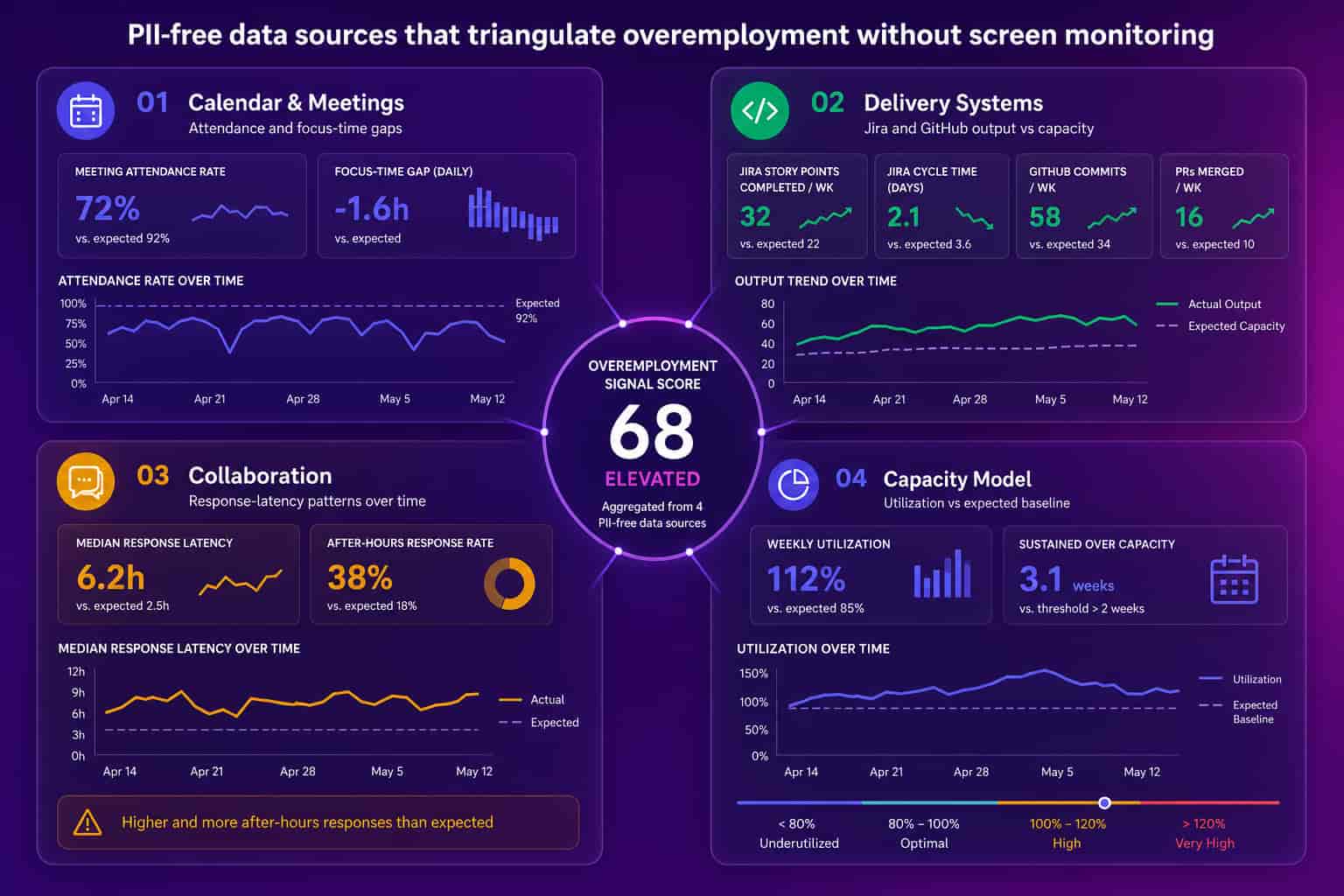
A: Abloomify connects to Google Workspace, Jira, and GitHub through 100+ PII-free API integrations and reads aggregated work patterns, not screenshots or keystrokes. Multiple weak signals triangulate into a clear picture of split capacity without reading anyone's screen.
What does "overemployed" actually mean?
Overemployed describes someone working two or more full-time jobs at the same time, almost always remote, usually without telling any of the employers involved. The word went mainstream through the r/overemployed community, where engineers and other knowledge workers trade tactics for running two paychecks at once. It is close to moonlighting and polyworking, but those usually mean a side gig on your own time. Overemployment means two primary jobs that each believe they have your full attention. From the employer's seat, the problem is not moral panic about side income. It is split capacity. You hired and you pay for one full-time person, and you receive a fraction of one, while a second company pays for the same fraction. The work that does not get done is invisible, which is exactly why it is expensive.
Why overemployment became a real cost in 2026
Overemployment turned from a curiosity into a real line item because three things changed at once. Remote and hybrid work removed the physical signal that someone was actually present and focused. Async culture made it normal to be offline for hours, so a missing teammate no longer looks unusual. And AI coding tools let a single person produce enough output to look productive on two teams at the same time. Stack those together and a senior hire can split their week across two companies without either one noticing for months. Meanwhile, boards spent 2026 asking COOs where payroll leaks. A single over-employed senior engineer or manager can sit comfortably inside the $500K to $2M in hidden workforce waste that many tech companies carry. The ironic part is that the obvious fix, more monitoring, is the one with the least evidence behind it.
The reflex when leaders hear "overemployed" is to install a screen recorder. That reflex is backwards. There is no evidence that monitoring improves performance (Personnel Psychology meta-analysis), and roughly 1 in 6 workers say they would quit over surveillance, per 2026 survey research. So you catch one over-employed person and trigger your best engineers to start interviewing. The same pattern shows up with disengagement, which is why we wrote about spotting quiet quitting without monitoring. The goal is to find split capacity without breaking the trust of the people who are doing exactly what you hired them to do.
The signs someone is overemployed
The signs someone is overemployed show up as a pattern across systems, never as one smoking gun. The common ones are recurring calendar gaps at the same times each week, chronic meeting no-shows or camera-off late joins, output that lags well behind the person's capacity and seniority, and response times that spike during normal business hours and then catch up late at night. On their own, each of these has an innocent explanation. A new parent guards their mornings. A senior engineer blocks the focus time you asked them to protect. A thoughtful person batches Slack instead of answering instantly. What separates a healthy work style from a second job is the combination: low daytime presence, plus delivery below capacity, plus collaboration that consistently happens around the edges of your hours. The shape is what tells the story, not any single data point.
I spent seven years building fraud detection at Verafin before starting Abloomify, and the logic here is familiar. No single transaction is proof of anything. The shape of behavior across many accounts is. Overemployment reads the same way. You are not looking for the one alert that nails someone. You are looking for a pattern that does not fit the role you are paying for.
How to spot overemployment without surveillance
You can spot overemployment without a single screenshot by reading the work signals you already generate, not the screen behind them. Abloomify connects to the tools where work actually happens, Google Workspace, Microsoft 365, Jira, GitHub, calendars, and CRM, through more than 100 PII-free API integrations. It reads aggregated patterns: when focus time happens, how delivery tracks against capacity, how response latency moves through the day, whether meeting attendance matches calendar load. An optional device agent on Mac or Windows adds application-category usage, again with no screenshots, no keyloggers, and no screen recording. No single feed is conclusive. Layered together, calendar plus delivery plus collaboration plus a capacity model triangulate split attention the same way a fraud system triangulates a suspicious account from many weak signals. That is the difference between knowing the shape of someone's work and spying on their desktop.
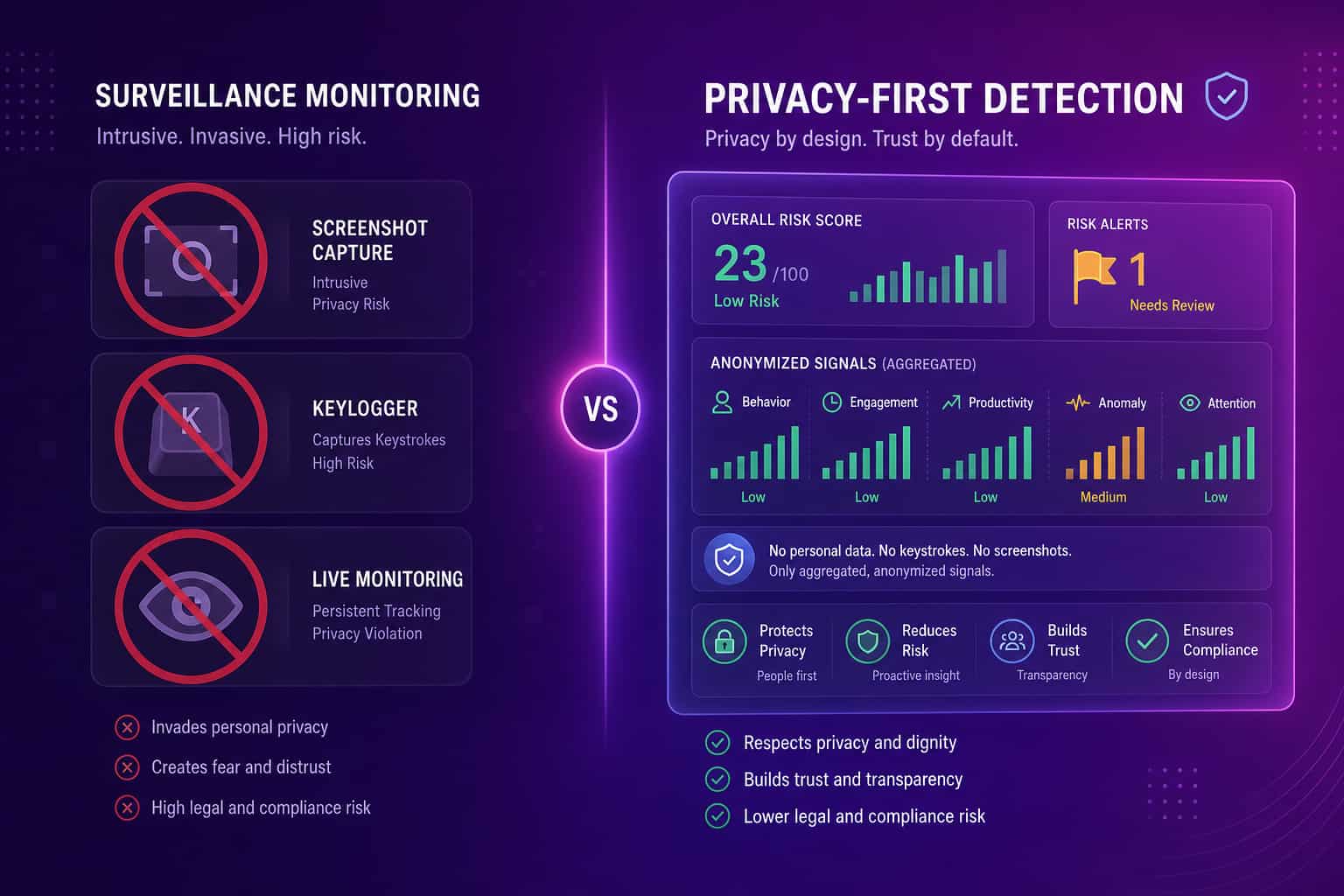
Surveillance monitoring (ActivTrak, Insightful, Time Doctor)
Privacy-first detection (Abloomify)
When we first sold this wedge to a 3,500-person enterprise, we led with a single data source, Google Workspace, and learned the hard way that one source under-proves the case. The COO told us the data showed low correlation with their internal performance metrics. The lesson stuck, and it is the whole point of this section: overemployment hides in the gaps between systems, so you need more than one. You can see the connected approach on our privacy-first workforce analytics page.
Is overemployment illegal, and what can leaders do?
Overemployment is usually not illegal for the employee, but that is the wrong question for a leader to start with. In most US roles, holding a second job is legal unless it breaches a signed exclusivity clause or non-compete, creates a conflict of interest, exposes confidential information, or involves billing two employers for the same hours. Those last cases can cross into breach of contract or fraud, which is why you check your employment agreements with counsel before doing anything. For the large majority of cases, though, the real issue is simpler and more useful to act on: are you getting the capacity and the focus you are paying for? Frame it as a performance and capacity conversation backed by data, and you avoid both the legal swamp and the morale damage of treating your whole team like suspects.
The practical move is to manage to outcomes. If two engineers carry the same scope and one ships half as much across a quarter, the second job almost does not matter. You have a capacity problem to solve either way, and measuring productivity through outcomes gives you the conversation without the spyware.
Detecting overemployment without breaking trust
Detecting overemployment without breaking trust comes down to one principle: measure outcomes and capacity openly, instead of watching people secretly. When your team knows you look at delivery, focus time, and meeting load, and that you do not read their messages, screenshots, or keystrokes, the honest majority has nothing to fear and the math still surfaces the few who are stretched across two payrolls. This is the same privacy-first posture that finds quiet quitters, flags burnout risk 60 or more days early, and recovers $50K to $100K a year in unused SaaS licenses, all from one signal layer. You get the visibility that monitoring tools promise, without the surveillance that makes one in six of your people quietly update their resume. Overemployment is just one pattern that falls out of doing this well.
The cost rarely stops at one paycheck. Split capacity shows up as missed commitments, slipped roadmaps, and a license-and-tooling bill nobody trimmed, which is why the same data feeds SaaS license optimization once you can see who actually uses what. Find the pattern, have the human conversation, fix the capacity gap, and move on.
Screenshots tell you a window was open. Work signals tell you whether the job is getting done.
The 30-Day Workforce Waste Assessment
If you want the answer for your own org rather than the theory, we run this as a 30-Day Workforce Waste Assessment. You connect Google Workspace or Microsoft 365 plus one more source, which takes about an hour of setup with read-only access. Thirty days later you get an executive report with dollar-quantified waste findings, a capacity map by team, and recommended actions. We also leave a recurring exec brief configured, a scheduled Bloomy task that keeps the same read arriving in your inbox after the assessment ends, so the visibility does not stop when the report lands.
The risk reversal is simple: if we find zero actionable insights, no further obligation. Start the 30-Day Workforce Waste Assessment.
FAQ
What is the meaning of overemployed?
Overemployed means holding two or more full-time jobs at the same time, usually remote and usually undisclosed. The term spread through the r/overemployed community. For employers, the practical meaning is split capacity: you pay for one full-time person and receive part of one, because a second company is paying for the rest.
Is overemployment illegal?
For the employee, usually not, unless it breaches an exclusivity clause or non-compete, creates a conflict of interest, leaks confidential data, or involves billing two employers for the same time. Those cases can become breach of contract or fraud. Most situations are a performance and capacity issue, so check your agreements with counsel before acting.
What are the signs an employee is overemployed?
Recurring calendar gaps at the same times, frequent meeting no-shows with camera off, delivery that lags behind the person's capacity, and response times that spike during business hours then catch up at night. No single signal is proof. Overemployment shows up as the pattern across calendar, delivery, and collaboration data.
Can you detect overemployment without monitoring software?
Yes. Abloomify reads PII-free work signals from 100+ integrations like Google Workspace, Jira, and GitHub, plus optional aggregated device-agent metrics, with no screenshots, keyloggers, or screen recording. It triangulates split capacity from many weak signals, so you get the picture without surveilling anyone's screen.
How is overemployment different from quiet quitting?
Quiet quitting is doing the minimum at one job. Overemployment is doing the minimum at one job because the person's real attention is on a second full-time job somewhere else. Both show up as output below capacity, which is why the same privacy-first signal layer surfaces them.

Amir Tavafi
Co-Founder & CEO
Product leader and innovator with over 15 years of experience in the tech sector, grounded in AI and robotics. Previously led product development in fraud detection and AI solutions at Nasdaq Verafin.