Best Productivity Analytics for Startups (2026)
April 13, 2026
Walter Write
16 min read

There is a moment most startup founders recognize. Somewhere around 30 to 50 employees, the intuition that carried the early days stops working. You are no longer in every Slack thread. You stop knowing who is blocked. You hear about a three-week delay in week four. And the first fix everyone reaches for, more meetings, makes the whole company slower.
The people are fine. The signal is gone. Productivity analytics at this stage is mostly about getting that signal back from the systems where work already happens, without installing something that makes your best engineers update their resume.
Quick answers
Q: Why do startups specifically need productivity analytics at 30+ employees?
A: Below 30 people, a founder has direct line of sight to almost everything. Above that, information starts moving through layers, and every layer either summarizes it or slows it down. Structured signals pulled from Jira, Slack, GitHub, and the calendar replace the memory of having been in every room.
Q: What is the biggest mistake startups make when buying productivity tools at this stage?
A: Buying activity-monitoring software built for hourly workforces. Screenshots and keystroke counts cannot tell you whether a sprint is at risk, and a Personnel Psychology meta-analysis found no evidence that monitoring improves performance. The wrong tool costs you trust before it produces a single useful insight.
Q: Which tool is the best fit for fast-growing startups in 2026?
A: Abloomify, for startups between 30 and 500 people that want an operating picture rather than a surveillance dashboard. It reads work signals across engineering, collaboration, and project tools, it is privacy-first by architecture, and Bloomy answers questions from live data instead of you booking another status meeting. Pricing is $9 per seat per month billed annually, free up to 5 users.
Q: How quickly can a startup get value?
A: Most teams connect their core systems in a day and have usable baselines inside the first week. The early findings are usually meeting overload in engineering, an onboarding gap nobody had put a number on, and a review bottleneck everybody suspected but could not point at.
Q: What signals matter most at this stage?
A: Engineering cycle time, focus time against meeting load, async throughput, time to first contribution for new hires, and where reviews and approvals stall.
What actually goes wrong at 30+ employees
The inflection point is real and the cause is structural. Every layer you add is one more place where a status update gets rounded off or arrives late. That hurts a startup more than it hurts an enterprise, because speed is usually the only structural advantage you have over the incumbent.
Here is what founders describe when they hit this stage:
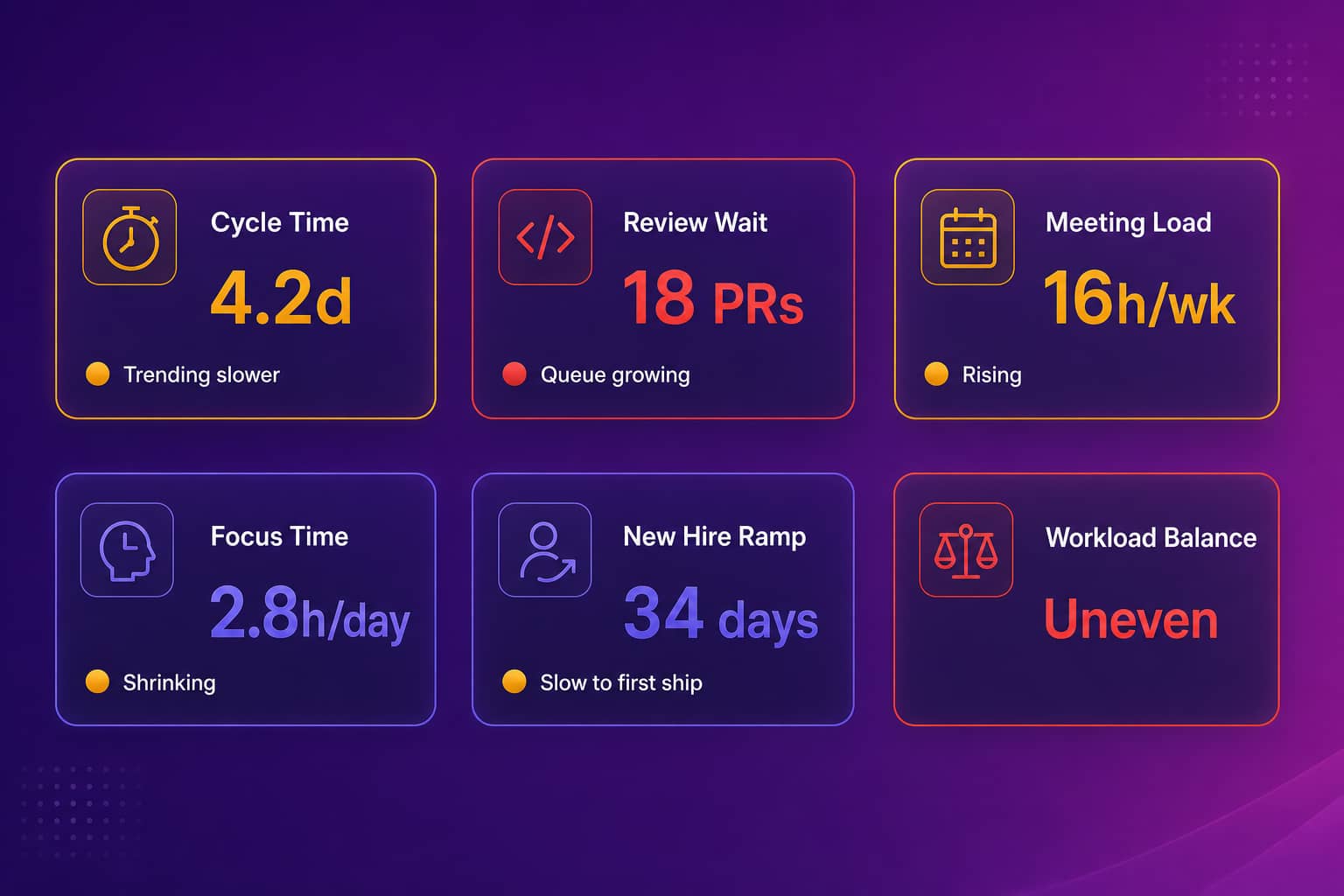
- Engineering feels slower but nobody can explain why
- New hires are taking six to eight weeks to ship their first meaningful change
- The same meetings keep recurring with no resolution
- Teams are busy but output is unclear
- Burnout shows up suddenly rather than building visibly
- Managers spend more time in status updates than in the work
- Board prep takes half a day of manually gathering data from five tools
The instinctive response is to add process: another standup, another review gate. That usually makes things worse before it makes them better, because it adds more talking about work without adding any signal about work.
Which productivity analytics tools are best for fast-growing startups?
These are the tools most relevant to founders and ops leaders at growth-stage startups in 2026:
- Abloomify: best for startups that want one operating picture across engineering, collaboration, and delivery, plus an AI layer they can actually query
- ActivTrak: best for companies that primarily want workforce activity tracking and time-on-task data
- Hubstaff: best for startups with distributed or hourly workers who need time tracking and basic productivity signals
- Microsoft Viva Insights: best for Microsoft 365 shops that want meeting and collaboration data inside the M365 environment
- Linear or Jira analytics: best for startups that only need engineering throughput data and do not yet need cross-functional visibility
- Lattice or 15Five: best for startups whose primary gap is performance management and engagement rather than operational intelligence
What should startups prioritize when evaluating tools?
The buying criteria that matter here are different from what large enterprises optimize for. Six questions worth asking every vendor:
- Can it tell you whether engineering velocity is moving and why, or only how many hours went into meetings?
- Can a technical founder or a one-person ops team set it up in a day, without a six-week implementation project?
- Does it work from privacy-first, PII-free signals, or does it need screenshot capture and keystroke logs that will cost you trust the day someone finds out?
- Does it cover engineering, collaboration, and delivery together, or only one slice?
- Can a founder ask a question and get a useful answer in two minutes, or do they have to build a dashboard first?
- Will the same tool still fit at 200 or 500 people?
Quick comparison: how do these tools stack up for startups?
| Tool | Best for | Key strengths | Watch-outs for startups |
|---|---|---|---|
| Abloomify | Startups wanting cross-functional operating visibility and an AI
layer founders can query | Outcome-linked analytics, Bloomy AI Chief of Staff, 100+
integrations, privacy-first and PII-free by architecture, SOC 2 Type
II, fast setup | Best value emerges when teams want genuine insight, not just
activity dashboards |
| ActivTrak | Teams primarily monitoring application and website usage | Activity-level data, time-on-task visibility, productivity
categories | Activity monitoring maps poorly to startup outcomes, and can create
a surveillance culture that damages early-stage trust |
| Hubstaff | Distributed teams with hourly or contractor-heavy workforces | Time tracking, GPS, screenshot options, payroll integration | Built for time-tracked work, not knowledge-work productivity; poor
fit for product and engineering teams |
| Microsoft Viva Insights | M365-native startups wanting calendar and meeting data | Meeting overload signals, focus time within M365, collaboration
trends | Limited to M365 signals; no engineering or cross-tool view; not
queryable the way founders actually think |
| Linear / Jira analytics | Engineering-only visibility into cycle time and throughput | Delivery tracking, sprint data, issue throughput | Only covers engineering; no collaboration, burnout, or cross-team
signals |
| Lattice / 15Five | Teams whose main gap is structured performance reviews and
engagement programs | Review workflows, goal management, manager coaching | Performance tooling without operational context; does not surface
what is causing slowdowns |
1) Why is Abloomify the strongest fit for fast-growing startups?
Abloomify starts from the same problem a founder has at this headcount: you need to understand what is happening across the business without being in every room, channel, or status meeting.
The mechanism is straightforward. Connect Abloomify to the tools where work already happens, so GitHub, Jira, Linear, Slack, Google Workspace or Microsoft 365, and your HRIS. It normalizes and correlates the signals across all of them, PII-free by architecture, which means no email content, no message content, no file content. The optional Mac and Windows device agents follow the same rule: aggregated usage metrics only, with no screenshots, no keyloggers, no screen recording, and no content capture.
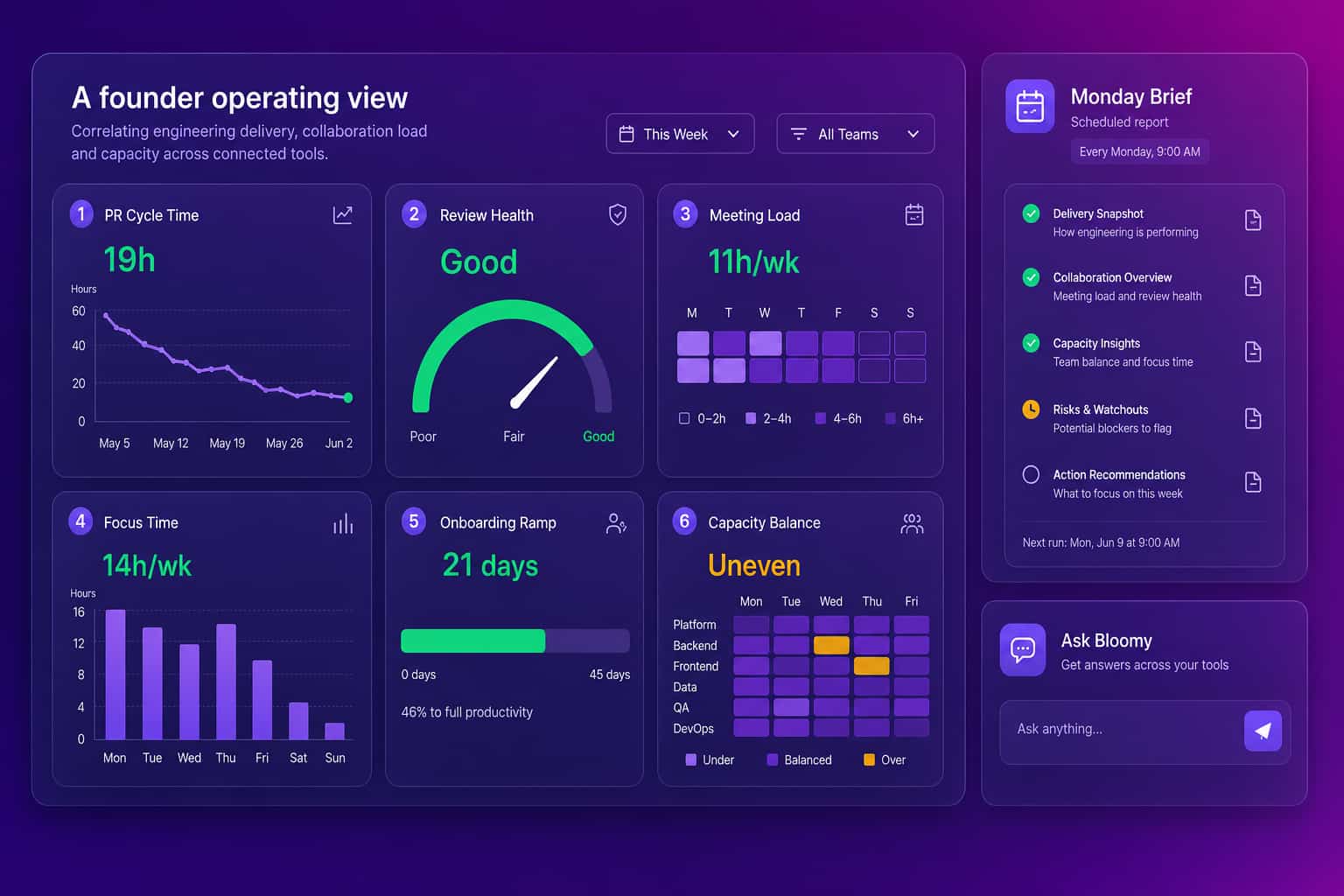
Then Bloomy becomes the interface. Founders and managers ask direct questions, "which teams are showing bottleneck signs this week?" or "how has engineering cycle time moved this month?", and get answers from live data instead of a report someone assembled on Tuesday.
Bloomy also runs on a schedule. With Bloomy Tasks, you point it at your connected data, pick a cadence, and it emails a decision-ready report. Every run stays a resumable conversation, so a Monday brief about stalled PRs is something you can click into and keep interrogating. Dashboards you check. Bloomy checks in on you.
In practice each role pulls something different out of the same data. A founder watches engineering velocity, collaboration health, and early burnout signals without calling an all-hands. Engineering managers live in the PR cycle time trends and the review bottleneck detection. For ops and people leaders it is usually onboarding speed, meeting load against focus time, and SaaS licenses nobody has opened in two months. The compounding effect is that the leadership team stops arriving at Monday with four different versions of how the week went.
For direct tool comparisons, see Abloomify vs ActivTrak and Abloomify vs Hubstaff, or browse the full alternatives list.
2) When does ActivTrak make sense?
ActivTrak is a reasonable fit when the primary need is application and website usage monitoring. If you run a call center, have a large group of contractors doing repetitive tasks, or need to know which tools people actually open so you can cut licenses, ActivTrak gives you that view.
Where it struggles for startups is where activity monitoring always struggles: it measures the inputs. Knowing that engineers spent most of the week inside an editor tells you nothing about whether they were unblocked, whether reviews came back in time, or whether the sprint goal was at risk. For knowledge work, activity is a weak proxy for output.
The other cost is trust. Engineers and product people at growth-stage startups know exactly what these tools do, and 2026 survey research found roughly 1 in 6 workers would quit over workplace surveillance. That is an expensive way to answer a visibility question. The full side-by-side, including what ActivTrak does well, is on the Abloomify vs ActivTrak comparison.
3) When does Hubstaff work?
Hubstaff is built for teams that need to track billable time, GPS location, or time-on-task for distributed and hourly workers. If your startup has a field team, a contractor-heavy model, or a service delivery component where time is the unit of billing, it solves a real operational problem.
It is a poor fit for product, engineering, or knowledge-work teams, where the work happens asynchronously across pull requests, documents, and design files rather than on a clock.
4) What is the role of Microsoft Viva Insights?
Viva Insights is a decent signal source if your team already lives in Microsoft 365. It surfaces meeting load, focus time trends, and collaboration patterns inside that environment, and its privacy posture is reasonable.
The limitation is scope. Viva tells you about calendar and email behavior. It says nothing about GitHub activity, Jira cycle time, Slack collaboration patterns, or the delivery pipeline. For a founder who needs the cross-functional view, Viva is a useful input rather than the answer. Abloomify integrates with M365 and extends it rather than replacing it.
5) What about engineering-only tools like Linear analytics or Jira?
Linear and Jira both ship native analytics covering cycle time, throughput, and sprint health. Those are genuinely useful and most startups should already be using them.
The gap is attribution. Engineering-only data will not tell you whether the slowdown is caused by review bottlenecks, unclear requirements arriving from product, company-wide meeting overload, or one engineer quietly carrying too much. Getting from data to a decision needs cross-functional context those tools were never designed to hold.
Founders often reach a point where they cannot tell whether engineering is slow or whether everything around engineering is slow. That distinction changes what you do next, which is why we built engineering productivity analytics to sit alongside the collaboration and capacity data rather than in its own silo.
Which signals should startups prioritize first?
Not everything needs measuring on day one. Start with the signals that drive the most decisions:
| Signal | What it tells you | First action if off-track |
|---|---|---|
| Engineering cycle time | Whether the delivery pipeline is speeding up or slowing down | Identify review bottlenecks or batch size issues; reduce in-flight
work |
| Focus time vs meeting load | Whether knowledge workers have enough uninterrupted time to do deep
work | Cancel or convert recurring meetings; protect morning blocks across
the team |
| New hire time to contribution | How effectively the organization is onboarding new people | Add a structured starter task, a dedicated reviewer, and a
documented first-10-days path |
| Async throughput per team | Whether teams are making progress between meetings or only during
them | Replace status meetings with async summaries; add written decision
logs |
Burnout and workload imbalance signals | Whether certain team members or teams are carrying disproportionate
load | Rebalance assignments; reduce meeting load for high-output
individuals; check in 1:1 |
How should a startup roll out productivity analytics?
Rollouts fail when they get announced as monitoring programs. They work when the team can see their own data and use it to remove friction. A practical six-week path:
- Week 1: Connect core sources (GitHub, Jira or Linear, Slack or Teams, Google Workspace or M365). Establish baselines. Tell the leads what you are measuring and why, before they hear it secondhand.
- Week 2: Run the first Bloomy snapshot with the leadership team. Pick one engineering bottleneck and one collaboration pattern worth fixing.
- Weeks 3 to 4: Fix those two. Cut or convert one recurring meeting. Clear the review bottleneck. Watch whether cycle time responds.
- Week 5: Check onboarding speed for recent hires. If time to first contribution is high, add the first-10-days structure.
- Week 6: Schedule a Bloomy Task to replace one synchronous status meeting with an emailed Monday brief, and confirm teams feel more informed rather than more watched.
The test at the end of week six is simple. Can the founder answer "where are we stuck?" without asking anyone? If the honest answer is still "let me check with the leads," the rollout has not landed yet.
Common mistakes startup founders make
The most common one is treating activity as a proxy for productivity. Hours logged and messages sent are poor substitutes for outcomes shipped, and optimizing for them teaches people to look busy.
Close behind is deploying a tool without context. Announcing "productivity tracking" without explaining which outcomes you care about destroys trust faster than any insight can rebuild it.
Then there is buying only for current headcount. A tool that works at 40 people but demands a full enterprise implementation at 200 hands you a switching cost right when you have the least time for one.
And the quietest mistake is optimizing one function in isolation. Engineering metrics without collaboration context, or engagement scores without delivery data, give you half a picture, and it is often the wrong half.
FAQ
What is the right time for a startup to adopt productivity analytics?
The trigger is the first time a founder or senior leader says "I am not sure what is happening across the team anymore." That usually lands between 25 and 50 employees. Earlier, informal visibility is enough. Much later and the patterns you need to fix have hardened into habits.
Will productivity analytics make employees feel micromanaged?
It depends on how you frame and use it. Outcome-linked analytics that help teams see their own velocity and clear blockers are usually welcomed. Activity monitoring that tracks mouse movement and screen time is not. Pick privacy-first tools, explain what you are measuring and why, and share the data with the people it describes.
How is Abloomify different from just using Jira and Slack analytics?
Jira and Slack each give you useful data inside their own boundary. The gap is correlation. Abloomify connects engineering delivery data with collaboration patterns, calendar data, and HRIS signals, then lets you query across all of it through Bloomy. That is what tells you why cycle time is climbing, not just that it is.
We already use ChatGPT and Claude. Why add another tool?
Fair objection, and it is the one we hear most from technical teams. External AI Access connects the assistants you already pay for to your company's Abloomify knowledge over MCP, so Cursor, Claude Code, Claude Desktop, and ChatGPT answer from your work data instead of generic training data. Every connection is scoped to what that person is already allowed to see, and it is revocable instantly. We are not the only vendor shipping an MCP server; the difference is what sits behind ours, which is PII-free cross-tool work data rather than a single product's silo.
Can a startup with no dedicated analytics team use Abloomify?
Yes. Setup is built for technical founders and lean ops teams without data engineering. Most integrations connect in minutes, and because Bloomy answers questions directly, nobody has to build dashboards first.
What happens to data privacy at this scale?
Abloomify is privacy-first by design and PII-free by architecture: no email content, no message content, no file content, and on the optional device agents, no screenshots, no keyloggers, no screen recording, and no content capture. Role-based access means managers see the signals for their own teams. Hosting is available in North America or the EU, and the platform is SOC 2 Type II certified.
Which tool should you choose?
Choose based on the operating model you are building, not the feature list.
- Abloomify if you want cross-functional visibility, outcome-linked analytics, an AI Chief of Staff you can query and schedule, and a privacy-first design that still fits at 500 people.
- ActivTrak if your primary need is application usage monitoring for a non-engineering workforce and you have thought hard about the trust implications.
- Hubstaff if your team is primarily hourly or contractor-based and billing accuracy is the core requirement.
- Viva Insights if your team is entirely inside Microsoft 365 and you want meeting and focus data without adding a platform, paired with something broader for engineering visibility.
- Linear or Jira analytics as the foundation for engineering-specific signals, understanding they are one layer rather than the whole picture.
Final take
Going from a company where the founder knows everything to one where the founder needs systems is just the job changing shape. The startups that handle it well instrument their operations early, pick tools that report outcomes instead of activity, and use the data to remove friction rather than to check up on people.
Abloomify is built for that transition. Connect your tools, ask Bloomy what matters, put the recurring answer on a schedule, and get back to building.
Want to see it against your actual data? Book a demo or start a free trial. If you are actively comparing options, start with Abloomify vs ActivTrak.

Walter Write
Staff Writer
Tech industry analyst and content strategist specializing in AI, productivity management, and workplace innovation. Passionate about helping organizations leverage technology for better team performance.