Best Performance Management Tools for Hybrid Teams (2026)
April 23, 2026
Walter Write
4 min read

Hybrid team leaders need performance tools that connect delivery outcomes to coaching. Abloomify's AI Chief of Staff, Bloomy, gives managers instant performance insights from live data across 100+ connected tools.
Key Takeaways
Q: What should hybrid teams measure?
A: Delivery/quality outcomes, communication clarity (handoffs, docs), and meeting load, no keystrokes or presence tracking.
Q: Which tools help?
A: Workforce analytics, lightweight decision/docs systems, async collaboration trackers, and outcome‑linked dashboards.
Q: Targets?
A: PR lead time down, handoff issues fewer, meeting hours reduced, and docs clarity higher via examples and templates.
Which signals matter most, and what quick reference should we use?
Hybrid performance should emphasize outcomes and clarity over presence tracking. Use a compact set across delivery/quality, collaboration, and load.
- Delivery & quality: lead time, rework, incidents
- Collaboration: handoff quality, doc patterns, async response
- Load: meeting hours, interrupt rate
| Metric category | Example metrics | Why it matters |
|---|---|---|
| Collaboration | Handoff completeness, doc examples, async response | Reduces friction and status meetings |
| Load | Meeting hours, interrupt rate | Protects focus time |
How do tools compare at a glance?
We compare workforce analytics, docs/decision systems, calendar insights, and collaboration tools by how well they reduce friction and tie work to outcomes.
| Capability | Workforce Analytics | Docs/Decision Log | Calendar/Time | Collab Tools |
|---|---|---|---|---|
| Outcome correlation | Effort → delivery/quality | Decisions only | Load only | Messages only |
Which data sources and integrations do we use?
- Git/issue trackers for delivery and rework signals
- Docs/edit history and templates for clarity patterns
- Calendar/time insights for meeting load
- Helpdesk/collab tools for handoff quality and response time
What targets are reasonable?
Targets should be reachable within one quarter and visible on demand via Bloomy so teams can steer toward them.
- Lead time −10–20%; rework incidents trending down
- Handoff quality ≥ 85% completeness with examples
- Meeting hours −15–25% with async norms
Which thresholds should trigger coaching?
Use simple thresholds so managers can act without adding process bloat.
| Signal | Threshold example | Action |
|---|---|---|
| Meeting load | 12 hrs/person/week | Cut status; enforce async templates |
| Handoff quality | 85% completeness | Adopt checklist; add example library |
| Async response | 24 hrs for tagged requests | Introduce office‑hours + response SLA |
What is our 8‑week rollout plan?
Week 1–2: Baseline outcomes and meeting load.
Week 3–4: On-demand snapshot via Bloomy; handoff checklist and docs examples.
Week 5–6: Reduce recurring meetings; async norms.
Week 7–8: Review outcomes; scale templates.
Week 3–4: On-demand snapshot via Bloomy; handoff checklist and docs examples.
Week 5–6: Reduce recurring meetings; async norms.
Week 7–8: Review outcomes; scale templates.
What’s our definition‑of‑done checklist?
- □Handoff checklist live
- □Docs examples published
- □Meeting reductions implemented
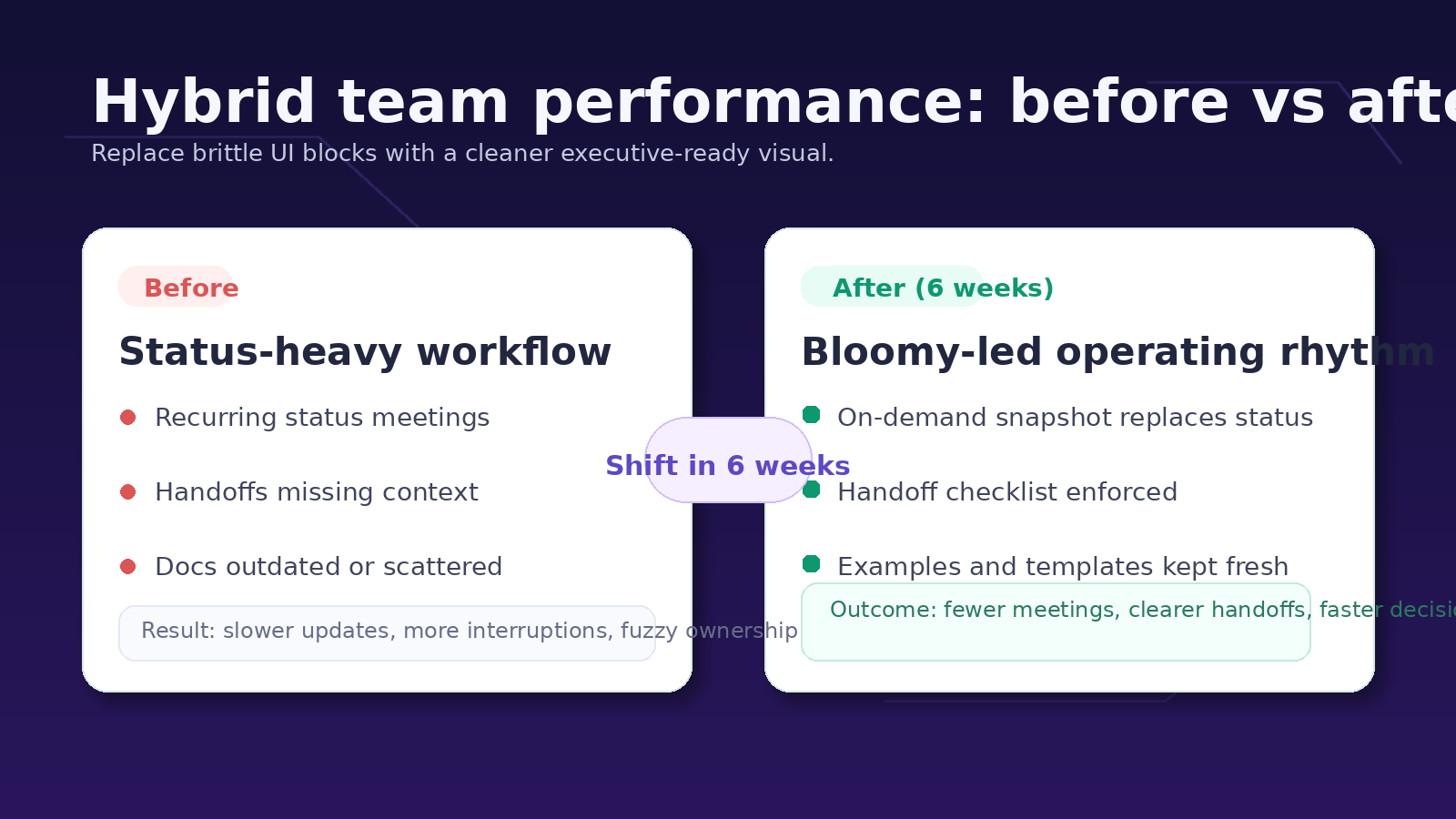
Before vs after (hybrid snapshot)
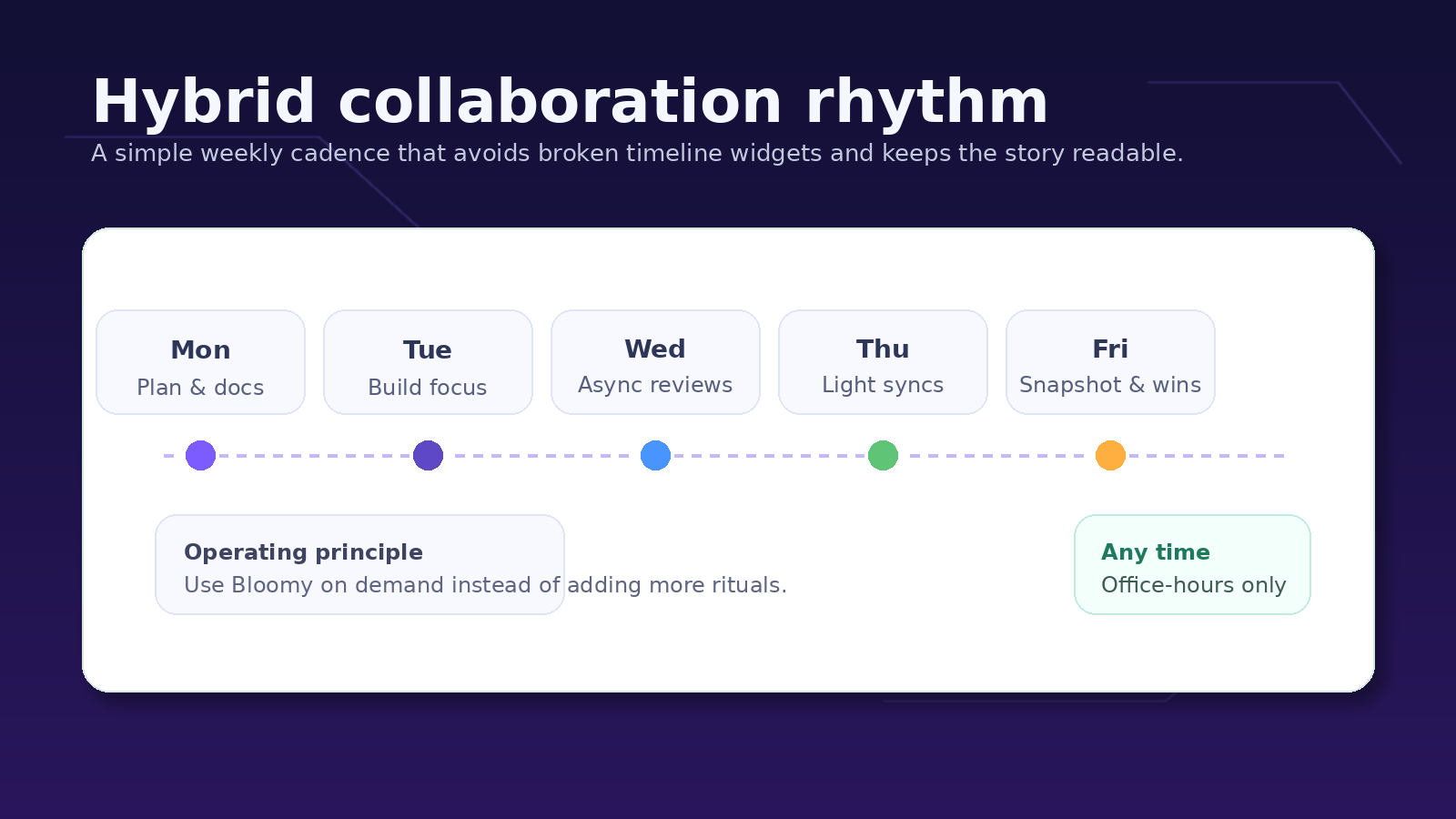
Hybrid collaboration rhythm (timeline)
What leadership reporting should we use?
- On demand: ask Bloomy for delivery/quality, handoff examples, meeting load actions
- Monthly: templates refreshed, async norms adherence, incident links
What does “good” look like by area?
Delivery & quality
- Lead time trending down; rework lower
Collaboration
- Handoff checklist enforced; examples reused
Load
- Meeting hours falling; focus blocks protected
What operating cadence keeps momentum?
- On demand: ask Bloomy for one snapshot with three actions
- Monthly: norms review, template refresh, trend check
FAQ
Q: Can we improve without monitoring presence?
A: Yes, use outcomes, handoff quality, docs patterns, and meeting load, not presence.
Q: How do we prevent meeting creep?
A: Enforce async templates and a meeting‑reduction review in the on-demand snapshot via Bloomy.
What did a pilot achieve?
In a six‑week pilot with a hybrid product squad, we replaced two standing status meetings with a on-demand snapshot via Bloomy and async updates. Meeting hours dropped 23% while lead time improved 14%. A lightweight handoff checklist cut “where is this?” pings and reduced reopen loops in the helpdesk by 18%. The team curated a small examples library for docs (before/after snippets), which sped up onboarding and made handoffs clearer between product, design, and engineering.
Decision log snapshot (example)
| Decision | Owner | Date | Link |
|---|---|---|---|
| Adopt async handoff checklist | Eng Manager | 2026‑02‑03 | /docs/hand-off |
Replace Tues status with snapshot | Product Lead | 2026‑02‑10 | /docs/snapshot |
What does our measurement glossary include?
- Handoff quality: completeness/clarity of cross‑team transfers
- Async SLA: expected response time for tagged requests
- Meeting load: scheduled time in meetings per person
- Rework: time/effort caused by unclear requirements or defects
Next steps
Select one hybrid squad and three measures (lead time, handoff quality, meeting hours). Use Bloomy to generate a live snapshot and scale after eight weeks.
Ask Bloomy any question about your team and get answers from live data, instantly.

Walter Write
Staff Writer
Tech industry analyst and content strategist specializing in AI, productivity management, and workplace innovation. Passionate about helping organizations leverage technology for better team performance.