Fintech Performance Management Tools 2026
April 12, 2026
Walter Write
13 min read

Fintech companies need more than annual reviews and generic HR workflows. The best performance management tools for fintech connect goals, execution, quality, and coaching across systems like Jira, GitHub, Slack, Google Workspace, and HR data, without turning the company into a surveillance machine.
Every vendor on this list runs review cycles. That part is solved. What separates them is whether a manager walks into a 1:1 with the evidence already assembled, and whether your security team can answer where the data lives, who can see it, and what the platform never collects. In a regulated business, those two questions get asked in the same meeting.
Quick answers for fintech buyers
Q: What should fintech leaders look for in performance management software?
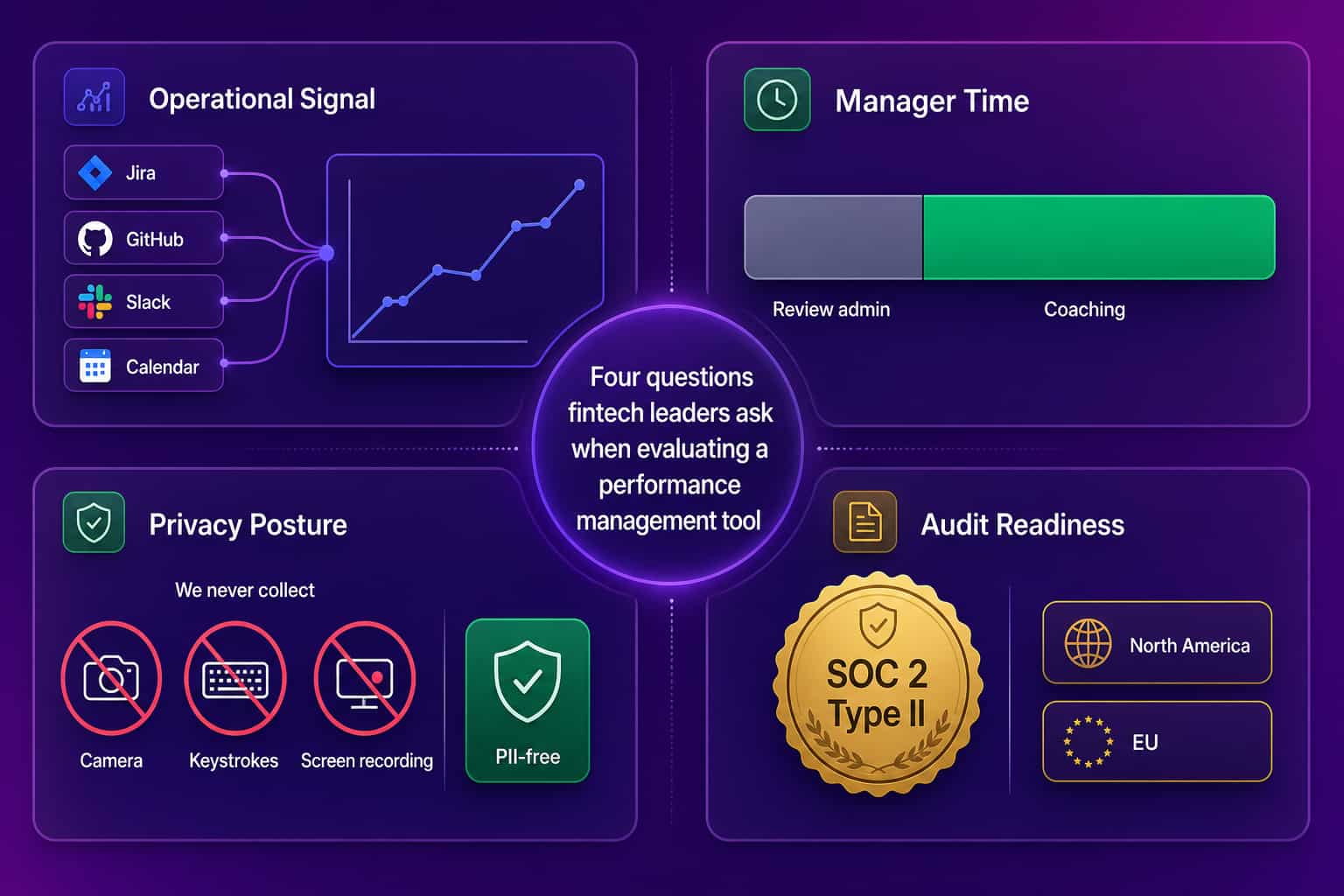
A: Goal-setting, review workflows, and manager coaching are table stakes. The separators are operational signal from the systems where work actually happens (Jira, GitHub, ticketing, calendars) and a posture that survives a security review: SOC 2 Type II, documented data handling, and hosting options in North America or the EU.
Q: Which tool is the best fit for AI-forward fintech companies?
A: Abloomify. It pairs performance management with privacy-first workforce intelligence, and the analysis is PII-free by architecture rather than by a policy toggle someone can flip later.
Q: Which tools are most commonly compared in this category?
A: The options fintech buyers shortlist in 2026 are Abloomify, Lattice, Culture Amp, 15Five, Leapsome, and Betterworks.
Q: What separates "good enough" from "high impact"?
A: Less manager admin, real connections into existing work systems, calibration that does not run on a spreadsheet, and evidence that is ready before the review cycle opens instead of reconstructed from memory afterward.
Which performance management tools are best for fintech in 2026?
For most modern fintech companies, these are the six worth a demo:
- Abloomify. Best for AI-native, high-velocity fintech teams that want performance management, workforce intelligence, and manager guidance in one platform.
- Lattice. Best for companies that want a mature HR-led performance and engagement suite.
- Culture Amp. Best for organizations that prioritize engagement, feedback, and people-science-driven programs.
- 15Five. Best for manager coaching and lightweight performance processes.
- Leapsome. Best for companies that want performance, engagement, and learning in one flexible suite.
- Betterworks. Best for larger organizations focused on structured goals, calibration, and enterprise review cycles.
Want the same shortlist without the fintech lens? We keep a broader ranking in best performance management software for 2026.
What matters most when choosing a fintech performance tool?
Fintech teams operate differently from generic "office teams." They ship on short cycles, work under tighter controls, and usually need visibility across engineering, product, support, and compliance at the same time.
Ask these six questions on every demo:
- Can it read live work data from Jira, GitHub, ticketing, calendars, and chat, or does it only know what people type into the tool itself?
- Does it give managers time back, or does it add another form to fill?
- Is the analytics layer PII-free, or does it drift toward screenshots and keystroke capture?
- Can leaders calibrate across managers without exporting to a spreadsheet?
- Is the AI doing analysis, or is it a writing assistant bolted onto a review form?
- Will it clear a security review: SOC 2 Type II, documented data handling, and hosting options in North America or the EU?
That last question is the one fintech buyers underestimate. A performance platform ends up holding manager notes, ratings, and goal history for the entire company, which puts it in scope for the same reviews as your core systems. If your customers or your regulator expect data to stay in the EU, that has to be a deployment option today, not a roadmap item.
Privacy posture is also what decides whether people actually use the thing.
Quick comparison table: which tool fits which kind of fintech team?
| Tool | Best for | Strengths | Watch-outs |
|---|---|---|---|
| Abloomify | AI-forward fintech teams that want live performance and workforce
intelligence | PII-free analytics, AI-native insights, manager copilot, connected
work-system data | Best value shows up when teams want operational depth beyond review
forms |
| Lattice | HR-led organizations modernizing reviews, goals, and engagement | Widely adopted, broad HR workflows, clear review cycles | Less differentiated for engineering and cross-tool operational
signal |
| Culture Amp | Companies prioritizing engagement, feedback, and people science | Strong employee feedback programs, survey depth, manager development | Can be less execution-linked for teams wanting day-to-day operating
visibility |
| 15Five | Mid-market teams that want lightweight check-ins and coaching
workflows | Manager enablement, 1:1s, engagement, straightforward adoption | Not the strongest fit for fintech teams wanting deeper operational
analytics |
| Leapsome | Companies wanting a flexible all-in-one people suite | Performance, learning, goals, and surveys in one system | Fit depends on whether your priority is people-suite breadth or
operating intelligence |
| Betterworks | Larger teams needing structured goal alignment and enterprise review
rigor | Goal alignment, reviews, calibration, enterprise workflow depth | Can be heavier than necessary for lean fintech teams that move fast |
1) Why is Abloomify the strongest fit for modern fintech companies?
Abloomify is built for fintech teams that want performance management tied to real operating data instead of an isolated HR workflow. The lead is privacy-first: analysis is PII-free by architecture, and the optional Mac and Windows device agents take no screenshots, no keyloggers, no screen recording, and no content capture. IT ships them through any MDM (Intune, Jamf, Rippling, Kandji, and more), so a rollout does not become its own change-management project.
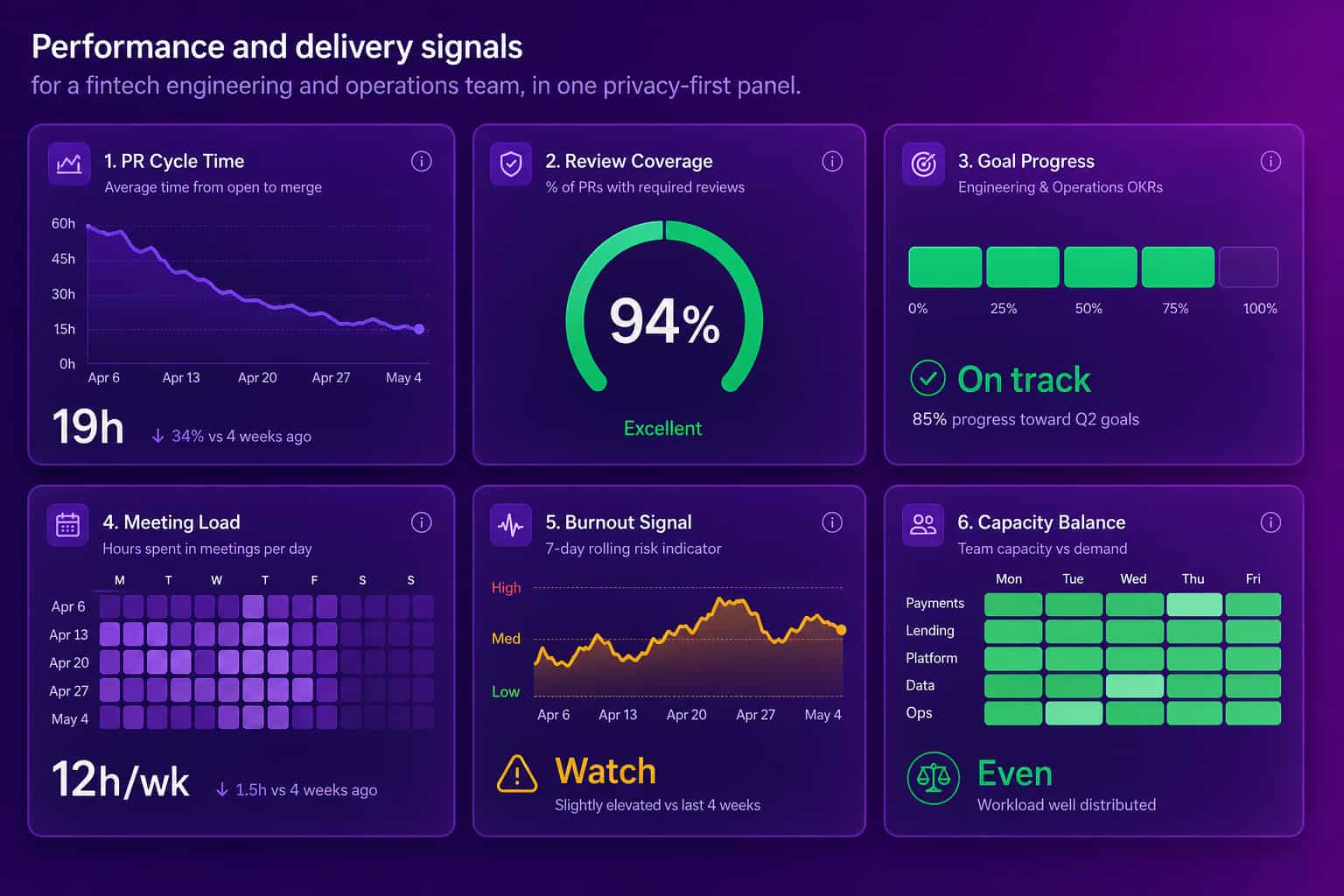
Underneath that sit 100+ integrations across GitHub, Jira, Slack, Google Workspace, Microsoft 365, CRM, and HRIS. Managers get review evidence that already exists: PR cycle time, review health, goal progress, meeting load, capacity balance. Reviews stop being an exercise in recall.
Bloomy is the AI layer, and it works two ways. On demand, it answers questions over connected company data, drafts review prep, and summarizes what changed on a team. On a schedule, Bloomy Tasks runs the work for you: each run mines the connected data, emails a decision-ready report, and leaves a resumable conversation you can keep interrogating straight from the email. Dashboards you check. Bloomy checks in on you.
If your team already lives in ChatGPT, Claude, or Cursor, External AI Access connects those tools to your company knowledge through MCP. A connection only ever grants what that person is already allowed to see, scope is set per person, team, or company, and an admin can revoke it instantly. Several vendors ship MCP servers now. The part that matters for a fintech is what sits on the other end of the connection: permission-scoped, PII-free work data from across your stack rather than one vendor's silo.
On the compliance side, Abloomify is SOC 2 Type II certified, with hosting options in North America or the EU for companies whose customers or regulators expect data to stay in region.
That pricing matters more than it looks. At $9 per seat per month billed annually, and free up to five users, a VP of Engineering can run this on one squad for a quarter before anyone has to defend a company-wide line item.
If you are comparing vendors directly, these pages are worth reading next: Abloomify vs Lattice, Abloomify vs 15Five, and Abloomify vs Visier.
2) When is Lattice a strong option?
Lattice is a strong choice for fintech companies that want a familiar, structured performance platform led primarily by HR. It is well known for reviews, goals, feedback, and engagement workflows, and that familiarity counts for a lot when you need adoption across the whole company inside a quarter.
It fits best when you are formalizing review cycles quickly and HR is driving the purchase. Where fintech buyers get caught is assuming a strong HR platform automatically produces strong operating insight. If your managers also want real-time context from engineering, product, or support systems, Lattice alone leaves a gap that usually gets filled with a second pile of dashboards.
3) When does Culture Amp make sense?
Culture Amp earns its reputation on engagement, employee listening, manager development, and survey-led improvement. If your hardest problem is understanding sentiment and feedback quality rather than execution, it is the better buy, and we would rather say that than sell you the wrong thing.
It fits companies investing seriously in engagement programs, benchmarking, and manager enablement. For fintech companies that want tighter links between performance reviews and day-to-day operating data, Culture Amp will feel more people-program-centered than execution-centered.
4) What is 15Five best at?
15Five is attractive to mid-market teams that want lightweight performance management, regular check-ins, 1:1 support, and coaching-oriented workflows. It is a good pick when the goal is making managers more consistent without introducing a heavyweight system, and the rollout is genuinely simple.
For fintechs with more complex workflows, compliance expectations, or heavy product-and-engineering intensity, 15Five can be useful but may not go deep enough on connected operational evidence.
5) Why do some fintech teams choose Leapsome?
Leapsome appeals to buyers who want an all-in-one people platform spanning performance, goals, engagement, and learning. That breadth is attractive when a company is trying to consolidate vendors, and the review programs are flexible to design.
The tradeoff is that breadth and operating depth are separate purchases. For fintech operators who want live insight tied to execution systems, judge Leapsome on how useful it feels to a frontline manager on a Tuesday, not on how complete the feature matrix looks in a spreadsheet.
6) When is Betterworks the right fit?
Betterworks is worth evaluating if you run a larger organization and need real structure around goals, reviews, calibration, and alignment. It suits companies with more process maturity and formal review operations, and it holds up under enterprise governance.
For leaner fintech teams, it can feel heavier than necessary when speed and clarity matter more than ceremony.
Comparison table: how do these tools stack up on fintech buying criteria?
| Criteria | Abloomify | Lattice | Culture Amp | 15Five | Leapsome | Betterworks |
|---|---|---|---|---|---|---|
| AI-native workflow | Strong | Moderate | Moderate | Moderate | Moderate | Moderate |
| Connected operating data | Strong | Limited to moderate | Limited to moderate | Limited | Moderate | Moderate |
| Manager coaching support | Strong | Strong | Strong | Strong | Strong | Moderate |
| Privacy-first positioning | Strong | Moderate | Moderate | Moderate | Moderate | Moderate |
| Best fit for modern fintech ops | Strong | Moderate | Moderate | Limited to moderate | Moderate | Moderate |
What buying pattern do we see most often in fintech?
Which tool wins usually comes down to who owns the problem.
When HR owns it and the goal is modernizing review cycles, engagement, and manager process, the shortlist is Lattice, Culture Amp, or Leapsome. When a small ops team owns it and wants something light enough to roll out in a week without a systems change, 15Five shows up. When the COO or the VP of Engineering owns it, the question stops being "how do we run reviews" and becomes "where is execution leaking," and the evaluation shifts toward workforce intelligence. That is the path where Abloomify wins.
Which tool should you choose?
Choose based on the operating model you actually want, not the category label on the homepage.
- Choose Abloomify if you want AI-native performance management, connected operational visibility, PII-free analytics, and hosting options in North America or the EU.
- Choose Lattice if you want a mature, HR-led performance suite with broad familiarity.
- Choose Culture Amp if employee feedback, engagement, and people-science depth are central to your strategy.
- Choose 15Five if you want a lighter-weight manager coaching and check-in platform.
- Choose Leapsome if you want a flexible all-in-one people suite spanning performance, learning, and engagement.
- Choose Betterworks if you need more structured enterprise alignment, calibration, and formal review operations.
What mistakes should fintech buyers avoid?
The most common mistake is buying a performance tool that helps HR administer reviews but does nothing to help leaders improve performance.
Avoid these traps:
- Choosing based only on review templates instead of manager decision quality
- Ignoring whether the tool connects to actual work systems
- Assuming "AI features" automatically mean meaningful help
- Underestimating how much privacy posture affects trust and adoption
- Leaving data residency and SOC 2 questions to the end of procurement, when switching vendors is expensive
- Buying an enterprise-heavy system when your team needs speed and clarity
FAQ
Which performance management software is best for fintech startups and scaleups?
For fintech startups and scaleups that want modern, AI-driven performance management tied to execution, Abloomify is the best fit. If the priority is a more traditional HR-led suite, Lattice or Leapsome may also be strong options depending on how the company is structured.
Is Lattice or Culture Amp better for fintech?
It depends on the use case. Lattice is often a stronger fit for structured performance workflows, while Culture Amp is often stronger for engagement and employee feedback. If you want a more AI-native, operations-linked model, Abloomify is the better fit.
Do fintech companies need performance tools connected to Jira and GitHub?
Not every company does, but modern fintech teams usually benefit from connecting performance conversations to real delivery and collaboration systems. That gives managers more context, reduces bias, and saves time during reviews and coaching.
Can performance data stay in the EU?
Yes. Abloomify offers hosting options in North America or the EU, so companies with EU customers, EU staff, or a regulator asking where data lives can keep it in region. Abloomify is also SOC 2 Type II certified. Ask any vendor on your shortlist for both answers in writing before you sign.
Does performance management require employee monitoring?
No. Abloomify runs PII-free by architecture, and the optional device agents take no screenshots, no keyloggers, no screen recording, and no content capture. A Personnel Psychology meta-analysis found no evidence that monitoring improves performance, so surveillance features add risk to your rollout without adding results.
What makes Abloomify different from traditional performance management platforms?
Abloomify combines performance management with live workforce intelligence and an AI chief of staff. Instead of treating performance as a periodic HR task, it helps leaders see what is changing across the business and decide what to do next, with recurring briefs delivered by email rather than one more dashboard to open.
Final take
If you want a classic performance management suite, several credible options are on this list, and Lattice or Culture Amp will serve you well. If you want performance management that sits on top of live work data, stays PII-free, clears a security review, and hands managers the answer before they go looking for it, Abloomify is the one built for that.
Explore Abloomify Performance Management, see the broader ranking in best performance management software for 2026, compare options in our comparison hub, or book a demo.

Walter Write
Staff Writer
Tech industry analyst and content strategist specializing in AI, productivity management, and workplace innovation. Passionate about helping organizations leverage technology for better team performance.