AI-Powered Productivity Platforms: 9 Ranked for Teams (2026)
July 23, 2026
Amir Tavafi
13 min read

Most lists of AI-powered productivity platforms rank personal task assistants: a smarter to-do app, a calendar that schedules itself, a chatbot that drafts your email. Useful for one person. Useless for a COO asking whether the whole team is actually productive. This is the honest 2026 shortlist, ranked for teams and leaders, starting with how Abloomify approaches the problem and covering the personal tools too.
Key Takeaways
Q: What is an AI-powered productivity platform?
A: An AI-powered productivity platform uses AI to help people or teams get more done. There are two kinds: personal assistants that help one user (Motion, ChatGPT), and team platforms like Abloomify that connect 100+ work tools to show leaders where capacity, velocity, and tool spend actually go.
Q: What is the best AI-powered productivity platform in 2026?
A: It depends on the buyer. For an individual, Motion or ChatGPT wins. For a leader who needs to see whether a whole team is productive, Abloomify is the privacy-first pick, combining capacity, engineering velocity, and AI tool ROI from 100+ integrations without screenshots or keyloggers.
Q: Are AI productivity platforms the same as employee monitoring?
A: No. Monitoring tools like ActivTrak capture screen activity tied to a named person. Privacy-first platforms like Abloomify are PII-free by architecture: no screenshots, no keyloggers, no screen recording. That matters because about 1 in 6 workers say they would quit over surveillance.
Q: Do AI productivity platforms replace ChatGPT or Copilot?
A: No, the good ones make them better. Abloomify connects the AI tools a team already pays for, like ChatGPT, Cursor, and Claude Code, to company work data through its MCP server, so those assistants answer from your context instead of generic training data.
What an AI-powered productivity platform actually is
An AI-powered productivity platform is software that applies AI to help people or teams produce more, and in 2026 the category has split into two different things that share a name. The first is personal: a single-user assistant that drafts your email, schedules your calendar, or answers a question. Tools like ChatGPT, Motion, and Notion AI make one person faster. The second is organizational: a platform that connects the systems where work actually happens (GitHub, Jira, Google Workspace, CRM) and shows a leader where capacity is wasted, where delivery bottlenecks, and whether the AI tools the company bought are producing anything. Abloomify sits in the second group. Both are legitimately AI-powered productivity platforms. But a COO evaluating one and an engineer evaluating the other are shopping for completely different products, and most listicles blur the line.
That blur is expensive. A personal AI assistant can save you an hour a day and still leave you blind to the thing that actually costs money: a team running 30% over capacity, a review queue that adds two days to every release, or a pile of Cursor licenses nobody effectively uses. Reza and I built Abloomify after watching operators dig across five tools to answer something as basic as "who is overloaded right now?" No personal assistant answers that. It is not the job it was built for.
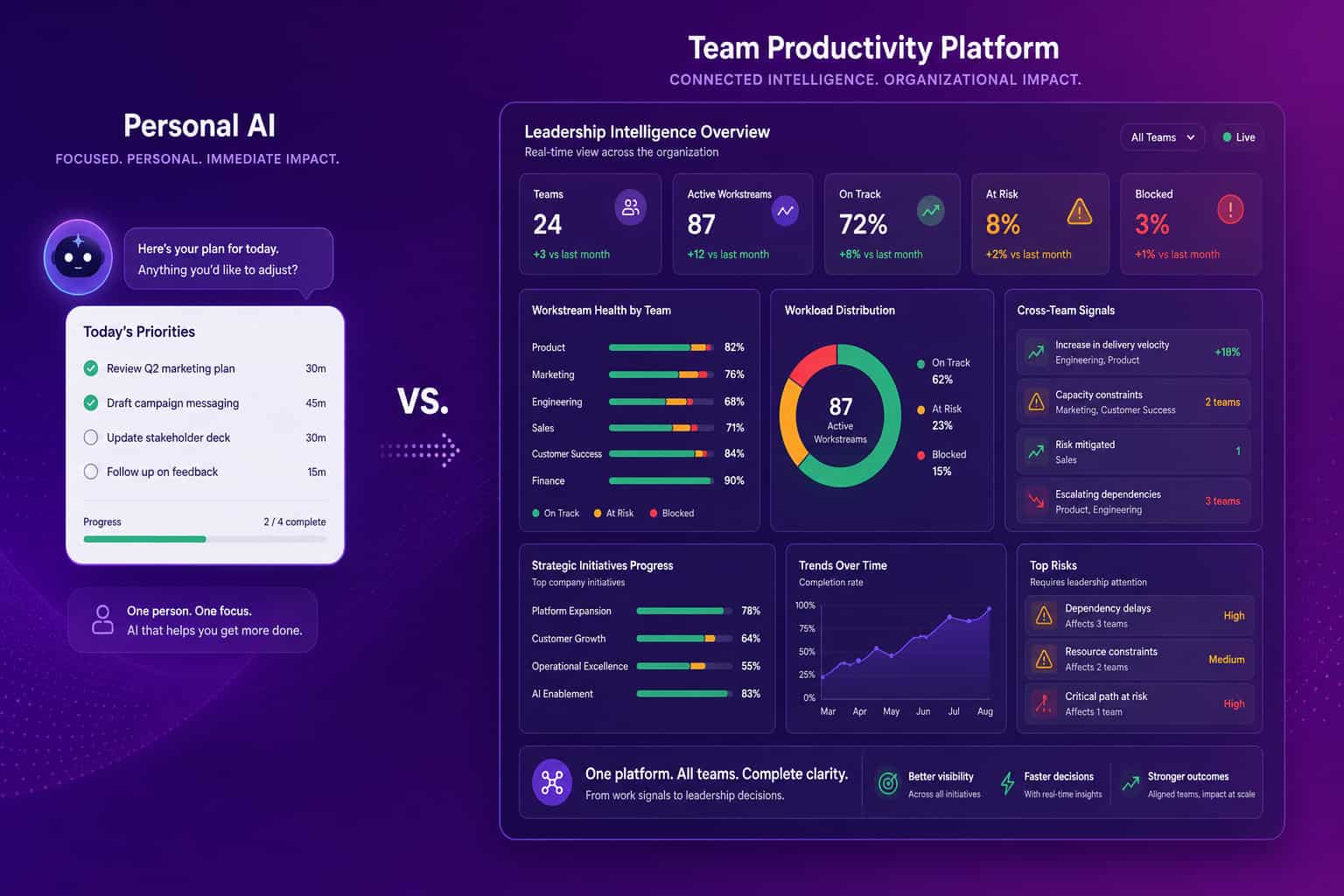
So this shortlist is sorted on one question: does the tool make a person faster, or does it make a leader see the whole team? Both matter. They are not the same purchase.
The 9 best AI-powered productivity platforms in 2026
The best AI-powered productivity platform depends entirely on who is buying and what they need to see, so this list is ranked for a specific reader: a team leader or operator at a technology company who wants whole-team visibility, not just a faster personal workflow. Ranked that way, a workforce intelligence platform that connects to real work data belongs at the top, team-level analytics tools sit in the upper middle, and general-purpose personal assistants land lower as complements rather than platforms in their own right. The nine picks below are grouped by the job they were built for, with an honest read on what each does well and where it stops. If you are shopping for yourself and not a team, read the order roughly upside down.
1. Abloomify (best for leaders who want to know if the team is actually productive)
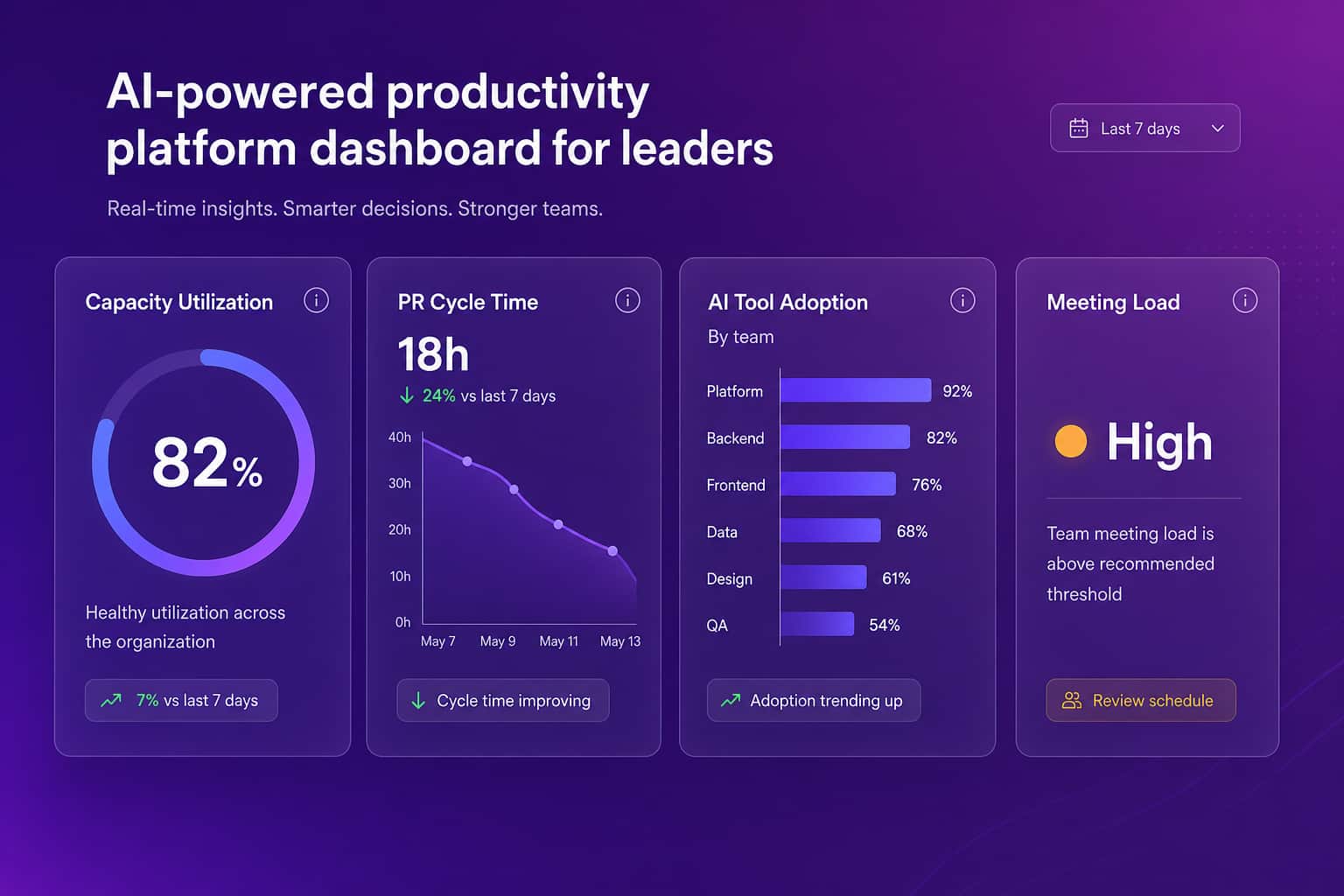
Abloomify is privacy-first workforce intelligence for technology companies. It connects 100+ tools (Google Workspace, M365, GitHub, Jira, Linear, CRM, HRIS) plus optional device agents that capture aggregated metrics, never screenshots or keystrokes. That gives a leader the things a personal assistant cannot: capacity utilization, meeting load, PR cycle time and DORA delivery metrics, AI tool ROI, burnout signals, and a full performance suite. Bloomy, the AI analyst, answers questions across all of it in plain language and also runs on a schedule, emailing a decision-ready brief every Monday that stays open as a conversation you can keep interrogating. The honest caveat: Abloomify is newer (founded 2024), carries no analyst recognition yet, and is not a personal to-do assistant. If you want a smarter calendar, look further down.
2. ActivTrak (best-known productivity analytics, monitoring-first)
ActivTrak is the recognized name in workforce productivity analytics, and it recently added an AI chat layer (Work Advisor). For a team-level view of app and activity usage, it is mature and familiar to compliance teams. The trade-off is architecture. ActivTrak is an endpoint agent that captures screen activity and can take screenshots, which generates employee resistance and carries the surveillance baggage that comes with it. It has no engineering intelligence, no AI coding tool ROI, and no PII-free design. For the same visibility without the trust damage, see the Abloomify vs ActivTrak comparison.
3. Microsoft Viva Insights (best for M365 collaboration analytics)
Viva Insights (formerly Workplace Analytics) brings collaboration and productivity analytics natively into Microsoft 365. For a company fully standardized on Microsoft, it is a low-friction starting point because the data already lives in M365. The constraint is the stack itself. Viva sees Microsoft signals. If your engineers live in GitHub and parts of your team run on Google Workspace or a mixed environment, large chunks of the work are invisible to it, and there is no engineering velocity or AI tool ROI layer.
4. Glean (best for enterprise AI search across company knowledge)
Glean is a connected enterprise assistant that indexes a company's apps and answers questions across them. For helping employees find things and get answers fast, it is genuinely strong, and it is a real productivity gain at scale. Where it stops is measurement. Glean helps people work; it does not tell a leader whether the team is productive, where capacity is leaking, or whether the AI budget is paying off. It is an answer engine, not a workforce intelligence layer.
5. Microsoft 365 Copilot (best for AI inside Office documents and email)
Copilot puts AI directly into Word, Excel, Outlook, and Teams, and for drafting, summarizing, and analyzing inside those apps it is the obvious pick for Microsoft shops. Treat it as a personal accelerator, not a team platform. It works within the Office surface, so it does not give cross-system operational visibility. The better move is to keep it and connect it: through Abloomify's MCP server, assistants like Copilot can draw on your company work data instead of generic output, scoped to each person's existing permissions.
6. Notion AI (best for teams that live in Notion)
Notion AI layers generation, summarization, and Q&A onto the Notion workspace. If your docs, wikis, and project notes already live in Notion, it removes real friction and keeps knowledge close to where the team writes. Its ceiling is the workspace boundary. Notion AI is strong inside Notion and limited outside it, so it improves how a team writes and organizes, not how a leader measures delivery, capacity, or tool ROI across the wider stack.
7. Motion (best for personal AI task and calendar scheduling)
Motion uses AI to auto-schedule tasks and rebuild your calendar as priorities shift. For an individual drowning in to-dos and meetings, it is one of the sharper personal productivity tools on the market. It is squarely single-user, though. Motion optimizes one person's day. It has no concept of team capacity, engineering velocity, or whether the company's AI investments produce output, which is fine, because that was never its job.
8. Zapier (best for automating repetitive workflows with AI)
Zapier connects thousands of apps and now adds AI agents and automation on top, so it is the default for wiring up repetitive workflows without engineering time. As a productivity multiplier it earns its place: automate the copy-paste work and people get hours back. It is an automation layer, not an intelligence layer. Zapier moves data between tools; it does not analyze whether your team is productive or where leverage is leaking.
9. ChatGPT Team / Enterprise (best general-purpose AI assistant)
ChatGPT is the most capable general-purpose assistant, and the Team and Enterprise tiers add admin controls and scheduled tasks. For drafting, reasoning, and analysis it is hard to beat, and most companies already pay for it. On its own it answers from general knowledge, not your company's work data. That is the gap Abloomify closes rather than competes with: connect ChatGPT via MCP and it answers from your connected systems and org context, so the tool you already bought gets meaningfully smarter.
Personal AI tools vs team productivity platforms
The clearest way to choose an AI-powered productivity platform is to decide whether you are buying for a person or for a team, because that single decision determines everything the tool can ever tell you. Personal AI tools (Motion, Notion AI, ChatGPT, Copilot) optimize one user's workflow: faster drafting, smarter scheduling, quicker answers. They are cheap, fast to adopt, and genuinely useful. Team productivity platforms (Abloomify, and partly ActivTrak and Viva) connect the systems where work happens and answer leadership questions: where is capacity wasted, which team is bottlenecked, is the AI spend paying off. Neither is universally better. An engineer buried in tasks gets more from Motion than from a dashboard. A COO trying to find hidden waste gets the opposite. The comparison below is the version I would draw for a leadership team.
Personal AI productivity tools (Motion, Notion AI, ChatGPT)
Team productivity platform (Abloomify)
The smart setup is usually both. Let engineers keep Cursor and Motion. Let the exec team keep ChatGPT. Then put a platform underneath that measures whether all of it is producing output, and feeds those same tools your company knowledge so they answer from context. Personal tools make people faster. A platform tells you if faster is turning into shipped work.
How to choose an AI-powered productivity platform
Choosing an AI-powered productivity platform comes down to four questions, and most buyers skip the one that matters most. First, who is it for: a person or a team? A single-user assistant will never answer an org-level question no matter how good it is. Second, how many data sources does it read? A tool that sees one app sees one slice of the work. Third, how is privacy handled? Privacy-first, PII-free architecture keeps employee trust intact, which matters when about 1 in 6 workers say they would quit over surveillance and a Personnel Psychology meta-analysis found no evidence that monitoring improves performance. Fourth, does the AI just chat, or does it work? Scheduled autonomous runs that email a decision-ready brief beat a chat window you have to remember to open. Score any platform on those four and the right pick for your situation gets obvious fast.
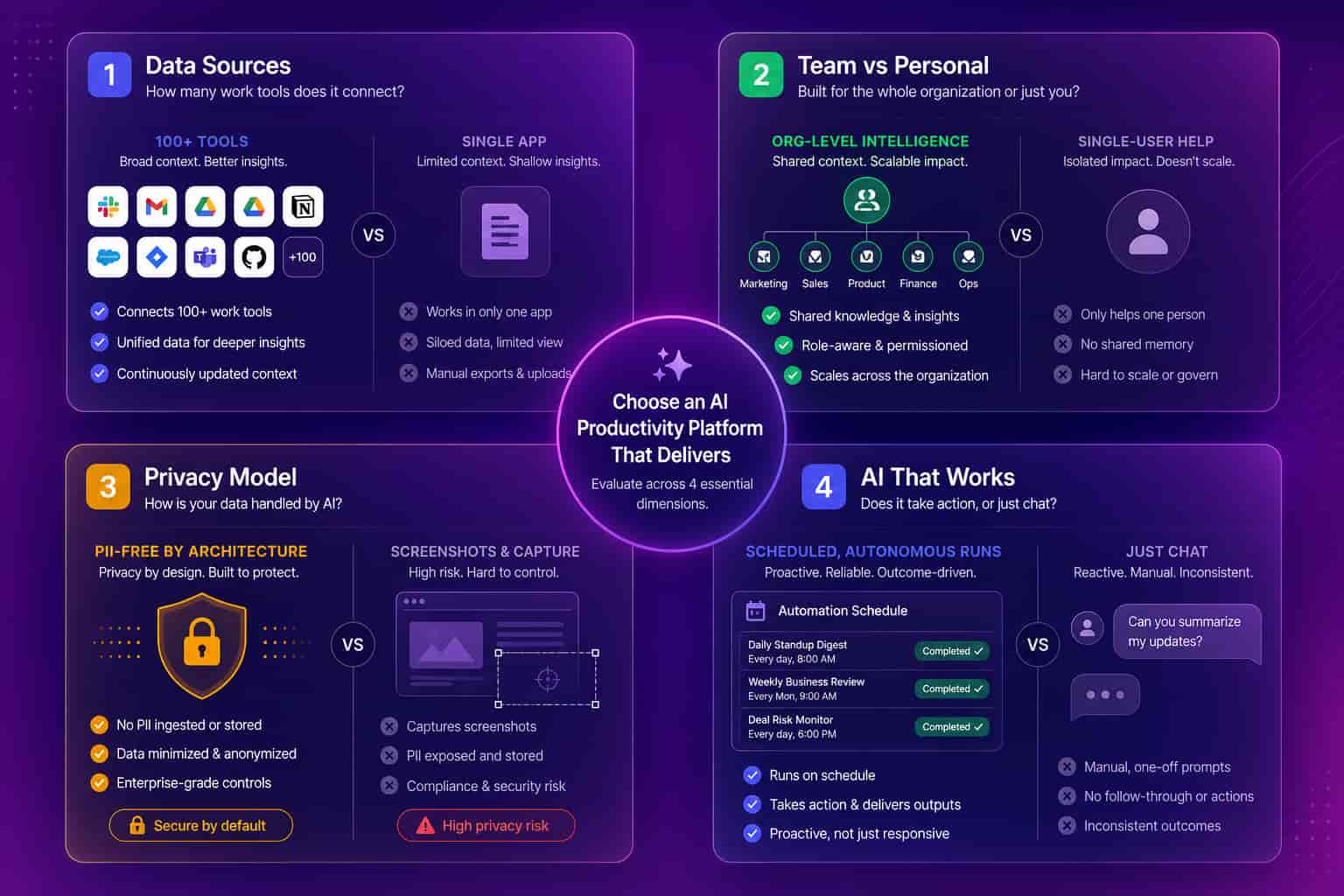
If you are one person trying to reclaim an hour a day, buy a personal tool and move on. Motion, Notion AI, and ChatGPT all earn their price. If you are a leader who has to answer for whether a team of 50 or 500 is productive, a personal assistant will not get you there, and no amount of individual tooling adds up to that view. You need a platform that sees the work. Start with employee productivity software that measures outcomes instead of activity, or the engineering productivity analytics view if your buyer is a VP Engineering.
Personal tools make you faster. A platform tells you if the whole team is.
FAQ
What is an AI-powered productivity platform?
An AI-powered productivity platform applies AI to help people or teams produce more. In 2026 the category splits in two: personal assistants that help one user (Motion, ChatGPT, Notion AI) and team platforms like Abloomify that connect 100+ work tools so leaders can see capacity, engineering velocity, and AI tool ROI across the whole organization, not just one workflow.
Which AI productivity platform is best for a team?
For a technology team, the best fit is one that sees the work, not just one person's calendar. Abloomify connects GitHub, Jira, Google Workspace, and CRM with a privacy-first, PII-free architecture, so a COO or VP Engineering sees capacity, delivery velocity, and tool ROI. Personal tools like Motion or ChatGPT are better for individual productivity.
Do AI productivity platforms require employee surveillance?
No. Privacy-first platforms like Abloomify are PII-free by architecture: no screenshots, no keyloggers, no screen recording, no message content. They analyze aggregated work patterns from connected systems and are SOC 2 Type 2 certified. That design matters because about 1 in 6 workers say they would quit over surveillance, and monitoring has no proven link to better performance.
Can an AI productivity platform work with ChatGPT and Copilot?
Yes, and the strongest ones do. Rather than compete with ChatGPT, Copilot, Cursor, or Claude Code, Abloomify connects them to company work data through its MCP server, scoped to each person's existing permissions. The assistants a team already pays for then answer from your connected systems and org context instead of generic training data.
How is an AI productivity platform different from employee monitoring software?
Monitoring software (ActivTrak, Insightful, Time Doctor) installs endpoint agents that capture screen activity and can take screenshots tied to a named person. An AI productivity platform like Abloomify measures aggregated signals from tools people already use, with no content capture. Same visibility leaders want, without the surveillance, the employee resistance, or the SaaS and license waste that hides alongside it.

Amir Tavafi
Co-Founder & CEO
Product leader and innovator with over 15 years of experience in the tech sector, grounded in AI and robotics. Previously led product development in fraud detection and AI solutions at Nasdaq Verafin.