AI Agents for Business: What Actually Pays Off in 2026
July 13, 2026
Amir Tavafi
13 min read

Every vendor now sells AI agents for business, and most of what they show you is a chatbot with a new coat of paint. Amir here. At Abloomify we build an AI agent called Bloomy, so I have opinions about which agents actually earn their keep and which ones just demo well. The short version: an agent that waits for you to ask it something is a search box. The ones worth paying for do the work before anyone asks.
Key Takeaways
Q: What are AI agents for business?
A: AI agents for business are software agents that act over a company's connected data and tools, not just answer questions in a chat window. The ones that pay off run on a schedule, mine systems like GitHub, Jira, and your CRM, and deliver a decision-ready result instead of waiting for a prompt.
Q: What can an AI agent actually do for my business?
A: It removes the recurring admin that quietly owns a leader's week: chasing updates, assembling reports, prepping for meetings, flagging deals going cold. Abloomify's Bloomy runs these on a schedule over connected work data and emails the finished brief, each run resumable as a conversation.
Q: What is the difference between an AI agent and an AI assistant?
A: An assistant responds when you prompt it. An agent takes initiative: it runs recurring work on its own, reasons fresh over your data each time, and pushes a result out. Most "AI agents for business" are really assistants. The scheduled, autonomous kind is where the leverage lives.
Q: Do AI agents for business work for small companies too?
A: Yes. A 50-person company feels admin overhead just as sharply as a 3,500-person one, sometimes more, because there is no ops team to absorb it. The build-your-own agent platforms fit tinkerers. Small teams usually get more from an agent that ships useful work on day one.
Q: How do I evaluate an AI agent before buying?
A: Ask three questions. Does it run over my real company data or just generic answers? Is it permission-aware and privacy-first? Can it work on a schedule and deliver results without me babysitting it? If the demo is a chat box and nothing else, keep looking.
What are AI agents for business?
AI agents for business are software systems that take actions over a company's connected data, tools, and workflows to produce an outcome, rather than only responding to questions the way a chatbot does. The distinction matters because the market blurs it on purpose. A large language model wrapped in a chat window is an assistant: helpful, reactive, and only as useful as your willingness to keep typing prompts. A true agent has a job. It reaches into the systems where work actually happens (GitHub, Jira, Linear, your CRM, email, call recordings, capacity data), reasons over what it finds, and delivers a result. The best ones do this on a schedule, without being asked, so the output shows up in your inbox the way a good chief of staff would hand you a brief before the meeting. That shift, from "ask and receive" to "runs and delivers," is the whole game, and it is where most business AI agent buying decisions go right or wrong.
At Abloomify this agent is Bloomy, a company-aware, role-aware, permission-aware AI Chief of Staff. Bloomy answers questions on demand, and it also runs scheduled work over your connected data and emails you the result. Two modes, one agent. Hold onto that split, because it is the line between an agent that pays off and one that just sits there looking modern.
The two kinds of AI agents (and only one pays off)
There are two kinds of AI agents for business, and confusing them is the most expensive mistake buyers make right now. The first kind is reactive: a copilot or chat interface that answers when you prompt it. ChatGPT, Copilot, and the dozens of "agent builder" platforms mostly live here, and they are genuinely useful for drafting, summarizing, and one-off questions. The second kind is autonomous: an agent you point at a recurring job, which then runs on its own cadence, reasons fresh over your live data each time, and pushes a finished result out to you. The first kind waits. The second kind works. Almost every "top AI agents for business" listicle you will read ranks tools from the first bucket, because reactive agents are easier to build and easier to demo. The problem is that a reactive agent only produces value in the exact moments you remember to open it, which for a busy operator is almost never.
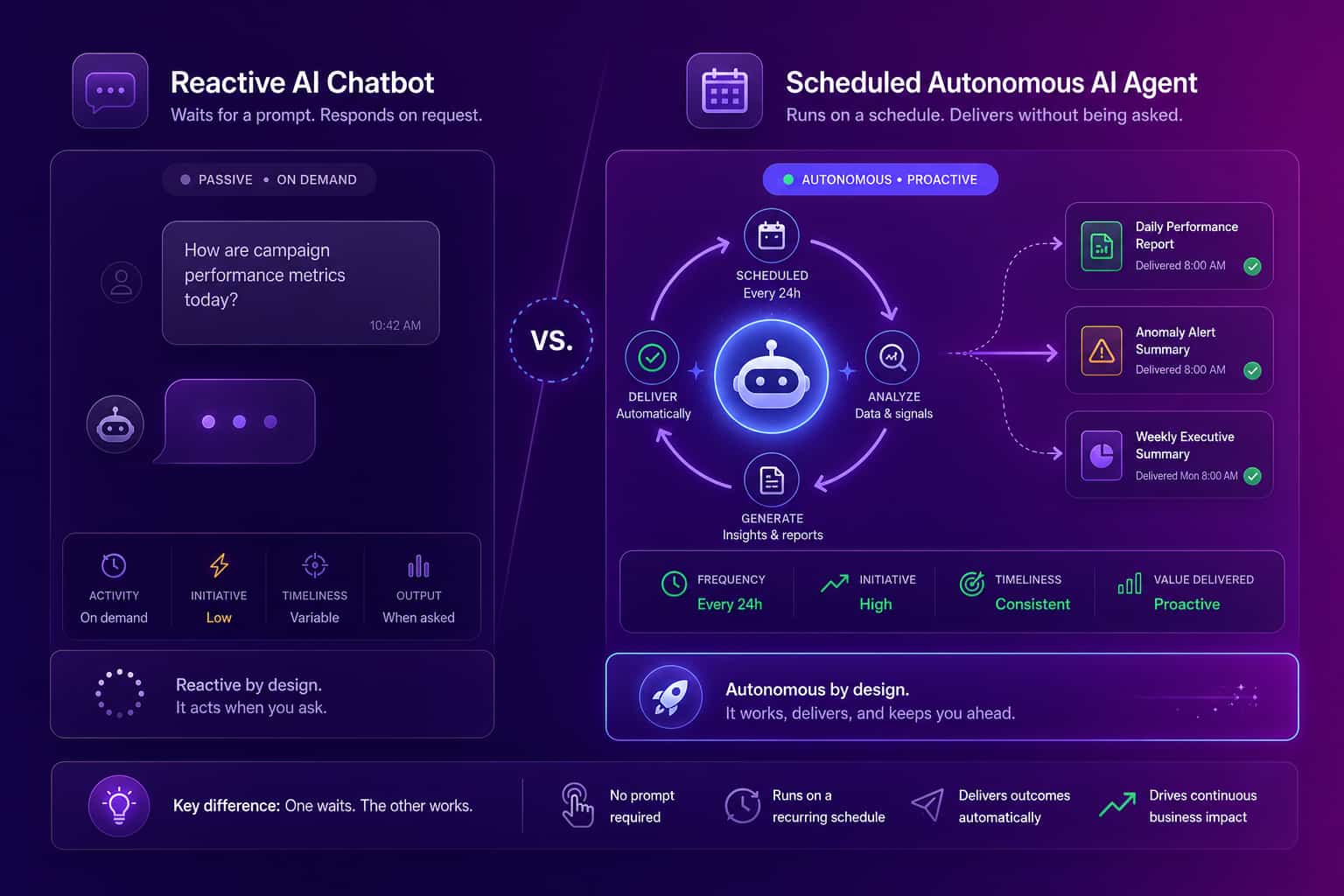
I learned this from watching my own calendar. When we started Abloomify, I thought we were building AI for managers. The more we shipped, the clearer it got that the real job is killing the low-value chores that quietly own a leader's week. Chasing people for updates. Copy-pasting metrics into decks. Turning meeting notes into follow-ups. Digging across five tools to answer "who is overloaded right now?" A reactive chatbot does not touch any of that, because you have to stop and ask it, which is its own chore. An autonomous agent does, because you set it up once and it keeps delivering.
What an AI agent should actually do in a business
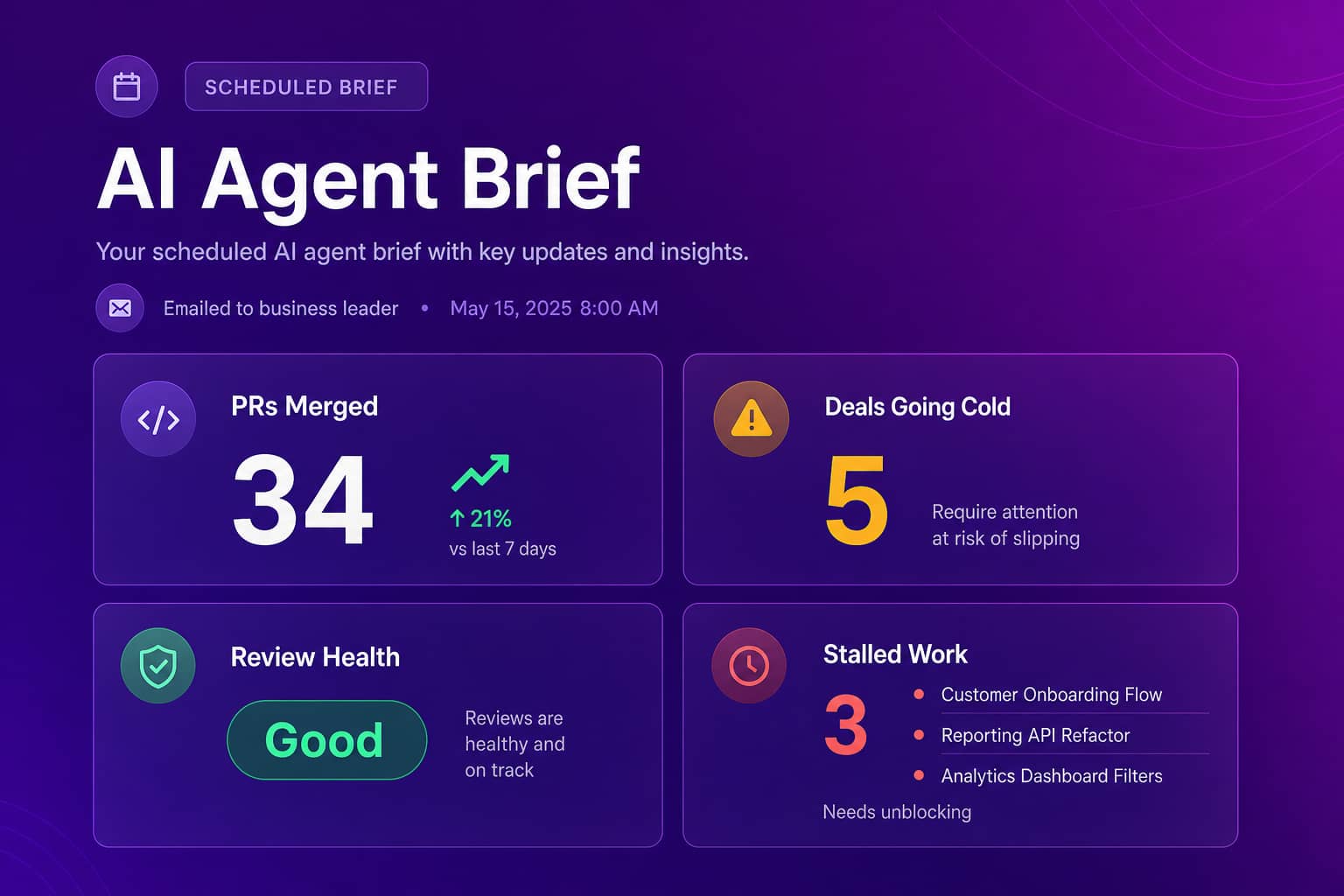
A business AI agent earns its cost when it takes a recurring, data-heavy chore off a human and returns a decision-ready result on a schedule. Concretely, that is what Bloomy Tasks does inside Abloomify: you schedule Bloomy to run daily, weekly, monthly, or once, and each run mines your connected data (GitHub, Jira, Linear, Salesforce, HubSpot, email, call recordings, OKRs, capacity analytics) and emails a clean report you can act on. A Monday engineering brief covering PRs merged, velocity, review health, and stalled work. A weekly pipeline review that flags deals going cold before your VP does. Morning meeting prep pulled together while you sleep. Every run persists as a resumable conversation, so you click through from the email and keep interrogating the result instead of starting over. There are around 35 ready-made templates across nine business domains, from Development to Sales to Operations, so you are not building agents from a blank canvas.
This is also where AI agents quietly pay for themselves on cost, not just time. Bloomy has surfaced meaningful SaaS spend for customers looking across their tool stack, and license waste is exactly the kind of thing a scheduled agent catches that a human forgets to check.
To be fair about the landscape: scheduled runs are not unique to us. ChatGPT has scheduled tasks, Claude has routines, and Copilot has the broadest connector catalog of anyone. What is hard to find in one governed product is the combination: permission-aware scheduled runs over a unified work graph that spans engineering, sales, email, and capacity, delivered by email and left behind as a resumable chat, with usage and cost governance on top. That combination is the thing worth shopping for.
AI agents for small businesses vs enterprise
The right AI agent for a business depends far less on headcount than the marketing implies, because the core pain (recurring admin nobody has time for) shows up at every size. A 50-person SaaS company feels it acutely, often more than a large one, because there is no operations team to absorb the busywork and the founder is the one copy-pasting metrics at 11pm. One of our earliest customers, a 50-person SaaS team, validated Abloomify by comparing its output to what their COO had been assembling by hand in a spreadsheet. Their words: "What I did manually this week in a spreadsheet is exactly what I think Abloomify should be doing automatically." That is the small-business case in one sentence. The work exists; the only question is whether a human or an agent does it.
Enterprise adds different requirements, mostly around control. A 3,500-person company we work with cared first about permissions, data scoping, and deploying without a security review dragging on for months. At that size the agent has to respect who is allowed to see what, and it has to prove it. The buying advice splits cleanly:
- Small business: favor agents that deliver useful work on day one over platforms that ask you to build your own. Your scarce resource is time, not tinkering budget. An agent with ready-made templates beats a blank agent canvas.
- Enterprise: favor permission-aware, privacy-first agents with scoped access, audit logs, and a deployment path your security team will sign off on. The demo matters less than the governance underneath it.
- Both: insist the agent works over your actual company data. A generic assistant that has never seen your systems gives generic answers, and generic answers do not move a business.
How to evaluate an AI agent for your business
Evaluating an AI agent for business comes down to whether it acts on your real work, respects your permissions, and runs without supervision, and you can pressure-test all three in a single demo. Ask the vendor to point the agent at your own data and produce something useful, then watch what happens. If it can only answer general questions or needs a human to trigger every step, you are looking at an assistant with agent branding. If it can run a scheduled job over your connected systems, scope what it sees to each person's real permissions, and hand back a result you would actually forward to your team, you are looking at the real thing. Governance is the part buyers skip and regret. An agent reaching into GitHub, email, and your CRM has to be permission-aware by architecture, not by policy, and you want audit logs and cost controls on automated runs before you turn it loose, not after.
Here is the checklist I would use, and do use, when I look at anyone else's agent:
- Does it run over my company's real data, or does it hand back generic answers a search engine could give?
- Is it permission-aware and privacy-first? A connection should only ever expose what that person is already allowed to see. Abloomify is PII-free by architecture and SOC 2 Type II certified, with no screenshots and no content capture.
- Can it work on a schedule and deliver a result without me babysitting it, or does every task need a human to press go?
- Does it leave a trail I can question? A good agent's output is resumable, so I can push on the "why" behind a number.
- Can I govern the spend? Autonomous runs consume credits. Budget guards and per-source cost visibility keep an agent from becoming a surprise line item.
If a vendor's agent clears those five, it can genuinely change how your team operates. If it clears one or two, it is a nice chat tool, and you should price it like one.
Turn the AI tools you already pay for into agents
The fastest way to get value from AI agents is often to make the tools you already own smarter, rather than buying yet another platform. Most teams are already paying for Cursor, Claude, ChatGPT, or Copilot, and the common objection is "we already have AI, why add more?" Fair. Abloomify's answer is External AI Access, an MCP server that connects those tools to your company's own Abloomify knowledge and work data. Same licenses, same seats, but now your assistant answers from your connected context instead of generic training data, scoped to exactly what each person is allowed to see and revocable in a click. Abloomify becomes the shared memory behind the AI tools your team already uses, which turns "we have AI" from an objection into the reason to connect it.
That is the honest posture on AI agents for business. Ignore the ones that only impress in a demo. Buy the ones that quietly do a job every week. Boring, scheduled, reliable work beats another chat window every time.
FAQ
What is the best AI agent for business?
There is no single best AI agent for business, because the right one depends on the job you need done. For recurring analysis and reporting over connected work data (engineering, sales, operations), an autonomous agent like Abloomify's Bloomy fits, since it runs on a schedule and emails decision-ready briefs. For ad-hoc drafting, a reactive assistant is fine. Match the agent to whether the work is recurring or one-off.
What can an AI agent do for my business?
A capable business AI agent removes recurring admin: chasing status updates, assembling executive reports, prepping for meetings, and flagging risks like deals going cold or work stalling. Bloomy runs these on a schedule across your connected tools and emails the finished result, so the output arrives before you would have thought to ask for it, and each run stays open as a conversation you can push on.
How much do AI agents for business cost?
Costs range from free consumer agent builders to enterprise platforms in the tens of thousands per year. Sticker price is the wrong lens. The right one is return: an agent that surfaces $50K to $100K in unused SaaS licenses, or reclaims hours of a leader's week every week, pays for itself well ahead of the invoice. Evaluate on the work delivered, not the seat price.
Are AI agents safe for company data?
They can be, if the agent is permission-aware and privacy-first by design rather than as an afterthought. Abloomify is PII-free by architecture and SOC 2 Type II certified, and any connection only ever exposes what a given person is already allowed to see, scoped per user and instantly revocable. Ask any vendor how their agent enforces permissions before you connect it to email, code, or your CRM.
What is the difference between agentic AI and a chatbot?
A chatbot responds to prompts inside a chat window. Agentic AI takes initiative: it runs a defined job on its own, reasons over live data each time it runs, and delivers a result without a human triggering every step. Most tools marketed as agents are really chatbots. The scheduled, autonomous behavior is what makes something genuinely agentic, and it is what separates a demo from a return.

Amir Tavafi
Co-Founder & CEO
Product leader and innovator with over 15 years of experience in the tech sector, grounded in AI and robotics. Previously led product development in fraud detection and AI solutions at Nasdaq Verafin.